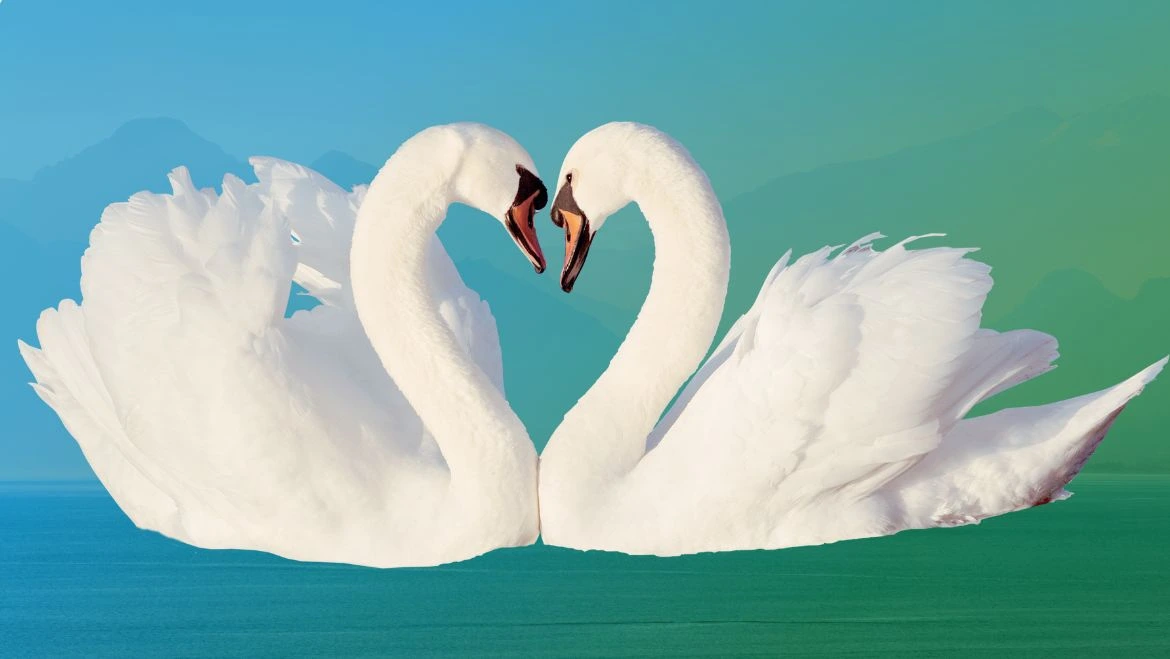
When the swan appears on a shamanic journey, people often describe the same odd detail: the water goes quiet first. Before the bird is visible, the surface of the lake settles, as if something had asked the wind to wait. Then the swan is simply there — white, unhurried, moving without apparent effort — and the person journeying almost always reports the same feeling, somewhere between awe and ache: that is what I was supposed to become.
That ache is the doorway. If you are here for waterfowl facts, this is the wrong page. This is about the swan spiritual meaning — what it says when this bird keeps returning in your dreams, your journeys, or your life, and why it so often arrives precisely when you feel least beautiful, least clear, and least yourself.
Hans Christian Andersen’s ugly duckling was never a duck. That is the whole story: not a transformation into something new, but the slow, painful discovery of what was true all along. In my practice, the swan tends to arrive for people in exactly that in-between — no longer who they were, not yet visible as who they are.
Swan Spirit Animal Meaning: What the Real Bird Teaches
The swan’s symbolism is not sentimental invention. It is written into the bird’s actual life, and the details are more instructive than the greeting-card version.
- Cygnets really are grey. A young swan spends its first year in drab grey-brown, visibly unlike its parents. The white comes later, feather by feather, through successive moults. The medicine is precise: becoming has a schedule, and it is not yours. The grey phase is not a mistake to be corrected. It is the required season.
- It feeds where it cannot see. A swan upends — the famous elegant curve above the surface, while the head works in dark water and mud below. Grace that is fed by depth work: that is the honest image. People who carry swan medicine are rarely those who avoid the murky material; they are the ones who have learned to reach into it without losing their line on the surface.
- It bonds for the long term. Swans form famously enduring pair bonds, raising brood after brood with the same partner. The romance is real, but so is the labour — a bond maintained through migrations, seasons and losses. Swan loyalty is not a feeling. It is a practice, renewed yearly.
- The gentle bird is fierce. Approach a nest and the serene swan becomes a hissing, striking guardian. Anyone surprised by this has confused gentleness with harmlessness. The swan never did. Beauty with boundaries — that combination is the whole character.
Swan Symbolism Across Traditions
Few birds have been loved by as many mythologies, and the traditions agree with each other to a striking degree: the swan stands where beauty, soul and the other world touch.
Greece: the bird of Apollo and the swan song
The swan was sacred to Apollo, god of music and prophecy. Plato has Socrates say, on the day of his death, that swans sing most beautifully at the end — not from grief, but because they sense what they are going toward. Whatever one makes of the ornithology, the image has held for two and a half thousand years: the swan song, the truest expression arriving at the threshold. Swan medicine often works this way — the real voice appears when something is ending.
Ireland: the Children of Lir
In one of Ireland’s great sorrow-tales, the four children of Lir are transformed into swans by a jealous stepmother and spend nine hundred years on cold waters — keeping, through all of it, their human voices and their songs. The Celtic swan is the soul in exile: changed on the outside, intact within. In Irish and Welsh material, swans are repeatedly otherworld beings, often wearing chains of gold or silver — beauty marking someone who belongs partly elsewhere. If your life has required you to hold an inner self through a long outer winter, this is your corner of the swan’s story.
India: the hamsa and discernment
In Hindu tradition the hamsa — the sacred swan or goose — carries the goddess Saraswati, patroness of wisdom and the arts, and is said to be able to drink only the milk from a mixture of milk and water, leaving the water behind. That is why India’s most realised sages are titled paramahamsa, “supreme swan”: the one who can separate the essential from the diluted. Swan medicine is not only about becoming beautiful. It is about discernment — the refined instinct for what is nourishing and what merely surrounds it.
The North: swan maidens and valkyries
Norse and wider Germanic tradition gives us the swan maiden — valkyries and otherworldly women who put on swan-forms to travel between worlds, and whose feathered cloak, if stolen, traps them in an ordinary life that was never theirs. It is one of mythology’s sharpest images of a modern wound: the person who handed their wings to someone else and called it love. Part of swan work, always, is asking: where is my cloak, and who is keeping it?
The Shadow: Confusion, Vanity and the Borrowed Cloak
The swan has a real shadow, and it is not ugliness. It is what happens to beauty and longing under pressure.
- Confusion as a habitat. I once worked with the swan for a client who had been left in a state of confusion, fear and self-doubt after an old relationship — and because we tend to attract the energy we carry, she kept meeting partners who were exactly as confused as she felt. The swan’s work with her was not about finding clarity like a fact; it was about letting go of fear and reclaiming her own elegance and self-worth first, so that clarity had somewhere to land. That pattern repeats: swan people in shadow do not lack answers, they lack standing — and the answers arrive once the standing returns.
- Grace as performance. The swan in shadow glides beautifully and hisses in private. If maintaining the surface has become your full-time work — if everyone says how well you are doing and no one knows how you are — the swan has not come to admire the performance. It has come to end it.
- Waiting to be revealed. The duckling story has a dangerous misreading: do nothing, and one day everyone will see. But the cygnet moults — it sheds, grows, migrates, survives winters. Revelation is the visible end of invisible work. If you are waiting to be discovered instead of moulting, that is the shadow.
- The borrowed cloak. The swan-maiden’s captivity names the hardest pattern: a life built around a partner, a family image or an aesthetic that requires your wings to stay hidden. A swan that appears chained, grounded or oiled in a dream usually points here — and the dream is rarely subtle about who is holding the cloak.
How to Journey to the Swan
Journeying is a learnable skill, and the swan is a kind first teacher. If the practice is new to you, begin with the beginner’s guide to shamanic journeying, or go deeper with the four-week spirit animal course. Shamanic work complements, and never replaces, medical or psychological care.
- Begin at water. In your journey, find the lake — still water large enough to hold sky. The swan’s country is the reflective surface: the place where you can be seen and see yourself at once.
- Bring the grey. Do not arrive polished. Bring the version of you that feels unfinished, awkward, in-between. The swan does not respond to performances of arrival; it responds to honest moulting.
- Let it swim to you. State your intention once — “show me what I am becoming” — and wait at the shore. The swan sets the pace of every encounter. That, too, is the teaching.
- Look at the water, not only the bird. What does the surface show when the swan is beside you? People often see a reflection that does not match what they believe about themselves. Take the reflection seriously. It is usually ahead of you, not behind.
- Ask about the cloak. One question before you return: “Where are my wings, and what would it cost to take them back?” The cost named in a swan journey is almost always payable. The fear of it was the captivity.
- Integrate gently. Afterwards, do one thing that treats yourself as already-swan: wear the thing, send the writing, say no with grace. Not to prove anything — to practise the posture.
Swan Spirit Animal: Questions People Actually Ask
What does it mean if the swan is my spirit animal?
You are likely a person of deep feeling and long becoming — someone whose truest qualities took years to surface and were not obvious in youth. Swan people carry the medicine of transformation, discernment, loyal love and beauty with boundaries. Their task is rarely to change into something new; it is to stop apologising for what they already are.
Why do I keep seeing swans?
Recurring swans — in life, images or dreams — usually mark a threshold of becoming: something grey in your life is closer to white than you can currently see. It can also be a message about love: a call to open toward it, or to bring more grace and honesty into a bond you already have.
What does a swan in a dream mean?
Read its state before its species. A gliding swan speaks of a self that is ready to be seen. A hissing or attacking swan is usually your own boundary, arriving late and loud. A grounded, chained or dirty swan points at beauty held captive — often by an arrangement you have been calling normal. And a cygnet, grey and awkward, is one of the kindest dream images there is: it means keep going, the white is already growing in.
Are swans a symbol of love?
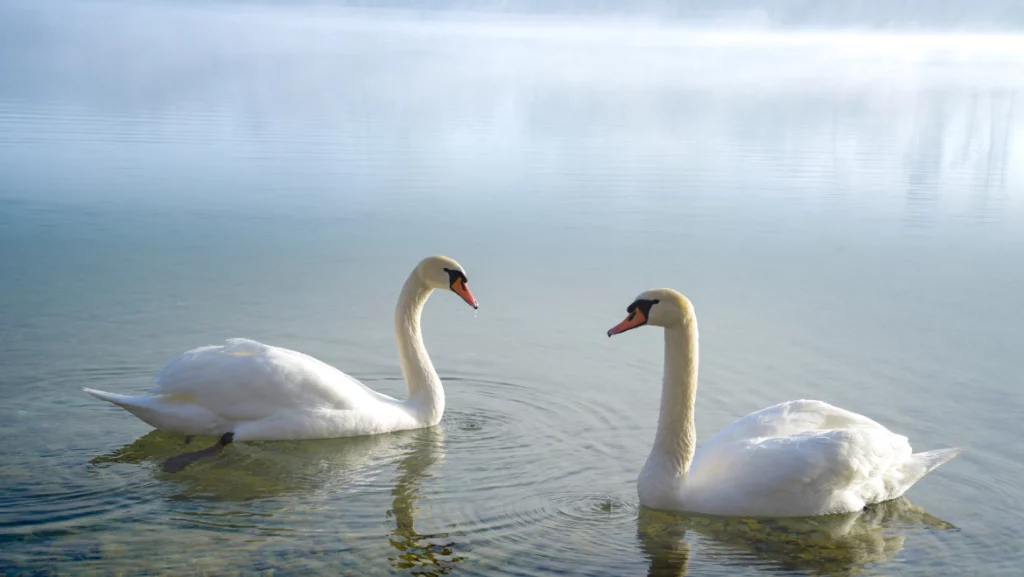
Yes — and of a specific kind: chosen, maintained, long-haul love rather than infatuation. Two swans facing each other, necks curved into a heart, became the emblem for a reason. If the swan arrives in a season of relationship questions, it tends to ask for depth and honesty rather than intensity. Its gentler cousin in this territory is the dove spirit animal, whose medicine is peace where the swan’s is devotion.
How do I find out if the swan is my spirit animal?
Watch for persistence — the swan returning across months, unbidden, in dreams, journeys and chance encounters. If you want a structured path instead of guesswork, the A–Z spirit animal guide maps the territory, and a guided journey will answer more than any checklist.
Is the Swan Your Spirit Animal?
Check the boxes that resonate with your spirit and current life journey.
Think about your own “ugly duckling” moments. What is one beautiful truth you’ve discovered about yourself after a period of transformation?