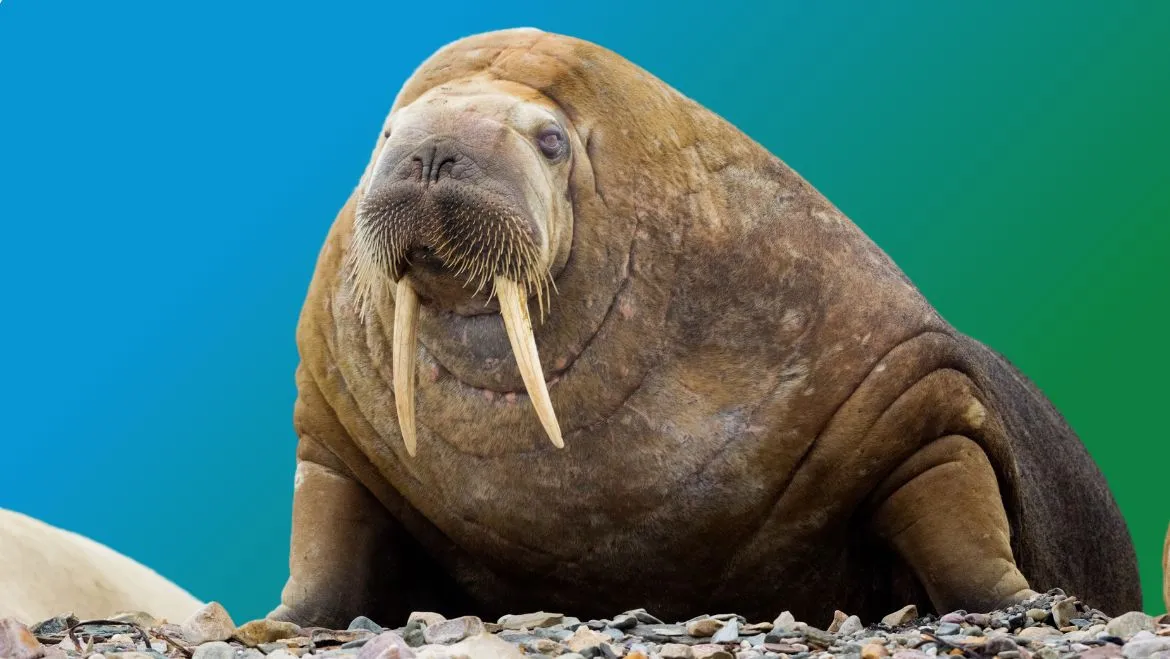
The walrus arrives in shamanic space as something almost comically formidable — vast, tusked, whiskered, hauling a body of impossible weight up onto the ice — and then, when it settles and turns its head toward you, the whole impression reverses. The eyes are gentle. The animal that looked like a warrior is leaning against a dozen others for warmth, murmuring, entirely at ease in the pile. What people notice, once the size stops startling them, is the tenderness the armour was protecting all along.
This page is about the walrus spiritual meaning — what it means when this animal keeps surfacing in your dreams and journeys, not its Arctic range. In my practice, the walrus tends to arrive for people who have built a convincing tough exterior and are quietly exhausted by it, and for people who have lost the line between belonging to their community and disappearing into it. It is an animal about the relationship between armour, tenderness, and the herd.
The Bridge: What Walrus Biology Teaches About the Walrus Spirit Animal
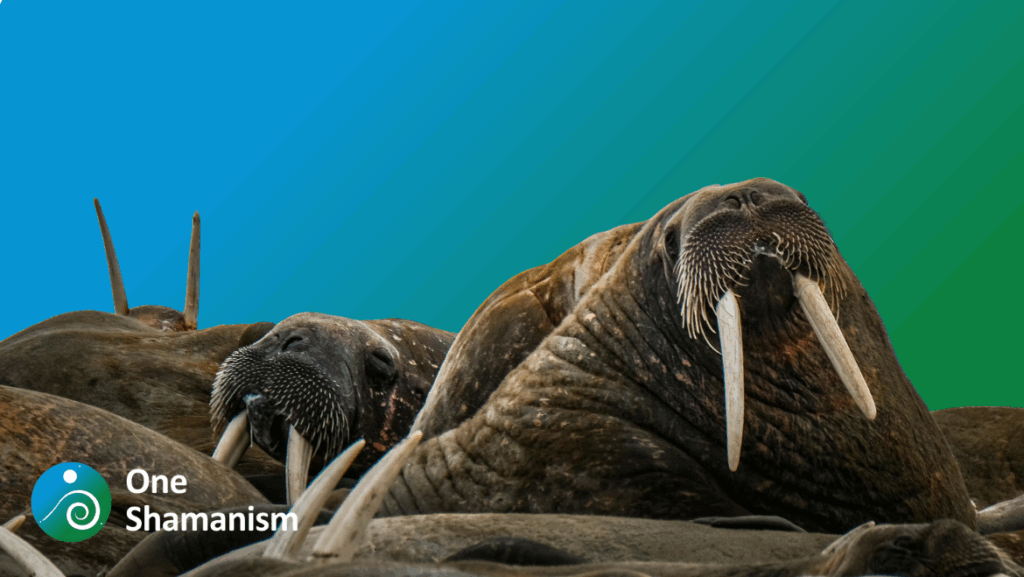
Nearly everything the walrus means is written into the features that look, at first, like pure intimidation — and turn out to be something gentler.
- The tusks are tools, not weapons. The walrus’s scientific name, Odobenus, means “tooth-walker” — it uses those great tusks to haul its enormous body out of the water and onto the ice, and to keep breathing holes open in the freeze. They can defend, but their daily work is leverage and survival. What looks like a threat display is mostly how the animal lifts itself out of deep water.
- It navigates the dark by touch. The walrus does not hunt by sight in the black seafloor. It has hundreds of exquisitely sensitive whiskers — vibrissae — that feel for clams in the silt and draw them out by suction. The most formidable-looking creature in the Arctic finds its food through its most sensitive instrument. That is the whole animal in one fact.
- Its blubber is protection that is also warmth. The thick layer that armours the walrus against the cold is the same layer that keeps its core alive. In frigid water it can pull blood away from the skin and go pale, then flush pink again in the warmth. The tough outer layer and the tender inner life are not opposites here — the armour exists so the softness can survive.
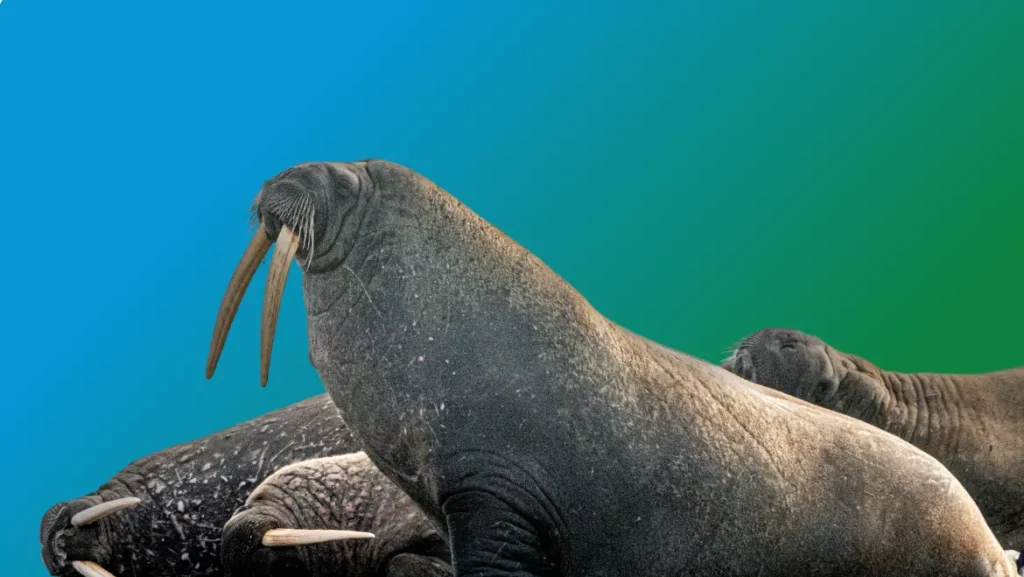
- It cannot really live alone. Walruses haul out in dense herds of hundreds or thousands, piled together, calves protected in the middle. The bond between mother and calf is long and strong. This is deeply social medicine — and, as we will see, that density is both the walrus’s safety and its danger.
Walrus Symbolism in the Arctic
The walrus does not have a scattered, worldwide mythology, and I will not invent one for it. Its symbolic weight sits with the Arctic peoples who have lived in reciprocal relationship with it for thousands of years.
Inuit, Yupik and Chukchi: the animal that must be honoured
For Inuit, Yup’ik and Chukchi peoples, the walrus has been central to survival — food, ivory, hide, oil — and, precisely because of that, central to a web of respect and ritual. In many Inuit traditions the sea and its creatures belong to a great spirit of the deep, often called Sedna (or Sanna), from whom the walrus, seal and whale come; the animals give themselves to the hunter who shows respect, and withdraw from the one who does not. The teaching inside this living tradition — which belongs to those peoples and is not a symbol set to be lifted — is reciprocity: what sustains you must be honoured, or it stops coming. The walrus, in this frame, is not a resource. It is a relationship.
The elder of the ice
Walruses are long-lived, and their gruff, heavy, whiskered presence has an unmistakably elder quality — the sense of an old one who has seen many seasons and is in no hurry. Across the human imagination the walrus tends to read as a patriarch or matriarch of the herd: slow, weighty, protective, carrying the memory of the group. When it comes to you, it frequently comes in that register — as the one being asked to hold, protect, and remember for others.
The Path of the Paws
42 hand-illustrated oracle cards, one for each animal guide — drawn from the same practice these articles come from. A way to sit with an animal instead of only reading about it.
Order your deck →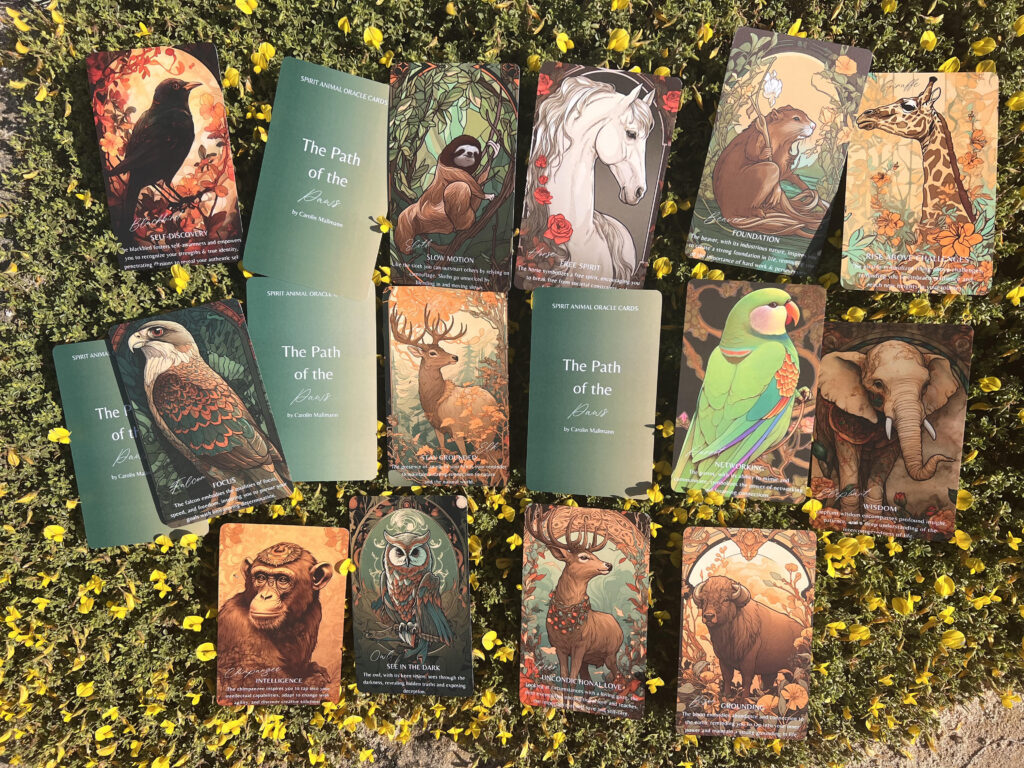
The Shadow: When the Armour Grows Over the Heart
The walrus’s shadow is one of the more poignant ones, because it begins as protection and ends as imprisonment.
- Armour that no longer comes off. The blubber exists so the tender core can survive the cold. The shadow is a toughness so total that nothing gets in and nothing gets out — the sensitive inner life still there, but sealed so deep that even the person can barely reach it. The most common distortion I meet with this animal is someone so well-defended that they have become unreachable to themselves.
- Disappearing into the herd. Belonging is real walrus medicine. Its shadow is a person who has no idea what they feel or want until the herd has decided — identity dissolved into the pile. There is a difference between being held by your community and being unable to exist apart from it, and the walrus knows both.
- The stampede. This is the walrus’s hardest shadow. A herd densely packed for safety can panic at a sudden noise and trample its own — calves are crushed in the very crowd that was meant to protect them. A community running on collective fear can destroy the vulnerable it exists to shelter. If you belong to a herd that panics, this is worth looking at squarely.
- Whiskers overwhelmed. The walrus feels its whole world by touch. The shadow of that exquisite sensitivity is over-attunement — feeling every current in the room, every need of every person, until you are exhausted and cannot tell which feelings are even yours. The gift of sensitivity, ungoverned, becomes a kind of drowning.
A walrus appearing alone on the ice, cut off from the herd, in a dream usually speaks to an isolation you have been minimising — this is not an animal built to be solitary. A walrus with broken or tangled tusks points to a difficulty setting boundaries or lifting yourself out of deep water. And a walrus encased in ice, unable to reach the surface, is a precise image of a tender heart armoured over so completely that it can no longer come up for air.
How to Journey to the Walrus
Shamanic work is not a substitute for medical or psychological care. If you are new to journeying, begin with the beginner’s guide to shamanic journeying before working with the practice below.
- Set an honest intention. Not “help me be stronger” — the walrus is strong enough already. Rather: “Show me where my armour is still protecting me, and where it has grown over my heart.” This animal responds to that distinction with unusual clarity.
- Journey to cold water and ice. A grey northern sea, a floe crowded with bodies, the sound of the herd. Do not look for the walrus in warmth or solitude. Go to the ice edge and let the herd become aware of you.
- Let it find you by touch. The walrus knows its world through its whiskers. Sit still and let it approach and sense you rather than performing anything for it to see. It reads presence, not display.
- Ask to feel your own core. Ask the walrus to show you the tender thing your armour has been protecting — and whether that armour is still serving it or smothering it. This is uncomfortable, and it is the point.
- Ask about your herd. “Who is in my herd — and does it hold me, or does it trample the tender parts of me when it panics?” Then notice, afterwards, one place where you can belong without disappearing.
Affirmations for Walrus Medicine
- “My armour exists to protect my tenderness, not to bury it. I can choose when to let it soften.”
- “I belong to my herd without disappearing into it.”
- “My sensitivity is how I find my way. I honour it without letting it drown me.”
Your Connection to the Walrus: Questions Answered
If the walrus is your spirit animal, you carry a deep need for community together with a tough, protective exterior and a surprisingly tender inner world. Your work is to let the armour serve the softness rather than smother it — to be a guardian of your herd without losing yourself in it, and to lift yourself out of deep water using your own strength.
Dreams of walruses usually concern your community and your boundaries. A crowded, peaceful herd can be a sign to lean on your people; a lone walrus cut off from the group often points to isolation you are underplaying. A walrus sealed in ice speaks to a tender heart that has been armoured over and needs to come up for air.
Nurture your closest relationships and let yourself be held by your community without dissolving into it. Practise firm but gentle boundaries — your tusks are for lifting and protecting, not only for warning. And let the armour soften with people who are safe, so your sensitivity becomes a source of wisdom rather than exhaustion.
If the cold northern water is your territory, you may also feel the pull of the orca, another being of the Arctic seas. And when you want to test which animal is truly yours, work through the A–Z spirit animal guide or sit with the Path of the Paws oracle deck.
Is the Walrus Your Spirit Animal?
Check the boxes that resonate with your spirit and current life journey.
Who is in your protective “herd,” and how does your community give you strength?