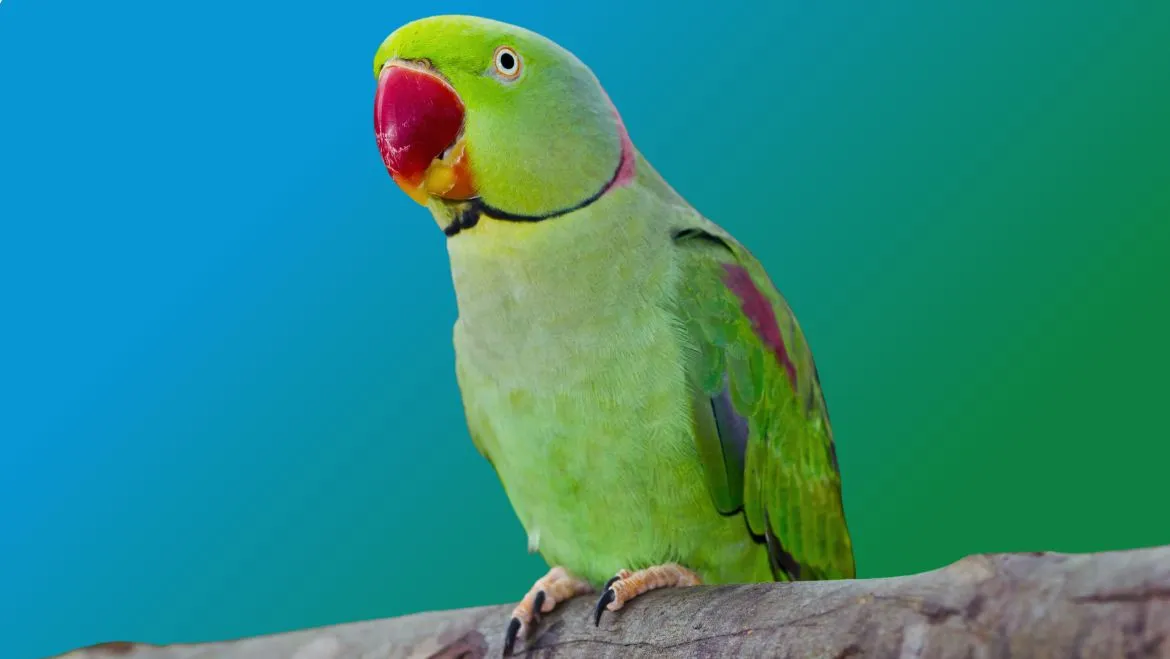
The parrot does not slip quietly into a journey. It arrives loud, close, and in full colour — landing on a branch at eye level, calling once, twice, and then doing the thing people never expect: it goes completely silent and looks at you. What they report afterwards is not the noise. It is that sudden quiet, and the sense of being asked a question they have been avoiding: where is your own voice in all of this?
This page is about the parrot spiritual meaning — what it means when this bird keeps appearing in your dreams, your journeys, or the strange persistence of an image that will not leave. It is not about aviculture. In my practice the parrot arrives for people whose voice has gone borrowed — who can speak beautifully in everyone else’s words and have lost the sound of their own.
In the Parque das Quintas das Conchas in Lisbon there is a colony of green ring-necked parakeets, and I have spent whole mornings under those trees with them calling overhead. They are pure voice and pure connection — and watching them is what first taught me that the parrot’s medicine is not chatter. It is the courage to make a sound that is unmistakably yours.
The Bridge: What the Real Bird Teaches About the Parrot Spirit Animal
Honest animal medicine is anchored in the actual creature, and almost everything the parrot has to say is written into how it lives.
- Its voice is learned, not inherited. A parrot is one of the few animals that acquires its calls the way we acquire language — by listening and imitating. Chicks learn the specific contact calls of their own flock, almost a family dialect. The parrot’s teaching begins here: your voice was shaped by the people who raised you, and part of adulthood is learning which of your sounds are truly yours and which you only inherited.
- It handles the world like a hand. Parrots have zygodactyl feet — two toes forward, two back — and they use a foot to grip, turn and examine food with startling dexterity. It does not swallow things whole. It takes them up, turns them over, and considers them. That is communication medicine too: the parrot does not repeat what it is given without first handling it.
- It cannot live without the flock. Parrots are intensely social, bond for life, and stay in constant vocal contact across distance. A parrot kept alone and understimulated will begin to pluck out its own feathers — a real and well-documented distress behaviour. Hold that image; it is the whole shadow of this animal in a single fact. The gift of voice, left isolated and unheard, turns against the one who carries it.
- It is loud on purpose, and it lives a long time. Larger parrots can live for decades and their calls carry across dense canopy where sight is useless. The parrot does not calibrate its voice down to be polite. In a noisy forest it makes itself heard — and the forest holds it perfectly well.
Parrot Symbolism Across Traditions
Wherever bright, speaking birds have lived alongside people, the parrot has been read as a creature of the voice — of message, of learning, and of the threshold between worlds.
Amazonia: the feathered messenger
Across many Amazonian peoples the macaws and parrots are birds of the upper canopy, their feathers used in ceremonial headdresses and their brilliance associated with the sun and with communication between the human and spirit worlds. The logic is worth pausing on: in these traditions, which belong to the peoples who hold them, the spirit world speaks through what is most vivid and most vocal. Voice and colour are not vanity. They are how a message is made unmissable.
India: the bird of speech and devotion
In Indian tradition the parrot — shuka — is bound up with speech, learning and love. The parrot is the mount of Kamadeva, the god of desire, and Shuka is the sage-narrator who recites the Bhagavata Purana, his very name meaning parrot. Here the bird is the one who carries sacred words accurately across generations. It is a striking counterpoint to the Western cliché of the parrot as mindless mimic: in India the parrot is the keeper and transmitter of what must be repeated faithfully.
Mesoamerica: the scarlet macaw and the sun
Among the Maya and at great cities such as Teotihuacan, the scarlet macaw was a solar and fire bird, its red-and-gold plumage tied to the sun’s heat and to elite power. Macaws were traded, kept and bred far north of their range for their feathers alone. The parrot here is radiance made audible — the bird whose brightness and voice together mark it as belonging to the daylight powers.
Sufi tradition: Rumi’s caged parrot
Rumi tells of a merchant’s caged parrot who sends word to the wild parrots of India, and learns freedom only by watching one of them drop as if dead — and then playing dead itself, so that its keeper throws it out, and it flies. The teaching is precise and a little severe: the voice that only performs from inside the cage has to let something die before it can fly. Sometimes the way out is to stop entertaining the people who are keeping you.
The Shadow: When the Voice Becomes an Echo
The parrot is the most sentimentalised of the talking birds — cheerful, colourful, sociable — and that is exactly why its shadow goes unexamined for years. Its gifts have precise distortions.
- Mimicry that has replaced speech. The parrot learns by imitation — and its shadow is the person who has become fluent in everyone else’s opinions and no longer knows their own. The most common parrot shadow I meet is someone who can articulate any position brilliantly except the one that is actually theirs. The test is uncomfortable: when you speak, whose words are they?
- Voice as performance. The parrot is applauded for talking, and it can learn to talk for the applause. Distinctiveness turns into a routine, a personality worn to be rewarded. If nobody were listening, would you still make this sound?
- The plucked feathers. This is the sharpest edge of parrot medicine. A social, expressive creature kept isolated and unheard turns the gift inward and harms itself. In people this looks like the natural communicator who has gone quiet, over-controlled, self-critical — the voice withdrawn and then turned into a weapon against its owner. The cure is not more silence. It is contact.
- The caged parrot in a dream is one of the clearest images of constrained expression there is — a bird built for a hundred-foot canopy, kept in a box. A parrot that cannot make a sound speaks to something you have not said and are physically holding. And a parrot repeating one phrase over and over usually points to a loop you are stuck in — a story about yourself you keep reciting and have stopped questioning.
How to Journey to the Parrot
Shamanic work is not a substitute for medical or psychological care. If you are new to journeying, start with the step-by-step guide to finding your spirit animal before working with the practice below.
- Set a parrot-shaped intention. Not “help me be more confident” but: show me where I am speaking in a borrowed voice, and what I would say in my own.
- Journey up into the canopy. The parrot is an upper-storey bird. Enter through a tree and go up, into light and leaf and open air, and wait on a branch. Do not go hunting for it; it lands where it wants to.
- Listen before you speak. When it arrives, let it call first. Notice whether it is imitating a sound you recognise — a parent’s phrase, a critic’s tone — or making something new.
- Ask it for your own call. This is the heart of the practice. Ask the parrot to give you the one sound that is unmistakably yours, and let it come as tone or feeling rather than words.
- Notice the flock. Are you alone with it, or is there a flock around you? Parrot medicine is never solitary. Who is meant to hear your voice, and who has you been performing for instead?
- Integrate by speaking once, plainly. Within a day, say one true thing out loud to a person, in your own words, without pre-editing it into something more acceptable. Parrot medicine is completed when you are actually heard.
Affirmations for Parrot Medicine
- “I can tell the difference between my own voice and the ones I only learned.”
- “I speak because I have something to say, not because I am being watched.”
- “My voice is meant to be heard by my flock, not performed for my keepers.”
Parrot Spirit Animal: Questions People Actually Ask
What does it mean when a parrot appears in your life?
It is almost always a message about your voice and your communication — and specifically about something you have been withholding or saying in someone else’s words. The parrot does not arrive to make you louder in general. It arrives pointing at one particular truth, opinion, or feeling that you have been keeping quiet, and it is not subtle about it.
Is the parrot a good omen?
Yes — in most traditions where it appears it is a bright, benevolent sign of communication, learning and connection. But it is an omen that asks for something in return. The parrot brings colour and voice, and then waits to see whether you will actually use them. An omen you do nothing with is just a pretty bird on a branch.
What does a parrot in a dream mean?
Look at what is happening to its voice. A calling parrot usually points to something you need to say. A silent one points to something you are holding. A caged parrot speaks to a situation — a job, a relationship, a role — that has become too small for the person you actually are. And a parrot repeating a single phrase often points to a loop of self-talk you have stopped questioning.
Why does the parrot mimic — does that make it a fake?
No — and this is the parrot’s deepest teaching. It learns by imitation, the way every child learns to speak. Mimicry is how the voice is built. The shadow is not learning from others; it is staying there, never moving past the borrowed sounds to make your own. The parrot asks you to keep what you learned and then add the one call that is only yours.
How do I know if the parrot is my spirit animal?
It tends to claim people whose gift and wound are both in the voice — the communicators, teachers and performers who have sometimes lost themselves in the sound. Persistence is the test: whether the image keeps returning uninvited. For a structured way to explore it, work through the A–Z spirit animal guide or sit with the Path of the Paws oracle deck. If it is colour and self-expression more than voice that you recognise, read the toucan spirit animal next.
Is the Parrot Your Spirit Animal?
Check the boxes that resonate with your spirit and current life journey.
The parrot does not arrive to make you talk more. It arrives to ask whether any of the talking is yours — and then to wait, in that sudden bright silence, until you finally make the one sound only you can make.