
Shamanic healing is defined as a transcultural practice in which a practitioner enters an altered state of consciousness to address illness by treating its spiritual root causes, including soul loss and energetic intrusions. The term was popularized in the West by scholar Mircea Eliade and has since gained recognition as a non-dogmatic modality that works across spiritual, mental, and physical dimensions. If you are asking what is shamanic healing and whether it applies to your life, the short answer is yes. It is one of the oldest healing systems on earth, and its core methods remain as relevant in 2026 as they were thousands of years ago.
What is shamanic healing and how does it work?
Shamanic healing is a practice where the shaman acts as an intermediary between ordinary reality and the non-ordinary spiritual realm to restore a person’s energetic wholeness. The word “shaman” comes from the Evenki of Siberia, a Tungusic people, but the practice itself appears across Indigenous cultures on every continent. Mircea Eliade’s landmark research established shamanism as a universal phenomenon, not a regional curiosity.
The core premise is that illness, emotional pain, and spiritual disconnection often have roots in the energy body rather than the physical body alone. A shaman identifies these roots by entering a trance state, typically induced by rhythmic drumming, and then works with spirit guides or healing intelligences to correct the imbalance. The client does not need to share any specific religious belief for this process to be effective.

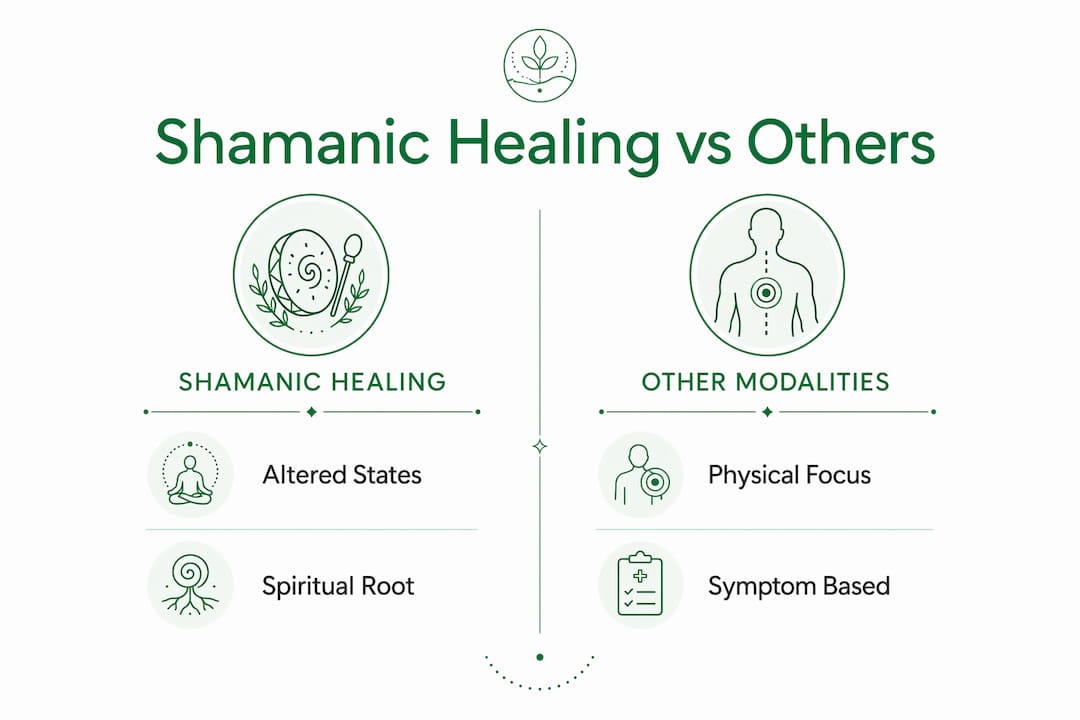
What makes this modality distinct from conventional medicine is its focus on cause rather than symptom. Where a physician treats a presenting condition, a shamanic practitioner looks for the energetic disruption that created the condition in the first place. That shift in perspective is what draws so many people to shamanic healing practices when other approaches have fallen short.
What are the main shamanic healing techniques?
Four principal techniques form the foundation of modern shamanic healing practice: soul retrieval, energy extraction, spiritual journeying, and power animal retrieval. Each addresses a different type of energetic imbalance, and a skilled practitioner will often use more than one in a single session.
- Soul retrieval targets soul loss, which occurs when a part of a person’s vital essence fragments and leaves following trauma, grief, or prolonged stress. The shaman journeys to locate and return that fragment, restoring a sense of wholeness the person may not have felt in years.
- Energy extraction removes intrusive energies that do not belong to the client’s energy field. These are not supernatural entities in a dramatic sense. They are misplaced energies that create blockages, chronic pain, or emotional heaviness.
- Spiritual journeying is the foundational skill underlying all other techniques. The shaman enters a trance state, often guided by drumming at 4–7 beats per second, and moves through non-ordinary reality to gather information, guidance, or healing. You can learn more about this practice through shamanic journeying.
- Power animal retrieval reconnects a person with a protective spirit in animal form. Many people feel a renewed sense of confidence and direction after this work.
Modern Western practice, often called core shamanism, relies on sound, trance, and intention rather than plant medicines. This makes it accessible to a wide range of people without the physical or legal complications associated with psychoactive substances. Indigenous traditions may include plant medicines, but that is a separate and culturally specific context.
Pro Tip: Before your first session, spend five minutes writing down your clearest intention. Practitioners consistently report that clients who arrive with a focused intention experience more defined and lasting results.
How does shamanic healing work on multiple levels?
Shamanic healing operates by accessing altered states to facilitate interactions with spiritual realms and restore energetic balance, with measurable effects on physical, emotional, and spiritual health. The altered state itself has physiological correlates. Rhythmic drumming promotes parasympathetic nervous system dominance, which reduces cortisol, slows the heart rate, and creates the internal conditions for deep healing work.
The mechanism works on three levels simultaneously:
- Spiritual level. The shaman retrieves lost soul parts, removes intrusive energies, and communicates with guides or ancestors on the client’s behalf. This addresses the root cause of the imbalance.
- Emotional level. Clients frequently experience emotional releases during or after a session, including grief, relief, or unexpected joy. These releases are signs that stagnant energy is moving.
- Physical level. While shamanic healing is not a substitute for medical care, many clients report reductions in chronic pain, fatigue, and somatic symptoms after sessions targeting the energetic root of those conditions.
A critical point that most people miss is the role of the practitioner. Shamans act as intermediaries, not as direct healers. They bring healing intelligence from the spiritual realm, but the client’s own energy system does the actual restoring. This reframes the entire dynamic.
“The shaman does not heal you. The shaman creates the conditions in which you heal yourself. The distinction matters because it places your own energy, intention, and participation at the center of the process.”
Client openness to spiritual experience is the single most important variable in session efficacy. You do not need to believe in any particular cosmology. You do need a genuine willingness to engage with what arises.
How is shamanic healing different from other healing practices?
Shamanic healing is often mistaken for magic, religion, or a form of alternative medicine that competes with conventional care. None of those descriptions are accurate. Shamanic healing is a Spirit-led collaborative process focused on energetic balance, not on rituals performed for dramatic effect.
The table below clarifies how shamanic healing compares to related modalities by category, not by brand or practitioner name.
| Category | Shamanic healing | Other energy or spiritual modalities |
|---|---|---|
| Core mechanism | Altered state, spirit engagement | Varies: breathwork, prayer, energy transfer |
| Belief requirement | None. Openness required | Often tied to specific doctrine or tradition |
| Practitioner role | Intermediary, guide | Varies: teacher, healer, minister |
| Focus | Root cause, soul integrity | Often symptom or belief-level work |
| Integration into therapy | Transpersonal psychology | Varies widely by modality |
Transpersonal psychology has formally integrated shamanic techniques into clinical frameworks. Practitioners trained in both fields use journeying and soul retrieval alongside conventional therapeutic tools to address trauma, identity disruption, and spiritual crisis. This is not fringe practice. It reflects decades of cross-disciplinary research.
The most persistent misconception is that shamanic healing delivers quick results. It does not work that way. Addressing unconscious patterns through spirit engagement is a process that unfolds over time, often across multiple sessions and months of personal integration work. Treating it as a one-time fix misses the point entirely.
Pro Tip: If you are exploring shamanic healing alongside conventional therapy, tell both practitioners. Transparency between your care providers creates a more coherent support structure and prevents conflicting approaches.
What should you expect during and after a session?
A typical shamanic healing session begins with intention setting. The practitioner asks what you are seeking, and you articulate your intention as clearly as possible. That intention becomes the compass for everything that follows.
- During the session, you will likely lie down or sit comfortably while the practitioner drums, rattles, or uses other sound tools to enter a trance state. You may hear singing, chanting, or silence. Some clients experience vivid imagery, emotional waves, or physical sensations. Others feel very little in the moment but notice significant shifts in the days that follow.
- Immediately after, the practitioner shares what they encountered in non-ordinary reality. This debrief is part of the healing. Hearing the narrative of what was found and restored helps your conscious mind integrate the energetic work.
- In the days following, journaling, meditation, and time in nature are the most effective ways to ground the changes. Practitioners consistently emphasize that post-session integration determines how deeply the healing takes root. Skipping this step is the most common reason people feel the effects fade quickly.
- Over weeks, you may notice shifts in recurring thought patterns, emotional reactivity, relationships, or physical symptoms. These changes are often subtle at first. Keeping a journal from the day of your session makes them easier to track.
The effectiveness of shamanic sessions depends heavily on what you bring to the process before, during, and after. Passive participation produces passive results. Active engagement, including honest intention setting and committed aftercare, produces lasting change.
Key Takeaways
Shamanic healing works because it addresses the spiritual and energetic root causes of imbalance, not just the surface symptoms, and its effectiveness depends on the client’s active participation before, during, and after each session.
| Point | Details |
|---|---|
| Core definition | Shamanic healing uses altered states to treat spiritual root causes like soul loss and energetic intrusions. |
| Four main techniques | Soul retrieval, energy extraction, spiritual journeying, and power animal retrieval form the foundation of practice. |
| Practitioner role | Shamans act as intermediaries, not direct healers. The client’s own energy system does the restoring. |
| Client openness matters | Willingness to engage with non-ordinary reality is the most important variable in session outcomes. |
| Integration is non-negotiable | Journaling, grounding, and time in nature after a session determine how deeply the healing takes hold. |
What I have learned from watching people approach shamanic healing
People come to shamanic healing carrying one of two attitudes. The first group arrives skeptical but genuinely curious, willing to set aside their usual frameworks for an hour. The second group arrives expecting the shaman to fix them the way a mechanic fixes a car. The first group almost always leaves changed. The second group almost always leaves disappointed.
What I have observed over years of working with and within shamanic communities is that the practice rewards honesty more than belief. You do not need to be convinced that spirit guides exist. You need to be honest about what is not working in your life and willing to sit with whatever arises. That combination is more powerful than any technique.
The other thing most articles will not tell you is that shamanic healing can be uncomfortable. Soul retrieval, in particular, often surfaces emotions that have been buried for years. That is not a side effect. That is the work. Clients who understand this going in are far better prepared to use the experience productively rather than retreat from it.
Shamanism’s approach, particularly through resources like trauma work with shamanism, reflects this reality honestly. The practice is not positioned as a shortcut. It is positioned as a serious tool for people ready to do serious work. That distinction is what makes it worth your time.
— Carolin
Ready to go deeper into shamanic healing?
Shamanism offers a structured path for anyone who wants to move from curiosity to genuine practice.
The beginner’s guide to shamanism covers the foundational philosophy and worldview that makes all healing techniques intelligible. From there, you can explore specific practices like soul retrieval and shamanic meditation in depth. Shamanism’s online courses, including “The Elements of Shamanism,” provide guided instruction within a warm community of practitioners at every level. Whether you are processing a difficult season of life or seeking long-term spiritual development, the resources at Shamanism meet you where you are.
FAQ
What is shamanic healing in simple terms?
Shamanic healing is an ancient practice where a trained practitioner enters a trance state to identify and address the spiritual root causes of physical, emotional, or mental imbalance. It treats soul loss, energetic intrusions, and disconnection from vital life force.
How does shamanic healing work without religious belief?
Shamanic healing requires openness to spiritual experience, not adherence to any specific doctrine. The process is non-dogmatic and works through the client’s own energy system guided by the practitioner’s work in non-ordinary reality.
What happens during a shamanic healing session?
A session typically includes intention setting, rhythmic drumming to induce trance, active spirit work by the practitioner, and a debrief where findings are shared. Clients may experience emotional release, imagery, or physical sensations during the session.
Can shamanic healing help with trauma?
Shamanic healing addresses trauma at the energetic level, particularly through soul retrieval, which targets the soul fragmentation that trauma often causes. It works alongside, not instead of, conventional therapeutic support.
How many sessions does shamanic healing take?
The number of sessions varies by individual and the depth of the work needed. Most practitioners recommend starting with one session and allowing several weeks for integration before deciding on further work.