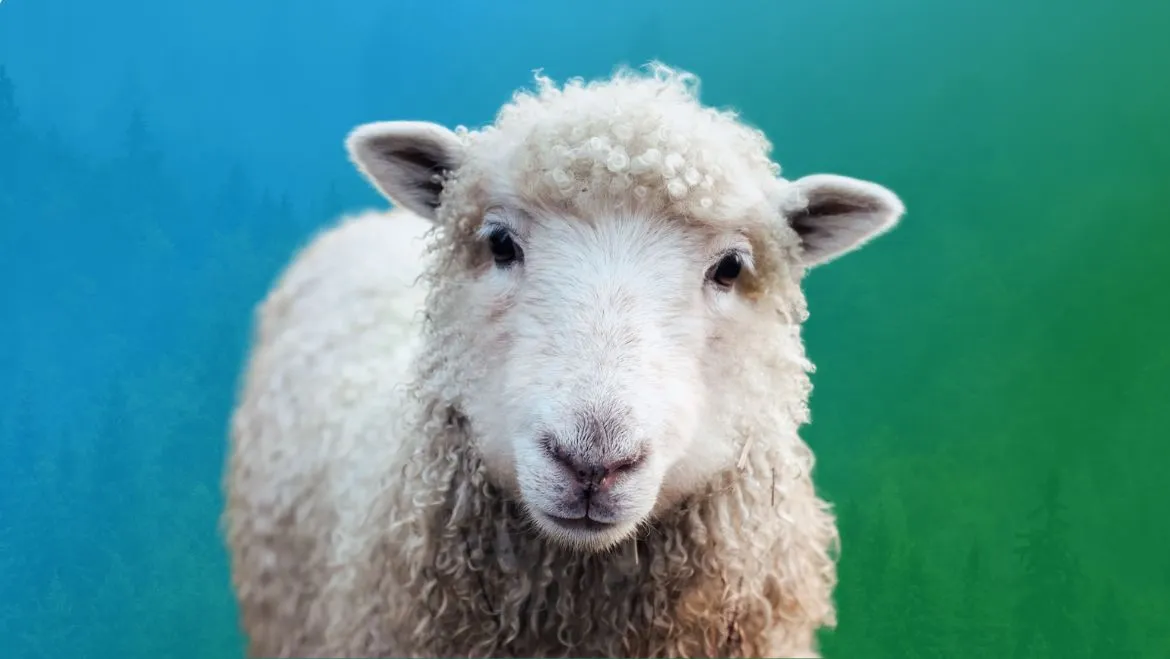
The lamb does not arrive in a journey the way most animals do. There is no approach, no circling, no assessment. It is simply already there when you turn around — close, closer than you expected, standing at the height of your hip, breathing. People almost always describe the same two things afterwards: the warmth of it, and the fact that it did not move away.
If you have come here for husbandry facts or Easter recipes, you are in the wrong place. This is about the lamb spiritual meaning — what it means when this animal keeps appearing in your dreams, in your journeys, in the corner of your attention where images go when they want something from you.
In my practice, the lamb rarely comes to gentle people. It comes to people who have become hard, and who are exhausted by the effort of it. And it does something that no fierce animal can do: it stands in front of you with no weapon, no armour and no exit strategy, and does not flinch. That is not innocence as decoration. That is innocence as a position held under pressure — and it is far harder to hold than aggression.
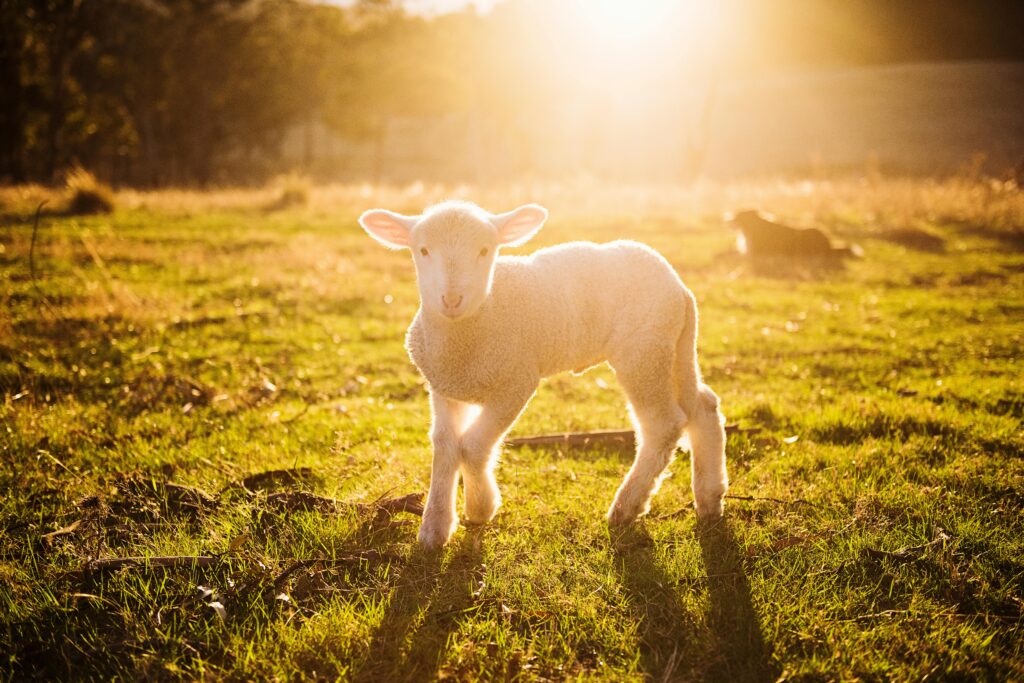
The Bridge: What the Real Animal Teaches About Lamb Spirit Animal Meaning
Honest animal medicine is anchored in the actual creature. Everything the lamb has to say is already written into its body and its first weeks of life.
- It has no defences at all. No claws, no speed, no venom, no antlers yet, no burrow. A newborn lamb is one of the least defended mammals in the landscape. And yet the species has persisted for ten thousand years alongside us. The medicine is not “be soft.” It is that survival does not always run through force — and that a strategy which looks like nothing is still a strategy.
- It stands within the hour. A lamb is born and is on its feet, unsteady but upright, in under sixty minutes. It does not get a childhood in the way a wolf cub does. Anyone who was required to be capable far too early recognises this animal instantly, and usually does not enjoy the recognition.
- It sees almost everything at once. The horizontal, rectangular pupil gives sheep a panoramic field of roughly 300 degrees — they can watch for danger without turning their heads. Constant peripheral vigilance is the price of having no weapon. If you are permanently scanning the room for who is upset with you, the lamb already knows exactly what that costs.
- It knows faces. Sheep can recognise and remember dozens of individual faces — of other sheep and of humans — for years. The animal we use as a byword for mindlessness is, in fact, keeping careful track of who is who. Do not mistake quietness for absence of judgement. The lamb is not naive. It is simply not retaliating.
- It plays for no reason. Lambs gambol — those absurd vertical leaps that serve no immediate purpose. It is one of the purest displays of surplus life in the natural world, and it happens in an animal that is entirely vulnerable. The lamb does not wait until it is safe to be joyful. It is joyful while it is unsafe. That, and not the white fleece, is what makes it sacred.
Lamb Symbolism Across Traditions
No animal has been placed at the centre of more sacred stories, and it is worth asking why the traditions kept choosing the defenceless one.
Jewish and Christian: the lamb at the threshold
In the Passover narrative of the Hebrew Bible, the blood of the lamb is placed on the doorframe, and the household inside is passed over. Note the geography: the lamb stands at the threshold — the boundary between the house and the terror outside. Centuries later, Christian tradition takes this image and intensifies it in the title Agnus Dei, the Lamb of God: innocence that does not resist, and in not resisting, ends the cycle. Whatever your relationship to that theology, the psychological structure is exact and it is one I meet constantly in shadow work. Someone in a system absorbs the violence, and the violence stops there. That is the lamb’s most costly gift — and, as we will see, its most dangerous shadow.
Islamic: the substitution at Eid al-Adha
In the Islamic tradition of Eid al-Adha, Ibrahim is prepared to sacrifice his son and a ram is provided in his place. The essential movement here is substitution — the animal arrives so that what was about to be destroyed does not have to be. When the lamb comes into someone’s journey during a period of dread, this is very often the register it works in: something you have been bracing to lose does not, in fact, have to be given up.
Celtic: Imbolc and the first milk
This is the tradition I find most useful, and the one almost nobody writes about. The Gaelic festival of Imbolc, at the start of February, is bound up with the lambing season and the ewes coming into milk — one common reading of the name connects it to oimelc, ewe’s milk. Imbolc is not a celebration of spring. It is a celebration of the first credible evidence of spring, arriving in the coldest, bleakest part of the year, when nothing else has changed. The lamb is born while the ground is still frozen. When this animal appears in a journey during a long, grey stretch of someone’s life, that is almost always what it is doing: it is not telling you the winter is over. It is telling you that something has already been born inside it.
The Shadow: When Gentleness Becomes a Cage
The lamb has, in my view, the most misunderstood shadow of any animal on this site — because its shadow is universally praised. Nobody is ever criticised for being too forgiving.
- The scapegoat. The sacrificial lamb is a role, and in families and workplaces it is a role somebody actually occupies. This is the person who absorbs the blame so that the system does not have to look at itself — and who has often been told, in spiritual language, that this is their gift. It is not a gift. It is a job nobody applied for. If the lamb has arrived while you are carrying something that is not yours, this is the message, and it is not a gentle one.
- Forgiveness as avoidance. The most common distortion I encounter is forgiveness offered before the anger has been felt at all. It arrives fast, it sounds serene, and it is a way of getting out of the room. Real forgiveness comes after full acknowledgement of the harm; anything that comes before it is not forgiveness, it is a lid. And the pressure underneath a lid does not dissipate. It accumulates.
- Innocence held past its season. A lamb is meant to become a sheep. Refusing to grow up — remaining unworldly, unable to negotiate, unable to hold a boundary, and calling it purity — is not the lamb’s medicine. It is the lamb’s arrest.
- The flock as a hiding place. Belonging keeps a sheep alive. But there is a point at which never leaving the group means never discovering what you actually think. If you cannot name a single opinion you hold that the people around you would dislike, the lamb is not asking you to be nicer.
A lamb that appears being led away in a recurring dream — calm, unresisting, going somewhere it should not be going — is one of the most serious images this animal produces. In my experience it is not a premonition. It points to a place in waking life where the dreamer has stopped objecting to their own situation. A lamb that appears separated from the flock and calling speaks to isolation that is being described as independence. And a lamb that appears bloodied or dead almost never predicts harm; it names something soft in the person that has already been damaged and has not yet been grieved.
How to Journey to the Lamb
Shamanic work is not a substitute for medical or psychological care. If you are new to this, begin with the beginner’s guide to shamanic journeying before attempting the practice below. Allow thirty undisturbed minutes.
- Set an intention the lamb can actually answer. Not “help me forgive.” Rather: “Show me what I am still carrying that was never mine.”
- Enter through open pasture in the cold. Not a summer meadow. Late winter, hard ground, low light. The lamb belongs to the season before the season.
- Do not reach for it. This is the instruction people ignore. The lamb is the one animal that does not need to be approached, and grabbing at it turns the journey into a picture of exactly the dynamic you came to look at.
- Notice whether it is alone. A lamb with the flock and a lamb by itself are two entirely different messages. In lamb journeys the surroundings carry as much information as the animal.
- Let it lean against you, and stay there. Most of the work in this journey is tolerating being cared for without earning it. Notice how quickly you want to get up.
- Ask one question before you leave: “Whose anger have I been holding instead of my own?”
The Integration Ritual: Forgiveness That Is Not a Lid
Do this within a few days of the journey, in this order. The order is the whole point.
- Name the harm precisely, out loud. Not “things were difficult.” The actual sentence. If you cannot say it, you are not ready to forgive it, and that is information, not failure.
- Say what it cost you. One sentence. This is the step that gets skipped and it is the step that does the work.
- Decide what you are not returning to. Forgiveness is a release of the debt, not an invitation back through the door. These are separate decisions and conflating them is how gentle people get hurt twice.
- Only then, offer the release. The Hawaiian practice of Ho’oponopono is a clean container for this — “I’m sorry. Please forgive me. Thank you. I love you.” — spoken toward the situation and, crucially, toward yourself. It works when it comes fourth. It becomes spiritual bypass when it comes first.
- Do one thing this week that no one will praise you for. The lamb’s counter-medicine to the scapegoat pattern is not defiance. It is the quiet experience of existing without being useful to anyone.
Lamb Spirit Animal: Questions People Actually Ask
What does it mean when a lamb keeps appearing?
Repeated lamb appearances are almost always about softening, but not in the way people assume. In my practice the lamb turns up for people who have hardened in order to survive something — and it is asking whether the armour is still necessary, or whether it is now the only thing standing between them and being touched. Ask what you would have to feel if you put it down.
Is the lamb a good or bad omen?
Overwhelmingly a sign of grace, renewal and the end of a barren stretch — but it is not a passive one. The lamb is also the animal of the scapegoat, and if it arrives while you are being blamed for something that is not yours, it is naming the role, not blessing it. Which reading applies depends entirely on whether the lamb in your image is being cared for or being used.
What does a lamb in a dream mean?
Read three things: whether it is alone, whether it is being led, and whether you are able to touch it. A lamb you cannot reach usually points to your own tenderness held at a distance from yourself. A lamb being led away calmly points to a situation you have stopped objecting to. A lamb sleeping against you is one of the kindest images this animal offers: something in you is finally allowed to rest.
What is the difference between the lamb and the sheep spirit animal?
The lamb carries beginning, vulnerability and unearned trust. The sheep spirit animal carries what happens next — belonging, the flock, endurance through weather, and the harder questions about conformity and voice. If you are unsure which one came to you, ask its age. Lamb medicine is about what has not yet been damaged. Sheep medicine is about what has to be maintained.
Does the lamb mean I have to forgive someone?
No — and this is the most important correction I make when this animal comes up. The lamb never demands forgiveness on a schedule. Premature forgiveness is the lamb’s shadow, not its gift. What it asks for first is honesty about the injury. Forgiveness, if it comes, comes afterwards and on its own, and it does not require you to stand within reach of the same harm again.
If you want a structured way to test which animal is actually working with you, rather than guessing, work through the A–Z spirit animal guide or sit with the Path of the Paws oracle deck and let the animal find you.
The lamb does not arrive to make you smaller. It arrives to show you that you have been standing in a field with no weapon for a very long time — and that you survived it anyway.