Breathing exercises can calm you by slowing your breath and making the out-breath longer than the in-breath. That tells your body it is safe to ease off. The seven breathing techniques below take a few minutes each, need no equipment, and suit everyday stress. If you have asthma, read the section on breathing exercises for asthma first, because they can support your treatment but never replace it.
When you are tense, your breath gets short and high in the chest, and it speeds up. You usually don’t notice. Then your body reads the fast breathing as a sign that something is wrong, and you feel even more on edge. The good news is that the link works in both directions. You can’t order your thoughts to calm down, but you can change how you breathe, and your body follows.
None of this is mystical. It is simple physiology, and it is also why many contemplative traditions, shamanic ones included, start with the breath. If you are curious about the shamanic side, I wrote about it in what shamanic breathwork is and who should avoid it. This article is the plain, practical version.
7 Breathing Exercises You Can Start Today
Try each breathing technique once while you are calm, so you know how it feels before you need it. Stop whenever you feel dizzy or uncomfortable, and go back to normal breathing.
1. Belly Breathing (Diaphragmatic Breathing)
This is the base for most other breathing exercises. It brings your breath down from the chest into the belly, where the diaphragm can do its work. It is good for general tension and for learning what a slow breath feels like.
- Sit or lie down and rest one hand on your belly, the other on your chest.
- Breathe in slowly through your nose. Let the hand on your belly rise, while the chest hand stays fairly still.
- Breathe out slowly, and feel the belly sink.
- Keep going for two to five minutes.
Not for you if: it makes you feel light-headed or strains your stomach after a big meal. Wait a while, or try it sitting upright.
2. The Longer Out-Breath (4 In, 6 Out)
If you only learn one of these breathing techniques, make it this one. A longer exhale is one of the quickest ways to tell your body to settle. It is good for racing thoughts, tension before a meeting, or trouble falling asleep.
- Breathe in through your nose for a count of four.
- Breathe out slowly for a count of six, through your nose or softly through your mouth.
- Repeat for two to three minutes.
If six feels like too much, try 3 in and 4 out. The exact numbers matter less than the exhale being longer.
Not for you if: counting makes you anxious. Then just let the out-breath be a little slower than the in-breath, without numbers.
3. Pursed-Lip Breathing
You breathe out through lips held like you are blowing on hot soup. This slows the out-breath and is widely taught in breathing training for lung conditions. It is also useful when you feel short of breath after climbing stairs.
- Breathe in gently through your nose for about two counts.
- Purse your lips as if you were going to whistle.
- Breathe out slowly through the lips for about four counts. Don’t force the air out.
- Repeat for a few minutes.
Not for you if: it feels like you are straining. The breath should stay easy.
4. Quiet Nose Breathing
Breathing in and out through the nose filters and warms the air, and it makes it harder to over-breathe. It is a gentle breathing practice for the whole day, not only for a quiet moment.
- Close your mouth and rest your tongue lightly on the roof of your mouth.
- Breathe in through your nose so quietly that someone next to you couldn’t hear it.
- Breathe out the same way, softly and without pushing.
- Do this for three to five minutes, or whenever you notice your mouth is open.
Not for you if: your nose is blocked. Don’t force it. Breathe through the mouth until it clears.
5. Box Breathing
Box breathing adds short pauses between the breaths. It is popular for focus under pressure, and the equal counts give the mind something steady to follow.
- Breathe in through your nose for four counts.
- Hold gently for four counts.
- Breathe out for four counts.
- Pause for four counts, then start again. Do four to six rounds.
Not for you if: you are pregnant, have heart problems, or have asthma and feel tight. Skip the holds, or shorten them to a second or two. If holding feels unpleasant, just breathe in and out in a square rhythm without the pauses.
6. The 4-7-8 Method
You breathe in for four, hold for seven, and breathe out for eight. Many people use it for falling asleep. The long hold and long exhale are strong, so go easy.
- Breathe in quietly through your nose for four counts.
- Hold your breath for seven counts.
- Breathe out through your mouth with a soft whoosh for eight counts.
- Do no more than four rounds when you are new to it.
Not for you if: you get dizzy, which happens to some people. Do it sitting down. It is not suitable during an asthma flare-up or when you feel breathless.
7. Resonance Breathing (Coherent Breathing)
Here you breathe at roughly five to six breaths per minute, which means about five seconds in and five seconds out. At this pace, the breath and heart rhythm tend to fall into step. It is a good daily practice for building a steadier baseline.
- Sit comfortably and breathe in through your nose for a count of five.
- Breathe out for a count of five, without a pause between breaths.
- Keep the breath smooth, like a slow wave.
- Continue for five to ten minutes.
Not for you if: the pace feels too slow. Start with four counts in and four out and work up.
Breathing Exercises for Asthma
If you have asthma, you are probably wondering whether breathing exercises can help you. The honest answer is: a bit, in some ways, and never as a substitute for treatment.
The best evidence comes from a Cochrane review on breathing exercises for adults with asthma (Santino and colleagues, 2020). It looked at 22 studies with 2,880 adults who had mild to moderate asthma. The exercises included yoga breathing, breathing retraining, the Buteyko and Papworth methods, and deep diaphragmatic breathing. The authors found moderate certainty that breathing exercises improve quality of life after three months and ease symptoms of hyperventilation. They found probably no clear effect on asthma symptoms themselves, and they say more research is needed.
So breathing exercises may help you feel better and breathe more calmly, but they are not a proven way to control asthma.
In practice, people with asthma are often taught pursed-lip breathing and belly breathing, sometimes with the Buteyko or Papworth method under guidance. For breathlessness, German respiratory guidance also recommends two positions. In the coachman’s seat (Kutschersitz), you sit leaning forward with your forearms resting on your thighs. In the goalkeeper’s stance (Torwartstellung), you stand with your hands on your thighs and your upper body slightly bent forward. Both give the chest more room.
Safety first
Breathing exercises complement your asthma treatment. They never replace your medication or your personal asthma action plan.
Talk to your doctor or a respiratory physiotherapist before you start, and ask them which techniques suit you.
- Never practise breath holds during an attack or when you feel tight. Skip box breathing and 4-7-8 on those days.
- In an attack, stay as calm as you can, use your reliever inhaler as set out in your action plan, and sit in the coachman’s seat while you breathe out slowly through pursed lips.
- If it doesn’t improve quickly, if it is severe, or if you can only speak in single words, call your local emergency number straight away (999 in the UK, 911 in the US, 112 in the EU).
How to Build a Daily Breathing Practice
A breathing practice works like any other habit. Small and regular beats long and rare.
- Start with two minutes. One exercise, once a day. That is enough for the first week.
- Pick a fixed moment. After brushing your teeth, before your first coffee, or when you sit on the bus. Tie it to something you already do.
- Use the same exercise for a week. Then add a second one. Changing every day makes it harder to feel what works.
- Practise when you are calm. The exercises are much easier to use in a stressful moment if your body already knows them.
- Add a short check-in. After each session, notice whether your shoulders dropped or your breath got slower. That small feedback keeps you going.
If you like a bit of structure around your practice, my article on daily shamanic practices for beginners has more ideas for short routines. And if you enjoy sitting quietly with your attention, mindfulness and shamanism shows how the two paths meet. For the body’s side of calming down, see the shamanic approach to nervous system regulation.
A Breathing Practice in Your Pocket: Phew
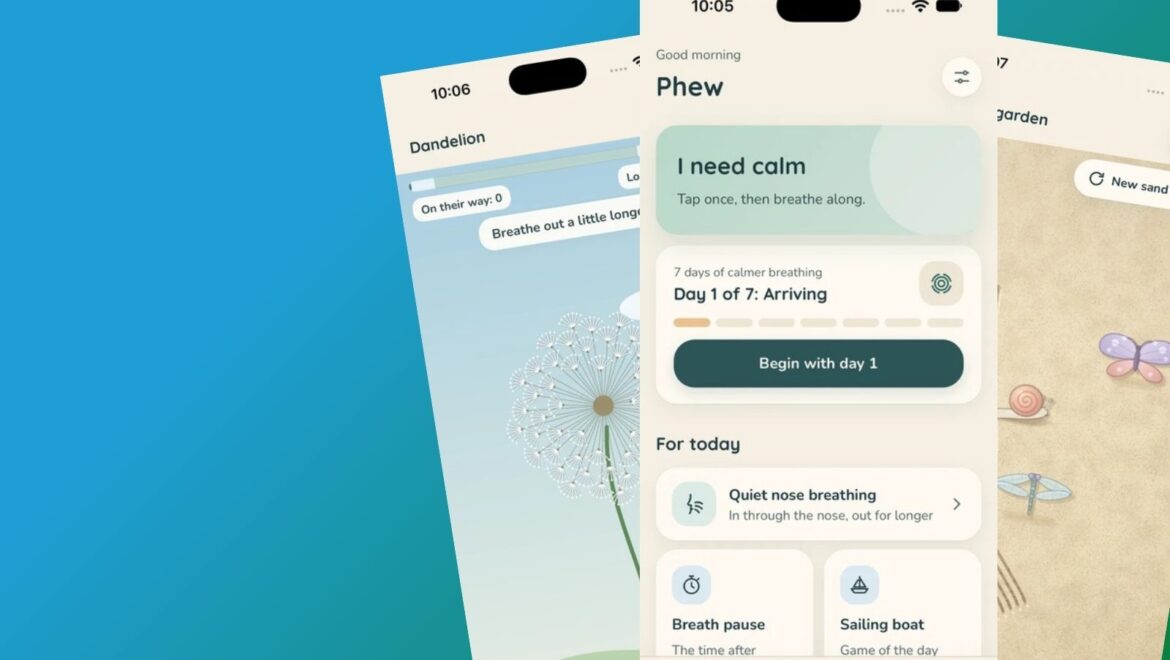
Phew is a breathing app for restless moments. It is a wellness app for calm breathing and relaxation. It is not a medical product.
The main button says “I need calm”. You tap it once, and a soft shape grows and shrinks on the screen while you breathe along with it. There are seven breathing exercises inside, including quiet nose breathing, a longer out-breath and a rhythm you set yourself, plus four more. You also get a short breathing pause and a programme called 7 days of calmer breathing.
If sitting still isn’t your thing, there are 14 small games. Some you play with your breath through the microphone, such as blowing soap bubbles, a dandelion, a feather or a candle, and nothing is recorded. Others you play with your finger. There is also a Buddha sand garden, colouring pages with mandalas and landscapes, constellations, and soundscapes you mix yourself with a sleep timer. A garden grows with the calm minutes you collect, and a diary with a calm scale lets you see how you feel over time. A Night Relief mode keeps things dim and quiet.
Phew is a one-time purchase, no subscription. There is no account, no ads and no tracking, and your entries stay on your device. It runs on iPhone and iPad in English and German, and the Android version follows later. You can read more on the Phew page or go straight to Phew: Breathing Practice in the App Store.
Questions About Breathing Exercises
Which breathing exercise calms you down the fastest?
The longer out-breath. Breathe in for four, out for six, for two or three minutes. It is simple, it works for most people, and you can do it anywhere without anyone noticing.
How often should I do breathing exercises?
Once a day for two to five minutes is a good start. After a few weeks you can add a second session. Short and regular is better than one long session a week.
Do breathing exercises help with asthma?
They can support your quality of life and ease hyperventilation symptoms, according to a Cochrane review, but they probably don’t change asthma symptoms themselves. They never replace your medication. Ask your doctor or a respiratory physiotherapist which techniques fit you.
What is the 4-7-8 method?
It is a breathing technique where you breathe in for four counts, hold for seven and breathe out for eight. It is often used to fall asleep. Some people feel dizzy with it, so do it sitting down and keep it to a few rounds. It is not suitable during an asthma flare-up.
Is it safe to do breathing exercises every day?
For most healthy people, gentle exercises like belly breathing and the longer out-breath are fine every day. Stop if you feel dizzy or tingly. If you have a heart condition, are pregnant, or have a lung condition, check with your doctor before you start.
What is the difference between breathing exercises and breathwork?
Breathing exercises are usually slow and calming. Breathwork often means fast, intense breathing meant to bring you into an altered state. They are different practices, and breathwork isn’t suitable for everyone.
Status: November 2026. This article is general information about breathing practice and does not replace medical advice.