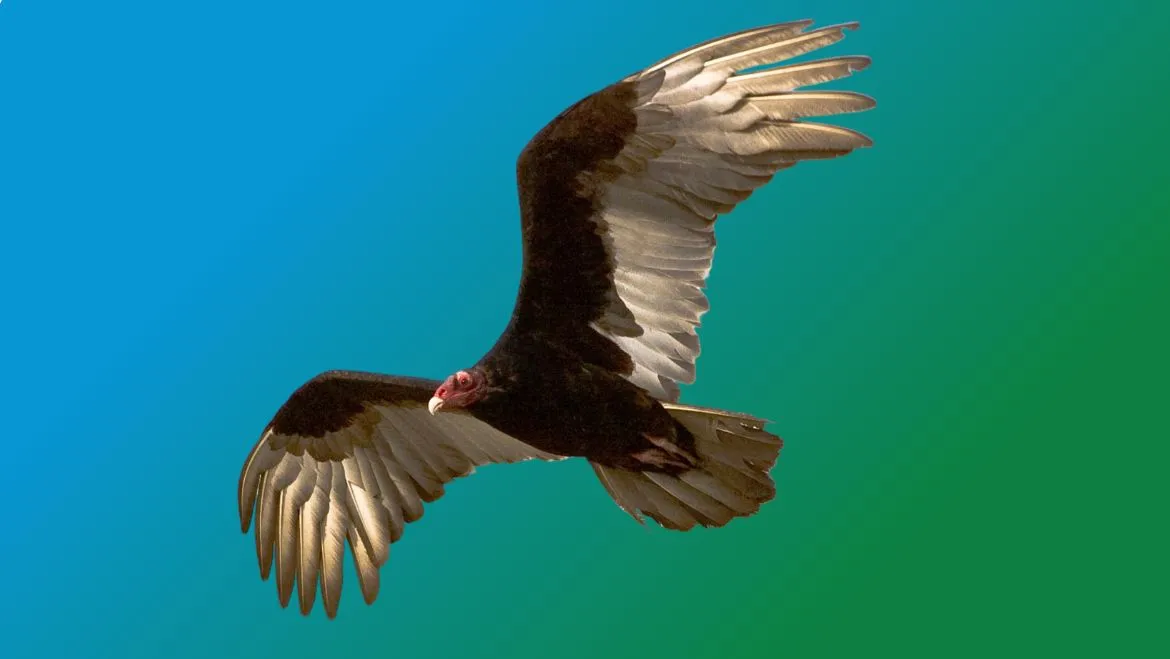
The first time Vulture came to me in a journey, I did not see him. I smelled him — or rather, I smelled what he was standing on. There was a heat in the vision, a dry, sun-cracked stillness, and the unmistakable sense that something in that place had already died and I had been avoiding walking past it. Then the shadow crossed. Enormous wings, held in a shallow V, circling without a single beat. And a feeling in my body that most people mistake for dread but is actually relief arriving before permission.
That is Vulture. He does not come to kill anything. He comes after. In more than two decades of shamanic practice and coaching, I have almost never seen Vulture arrive for someone who was thriving. He arrives for people who are standing next to a corpse — a marriage, a career, an identity, a story about themselves — and pretending it is still breathing. The Vulture spirit animal is the guide of cleansing, rebirth and the remarkable ability to thrive in the harshest conditions. But before he gives you any of that, he will make you look at the thing you have been walking around.
The Bridge: What Vulture Biology Actually Teaches
Everything spiritual about Vulture grows straight out of what he really is. This is not metaphor stretched over a bird — it is a bird whose actual body is the teaching.
- He digests what would kill anything else. A vulture’s stomach acid is extraordinarily corrosive — strong enough to destroy anthrax, botulism and cholera bacteria in carrion that would poison almost any other animal. Read that spiritually and it is devastating: Vulture medicine is the capacity to take in what is toxic and neutralise it rather than pass it on. He is the interrupter of contagion. When Vulture is your guide, your work is often to be the one in your family or your lineage who metabolises the poison instead of handing it down.
- He is bald for a reason. The featherless head is not ugliness; it is hygiene. He puts his head into the dead thing, and there is nothing for the rot to cling to. Do the difficult work — but do not carry it home in your hair. I have watched more healers burn out from ignoring that one line than from anything else.
- He does not flap. Vultures ride thermals, gaining altitude on rising columns of warm air with almost no muscular effort, and can travel enormous distances on the energy of the landscape itself. This is the medicine of effortless perspective. Vulture people are exhausted people who have forgotten that the current will hold them if they stop beating against it.
- He is patient, and he is not a predator. He does not force the ending. He waits for it, then he serves it. That distinction matters enormously in shadow work: Vulture never asks you to destroy something. He asks you to stop resuscitating what has already gone.
As scavengers, Vultures showcase exceptional adaptability and resourcefulness, thriving on what others leave behind. This vulture animal totem encourages you to use your innate abilities to navigate life, using every resource at your disposal — including the wreckage.
Core Symbolism & Historical Context: The Misjudged Purifier
Almost every culture that lived close to vultures revered them, and almost every culture that lived far from them despised them. That gap tells you something.
Egypt: the vulture as mother
In ancient Egypt the goddess Nekhbet was depicted as a vulture and served as protector of Upper Egypt and of the pharaoh, her wings spread over the king in a gesture of shelter. The Egyptian hieroglyph for “mother” was a vulture. This is a culture that watched vultures closely and concluded, reasonably, that a creature who cleans the land and shields her young is maternal, not morbid. Mut, another great mother goddess, wore the vulture headdress.
Tibet and Zoroastrian Persia: the vulture as psychopomp
In Tibetan sky burial and in the Zoroastrian Towers of Silence, the dead are given to vultures. These are living traditions belonging to living peoples, and I reference them here with respect and no claim to their ceremonies. What they establish, anthropologically, is a coherent worldview: the body is a vessel, and the vulture is the being who carries what remains upward. He is not a desecrator. He is the ferryman of the flesh. In shamanic terms this makes Vulture a genuine psychopomp — a guide of souls across the threshold — and it is why he so often appears to people sitting with grief, terminal illness, or the death of a version of themselves.
Europe and the Americas: the split reputation
Roman augury took the vulture seriously — Romulus’s twelve vultures were an omen that founded a city. Yet later European folklore reduced him to a hunched, greedy caricature: the opportunist, the circling profiteer. Compare that to the Andean condor, one of the great vultures of the world, who in Andean cosmology occupies the upper world alongside puma and serpent — a being of the heavens, not the gutter.
The archetype underneath all of this is consistent and worth naming clearly: the being who does the necessary work nobody wants to be seen doing, and is judged for it. If Vulture has come to you, ask honestly whether you have been that person — the one who handles the family’s dying, the team’s failure, the friend’s collapse — and whether you have been quietly resented for the very competence you offered.
Vulture as Animal Totem: Traits & Positive Powers
Those guided by the Vulture spirit animal are known for their steady energy, stamina, and a patient approach to their goals. They possess a keen perception, allowing them to sense the energies and intentions of those around them long before others do.
- Resourcefulness: making a life out of what everyone else discarded.
- Patience: a calm, deliberate refusal to force what is not ready.
- High perception: discerning the true state of a situation, including the parts that are already dead.
- Loyalty: a reliable presence precisely when things get ugly.
- Purification: the ability to clear negativity from a space, a body, or a lineage.
Vulture Tarot & Oracle Card Meaning
Drawn in a reading, Vulture carries themes of purification, renewal and transformation:
- Clearing out the old: it is time to release what no longer serves you — old habits, past relationships, outdated beliefs.
- Transformation and renewal: once the old has been cleared, new growth becomes possible. Not before.
- Insight in barren places: you can find sustenance and understanding in what looks like nothing but wreckage.
The Shadow Aspect: Vulture’s Warning Medicine
This is where most articles about Vulture go soft. They should not. His shadow is specific, and I see it constantly in practice.
- Feeding on the dead instead of building the living. Vulture’s shadow is a life organised entirely around other people’s crises. If you only feel useful when someone is falling apart — if a quiet week feels like starvation — Vulture has stopped being your guide and started being your excuse. Ask: what would I have to build if nobody needed rescuing?
- Circling without landing. The classic Vulture avoidance: endless analysis of a dying situation from a great height, mistaken for wisdom. You have been “processing” that relationship for three years. Vulture does not circle forever. At some point he lands and eats.
- The tendency towards heaviness. Sustained exposure to what is rotten takes a toll. Vulture people are sensitive to negative stimuli and can slide into a grey, depressive flatness — the price of a stomach strong enough to digest anything. If this is you, the medicine is not more strength. It is proportion: less carrion, more thermal.
- Overconfidence after survival. Having come through the worst can inflate the ego into believing you are beyond harm. You are not. Humility is part of the medicine.
When Vulture appears blocked, hostile, or in a recurring nightmare
If a vulture in your dream is circling you, and you are the thing on the ground, the reading I use in practice is not “you are about to die.” It is: a part of you already has, and you have not held the funeral. Something ended — a role, a hope, a self — and because you never grieved it, the psyche keeps circling the body. The vulture is not the threat. He is the one waiting, patiently, for you to admit what is lying there.
If a vulture in a dream is injured, caged, or refuses to fly, I read it as blocked cleansing: you have taken in something toxic — an inherited belief, a family shame, a colleague’s contempt — and it is stuck. It has not been digested. This is the moment to seek support, whether shamanic, therapeutic, or both.
Practical Shamanic Work: Journeying with Vulture
Vulture is not a beginner’s guide in the way that a bear or a wombat is. His work is confronting. Do not journey to him while in acute crisis, and never as a substitute for medical or psychological care. But if you are ready to name an ending, this is the practice I give clients.
The Carrion Journey: naming what has already died
- Set a Vulture-shaped intention. Not “help me heal.” Rather: “Show me what is already dead that I am still feeding.” Say it out loud, once, before you begin.
- Prepare. Sit or lie somewhere warm. Cover your eyes. Fifteen to twenty minutes of steady drumming or a drumming track.
- Ascend, don’t descend. Vulture is an upper-world guide. Find rising warm air — a sunlit rock face, a canyon wall, a thermal off a plain — and let it lift you. Do not flap. The moment you strain, you have left Vulture’s medicine.
- Look down and locate the body. From height, ask to be shown the dead thing in your life. It may appear literally, or as an object, a room, a name. Do not flinch away from it. This is the whole point of the journey.
- Land beside it, and ask Vulture one question: “What here is still nourishing, and what is only rot?” Vulture is a discerning eater. Not everything in the wreckage is waste — some of it is protein.
- Return, and eat something warm. Vulture journeys leave people cold and hollow. Ground yourself deliberately.
The Cleansing Ritual: giving the body back
- Write the ending on paper. One sentence, plain and specific: “The version of me who was going to be forgiven by my father is dead.” No softening, no “but maybe.”
- Sit with it for the length of one full breath cycle of ten. Do not fix it. Do not journal around it. Just let the thing be dead in front of you.
- Burn it, bury it, or place it under a stone outdoors. Speak a single line of thanks to what it once gave you. Gratitude is the difference between release and repression.
- Wash your hands and face in cold water afterwards. Vulture cleans himself after the work. So do you.
- Do one small living thing that same day — cook, plant, call someone. Cleansing must be followed by feeding, or it becomes a new emptiness.
If you are new to this work, start with the beginner’s guide to shamanic journeying, and read about finding your spirit animal if Vulture is not the one who answers. Vulture’s work also connects closely to what I have written on spiritual intrusions and bad energy, and to bringing this practice into daily life.
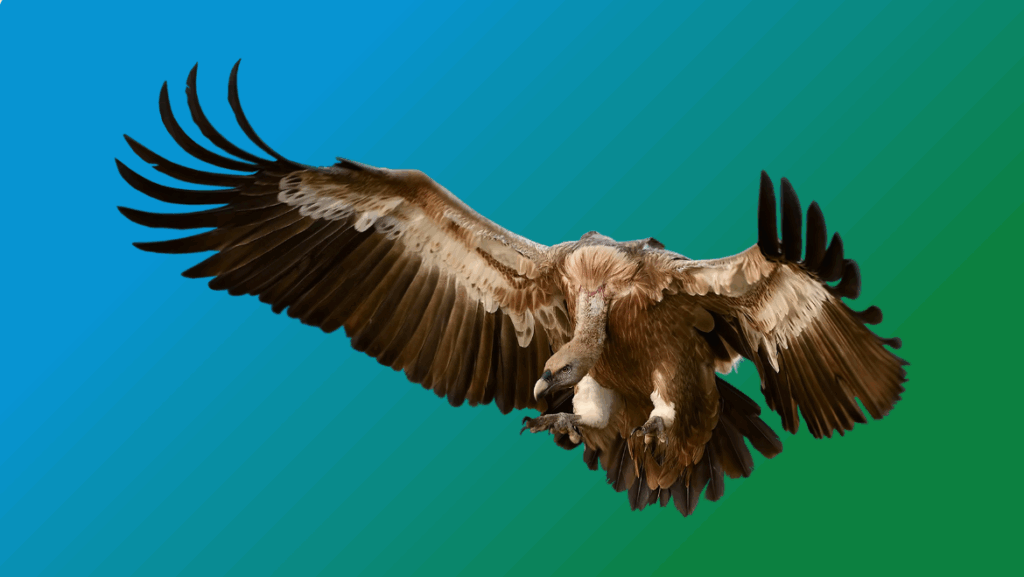
Embrace the Vulture power animal as protector and guide, and let his symbolism of cleansing, rebirth and resilience shape your spiritual journey. He will not make the ending gentler. He will make it honest — and honest endings are the only ones that compost into something new.
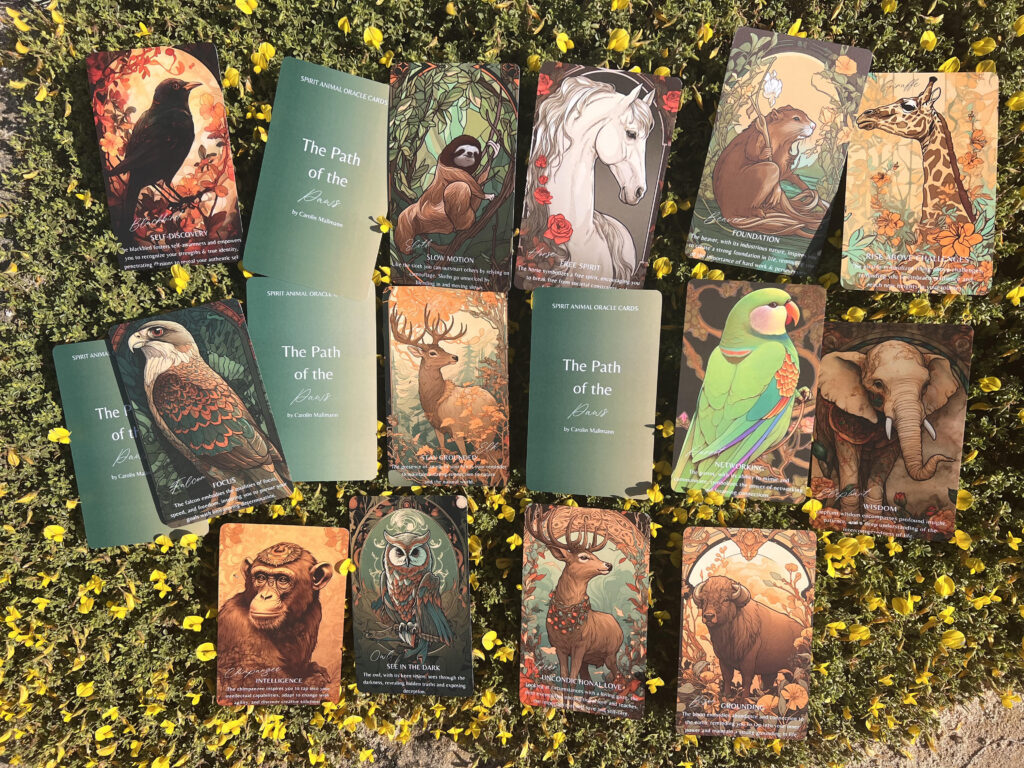
The Path of the Paws 🐾 Oracle Cards
The connection with animals has always been a deep, human ability. It guides us on our individual path – to our inner identity and to a fulfilling life.
“The Path of the Paws” is a unique oracle card deck that invites you on a journey of self-discovery and spiritual connection to your power animals.
Discover 42 beautifully designed Oracle Cards
About the Author — Carolin Mallmann
I am Carolin Mallmann, founder of One Shamanism and author of The Path of the Paws. For over two decades I have worked with people as a coach, certified NLP practitioner and shamanic practitioner, guiding thousands of one-to-one sessions and training students internationally in shamanic journeying, spirit animal work and shadow integration. Everything I write here comes from lived practice — my own journeys, my teachers, and the real experiences of the clients I sit with. I do not promise miracles, and shamanic work is not a substitute for medical or psychological treatment. What I can offer is an honest, grounded path through your own endings. Read more about my background and practice here.