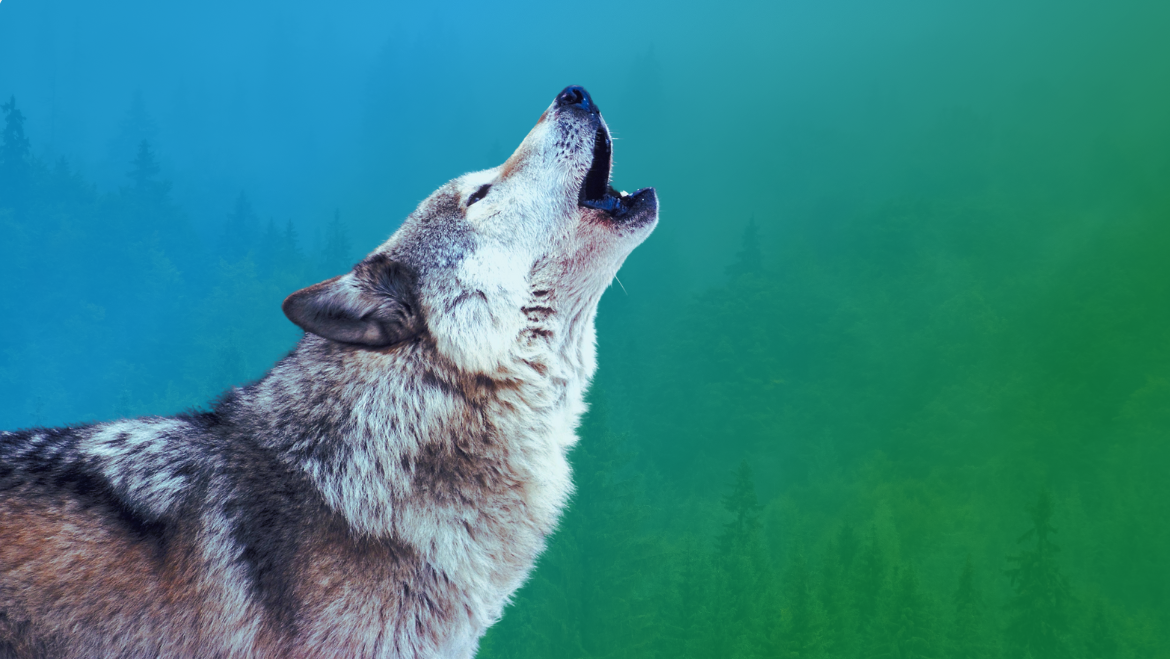
The wolf spirit animal is a guide of instinct, deep loyalty, and inner freedom. In shamanic traditions, a spirit animal (or power animal) is a compassionate helping spirit that takes an animal form to protect, teach, and lend you its strength. When Wolf comes to you, it usually asks you to trust your instincts again, to honour your bonds, and to remember that you are both a devoted member of a pack and a free, wild being who knows the way.
If you keep meeting Wolf — in journeys, dreams, on trails, or in that quiet sense of being watched over — you are being invited into a very old relationship. This guide walks through what the wolf spirit animal means, the symbolism it carries across cultures, the messages it tends to bring, and how to work with it respectfully.
In short: The wolf spirit animal symbolises instinct, loyalty, intelligence, protection, and freedom. As a guide, Wolf teaches you to trust your inner knowing, value your closest relationships, and move through life with both discipline and wildness. Its message is often: stop overthinking and trust what you already sense.
What does the wolf spirit animal mean?
The wolf spirit animal means trusting your instincts while staying loyal to your community. Wolf is a teacher of the balance between the individual and the pack — how to be fiercely yourself and deeply connected at the same time.
In shamanism, animals are not symbols we invent; they are met. When practitioners speak of a “power animal,” they mean a spirit ally encountered in non-ordinary reality that carries specific medicine. The wolf’s medicine centres on sharp perception, endurance, and the intelligence of the group. Wolves survive because they read their world accurately and cooperate. That is exactly what Wolf tends to awaken in the people it walks with.
Wolf rarely shows up to flatter you. More often it arrives when you have been ignoring what you already know — a truth about a relationship, a direction, a boundary. Its presence is a nudge back toward your own instinct.
What does the wolf symbolise?
The wolf symbolises instinct, loyalty, freedom, and the wisdom of the wild. Across many cultures it stands at the meeting point of danger and guidance, teacher and protector. Here are the core qualities Wolf carries:
- Instinct and intuition — Wolf reads what the mind cannot yet name.
- Loyalty and family — Wolves live and thrive in packs; Wolf honours the bonds that hold you.
- Freedom and wildness — the courage to walk your own path.
- Leadership and cooperation — Wolves lead through relationship, not just dominance.
- Protection — Wolf guards the edges as a fierce, watchful guardian.
- Communication — through howls, body language, and scent, wolves are masterful communicators.
- The teacher archetype — in several Indigenous North American traditions, the wolf is honoured as a pathfinder and teacher.
Wolf symbolism at a glance
| Aspect | Symbolic meaning | Message when it appears |
|---|---|---|
| Instinct | Embodied inner knowing | Trust your gut over the noise |
| Loyalty | Devotion to the pack | Tend to your closest bonds |
| Freedom | The wild, self-directed self | Reclaim your own path |
| Leadership | Guiding through relationship | Step up, but stay connected |
| Protection | Guardian of boundaries | Defend your energy and space |
| Shadow | Fear, aggression, isolation | Face what you have been avoiding |
What are the messages of the wolf spirit animal?
The wolf spirit animal’s central message is: trust what you already sense. When Wolf appears, it is usually asking you to stop second-guessing your instincts and act on your inner knowing. Wolf tends to carry a few recurring messages:
- Trust your instincts. You already know the answer.
- Return to your pack. Reconnect with the people who are your true kin — or find them.
- Protect your boundaries. It may be time to say a clear no and guard your energy.
- Reclaim your freedom. If you have shrunk yourself to fit, Wolf calls you back to your wild, honest nature.
- Face the shadow. Wolf can surface fear, anger, or a pattern of isolating yourself, and help you meet it directly.
Not every Wolf visit is gentle. The medicine sometimes arrives as a challenge — but always in service of your wholeness.
Wolf symbolism across cultures
Wolf has been honoured, feared, and mythologised for millennia, and the meanings vary widely by culture. It is worth holding this diversity with respect rather than flattening it.
- Indigenous North American traditions: many Nations regard the wolf as a teacher, pathfinder, and relative. Specific meanings differ from Nation to Nation and belong to those communities.
- Norse mythology: wolves are dual — Fenrir embodies untamed force, while Geri and Freki, Odin’s wolves, are loyal companions.
- Roman myth: the she-wolf who nurses Romulus and Remus makes Wolf a symbol of protection and survival.
- Celtic lore: wolves are associated with the wild, the moon, and guardianship of the forest.
- Mongolian and Turkic traditions: the wolf appears as a revered ancestor and emblem of strength.
The scholar of religion Mircea Eliade documented how, across many cultures, animals serve as guides and mediators between the human and spirit worlds — a pattern the wolf fits closely. This cross-cultural respect is central to how we practise at One Shamanism.
What does it mean to dream of a wolf?
Dreaming of a wolf usually points to instinct, a relationship, or a fear that is asking for attention. The dream’s tone matters more than the wolf itself. A calm or friendly wolf often reflects trust in your instincts; a threatening or chasing wolf can mirror a fear you are avoiding; a lone wolf may speak to independence or isolation; a pack of wolves frequently relates to community and belonging. Dreams are personal — the most reliable interpretation comes from asking how the wolf made you feel and what in your waking life echoes that feeling.
A personal note from Carolin
The first time Wolf came to me clearly was during a shamanic journey years ago, at a point when I was overriding my own instincts to keep everyone else comfortable. I dropped into the lower world expecting a soft, reassuring guide. Instead a large grey wolf met me at the entrance, sat down squarely in my path, and simply held my gaze until I stopped performing and got honest.
It did not speak in words. It communicated the way wolves do — through presence and unmistakable directness. What I understood was this: You already know. Stop abandoning yourself. In the weeks that followed, I ended a working relationship I had been tolerating for far too long. Nothing dramatic happened in the journey, but Wolf’s steadiness gave me permission to trust the knowing I had been burying. I share this not as proof of anything, but because Wolf so often works exactly this way — with a quiet, grounding insistence that you come home to yourself.
How to connect with your wolf spirit animal
You connect with the wolf spirit animal through respectful intention, shamanic journeying, and paying attention in daily life. You do not summon Wolf so much as make yourself available to it. Some grounded ways to begin:
- Set a clear, humble intention — ask to meet Wolf for guidance, without scripting the outcome.
- Journey with a drum. In a shamanic journey, travel to the lower world and invite Wolf to meet you. If you are new to this, our guide on how to do a shamanic journey walks you through it step by step.
- Notice waking signs — repeated encounters in dreams, images, or unexpected places are worth honouring.
- Give back. Relationship is reciprocal: learn about wolves, support their conservation, spend time in wild places.
- Keep a journal — patterns emerge over time that a single session can’t reveal.
If you are not yet sure which animal walks with you, start with our guide on how to find your spirit animal, and explore the wider Spirit Animals A–Z to see how different allies carry different medicine. It also helps to understand the difference between a spirit animal, power animal and totem, since these terms are often confused.
Frequently asked questions
The wolf spirit animal means trusting your instincts, honouring your closest bonds, and reclaiming your freedom. As a guide, Wolf represents intuition, loyalty, protection, and the wisdom of the wild, and often appears when you have been ignoring what you already know.
A wolf spirit animal is neither simply good nor bad — it is a teacher. Wolf brings supportive gifts like loyalty and sharp instinct, but it may also confront you with fear, anger, or isolation so you can heal them. Its intention is always your wholeness.
When a wolf appears repeatedly — in dreams, journeys, or the physical world — it often signals a call to trust your intuition, protect your boundaries, or reconnect with your community. Notice how the encounter made you feel, as that points to the message.
Yes. In shamanism, a power animal is a spirit ally met in journeying that lends you its strength. If Wolf consistently shows up for you and you feel a genuine bond, it may well be one of your power animals. A power animal retrieval with a practitioner can help you confirm and deepen the connection.
The lone wolf symbolises independence, self-reliance, and walking your own path, while the pack wolf symbolises loyalty, cooperation, and belonging. Wolf medicine holds both — the invitation is to be fully yourself and deeply connected.
Look for a consistent pattern: recurring encounters, a strong emotional pull toward wolves, and a felt sense of recognition. Shamanic journeying is the clearest way to meet and confirm a spirit animal, ideally with guidance if you are new to the practice.
A gentle note: shamanic work supports emotional and spiritual wellbeing and is meant to complement — never replace — medical or psychological care. If you are struggling, please also reach out to a qualified professional.