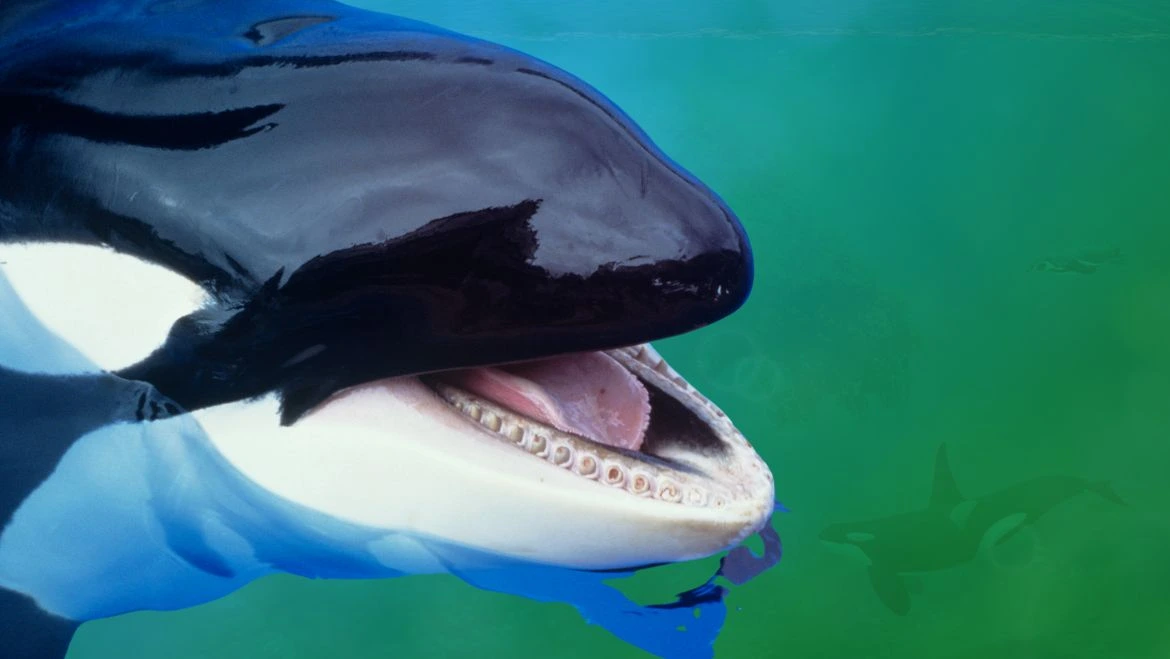
The orca does not surface gently. In journeys, people report it the way you would report a building moving underneath you — a shape passing beneath, enormous, deliberate, entirely aware of you long before you were aware of it. And then the sound. Almost everyone mentions the sound. Not a call to them; a call to someone else, somewhere out in the dark water. You are never the only one in the room with an orca. You are simply the only one who cannot hear the rest of the family.
If you have come here for facts about killer whale biology, you are in the wrong place. This is about the orca spiritual meaning — what it means when this animal keeps arriving in your dreams, your journeys, or in the place where an image goes when it is trying to tell you something about your own family.
In my practice, the orca does not arrive for people who are lonely. It arrives for people who are held — by a family, a role, a loyalty — and cannot tell any more whether they are being carried by it or contained by it. That is a much harder question than loneliness, and it is the question this animal exists to ask.
The Bridge: What the Real Animal Teaches About Orca Spirit Animal Meaning
Nothing in orca symbolism needs to be invented. Everything this animal means is already visible in how it actually lives — and the real biology is stranger and more demanding than the leadership-poster version of it.
- It is one of the only animals that goes through menopause — and then keeps leading. Female orcas stop reproducing decades before they die. Those elder females become the pod’s navigators, and in lean years the pod follows them to the salmon, because they are the only ones who remember where the fish were thirty years ago. The orca is living proof that the value of an elder has nothing to do with productivity. She is not kept because she is useful. She is followed because she remembers.
- The sons never leave. In resident pods, male orcas stay with their mothers for their entire lives. This is not sentiment — it is measurable: when an older mother dies, her adult son’s chance of dying in the following year rises sharply. He is not merely attached to her. He is structurally dependent on her. Sit with that if the orca has come to you and you know, somewhere, that you have never actually left home.
- Each family speaks its own dialect. Orca pods have distinct vocal repertoires passed down through generations, and different populations — fish-eaters and mammal-hunters sharing the same water — do not mix, do not interbreed, and do not speak the same way. Culture, not biology, is what divides them. Every family invents a private language and then mistakes it for reality. Yours did too.
- It has no predator — and no need to prove it. The orca is the apex of the ocean. Nothing hunts it. And an animal with nothing to fear does not display, does not threaten, and does not hurry. Real power is quiet because it has never had to argue.
- Its dorsal fin collapses in captivity. In the wild the tall fin stands; in a tank, in most captive males, it folds over. It is the most literal image of spiritual damage I know of in the animal world: the magnificence does not disappear, it just stops standing up. If you have been brilliant in a container too small for you for too long, the orca knows exactly what that has cost your posture.
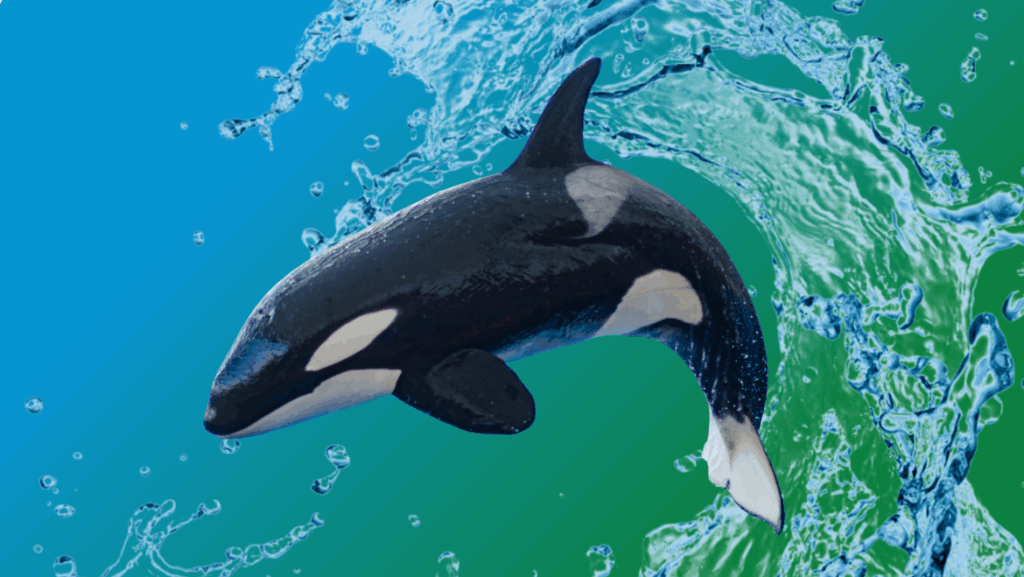
Orca Symbolism Across Traditions
The Northwest Coast: the chief beneath the water
Among the nations of the Pacific Northwest Coast — the Haida, the Tlingit, the Kwakwaka’wakw and their neighbours — the killer whale is one of the great crest beings, appearing on poles, on house fronts, and in the lineage crests of specific clans. These are living traditions belonging to living peoples, and I write about them as an outsider who was taught to approach them carefully. What I can say is that the recurring thread across the region is kinship: the orca is not a monster of the deep but a relative, a chief of an ordered society under the water that mirrors the ordered society above it. In some accounts, orcas are connected with the people who have gone before. The animal is a bridge between the living family and the ancestral one — and that is precisely the register it works in when it arrives in a journey.
Māori: the guardian who is not tame
In Māori tradition the orca is regarded as a guardian presence in the water — a being of protective power that is respected rather than romanticised. The distinction matters and it runs through every serious tradition that has met this animal: a guardian is not a pet. The thing that protects you is, by definition, capable of the force it is protecting you from.
The name itself
“Killer whale” is an inversion of what whalers originally called it: whale killer — the animal that hunts whales. Somewhere in the translation, the description of what it does became a description of what it is. I mention this because it happens to people too, constantly, and orca medicine is unusually alert to it. You were once described by something you did. Then the description became your name. Then you started answering to it.
The Shadow: When the Pod Becomes a Cage
The orca’s gifts — loyalty, memory, family, matriarchal authority — are the same traits that produce its shadow. There is no separating them, and any article that offers you the loyalty without the cost is selling you something.
- The son who never left. This is the pattern I encounter most often when this animal appears. A person of enormous capability whose entire life is still organised around a parent’s approval, a family’s expectations, or a role assigned to them at eleven years old. In orca terms this is not dysfunction — it is the species norm. That is exactly why it is so hard to see. It does not feel like a problem. It feels like love.
- The matriarch who cannot stop navigating. The elder who has become indispensable, and who has quietly arranged things so that she remains indispensable. Real elder power hands over the route. The shadow of it keeps the map.
- The dialect that excludes. Pods that share the same water do not speak to each other. In human terms: the family, team or circle whose closeness is maintained by a shared way of speaking that quietly makes outsiders wrong. Loyalty is a virtue. It is also the most respectable form of contempt.
- Grief carried past its season. Orcas have been observed carrying their dead — a mother staying with a calf that will not revive, for days, across hundreds of miles. It is one of the most affecting things in the natural world and it is also, in a person, one of the most dangerous. The orca will not tell you to stop grieving. It will ask you whether you are still swimming.
An orca that appears circling a boat you are in is not usually a threat image; in my experience it points to a force in the person’s own life — often a family loyalty — that is close, powerful, and has not been named. An orca stranded or in a tank is the collapsed-fin dream, and it is about your own greatness in a container that is too small. And an orca calling and receiving no answer speaks to the loneliest thing this animal can express: belonging to a family whose language you no longer speak.
How to Journey to the Orca
Shamanic work is not a substitute for medical or psychological care, and family-pattern work in particular can move more than you expect. If you are new to this, begin with the beginner’s guide to shamanic journeying. Allow thirty undisturbed minutes.
- Set an intention the orca can answer. Not “show me my purpose.” Rather: “Show me which of my loyalties is still mine.”
- Enter through cold, deep, open water. Not a warm sea. Grey, moving, with no floor visible. The orca does not appear in shallows.
- Listen before you look. This is the instruction that decides the journey. The orca is heard before it is seen, and people who strain their eyes usually meet nothing. Let the sound arrive first.
- Count how many there are. One orca and a pod are two completely different messages. A solitary orca almost always concerns your own separateness; a pod concerns the family system you are inside.
- Notice who is leading. If an older female is at the front, follow her and pay attention to where she takes you. She is not showing you a place. She is showing you a memory.
- Ask one question before you surface: “Whose voice am I still swimming toward?”
The Integration Ritual: Leaving Without Betraying
Orca work is family work, and family work is done in small, exact moves — never in a dramatic exit. Within a week:
- Name the family dialect. Write down three sentences your family says that everyone accepts as simply true. Then ask, for each one: is that true, or is it just ours?
- Identify the loyalty you never chose. There is usually one — a role you were given before you could speak. Say what it is out loud. Naming it is not disloyalty; keeping it unnamed is what makes it a cage.
- Make one decision without consulting the pod. Small. Genuinely small. The size is irrelevant; the fact that no one was asked is the whole point.
- Then call home anyway. This is what separates orca medicine from mere rebellion. The orca does not leave the pod to become itself. It becomes itself inside the pod — and that is far more difficult and far more mature than cutting the line.
- Ask an elder what they remember. Not for advice — for memory. Orca medicine says the old ones are followed for what they have seen, not for what they can still do. Give someone that dignity this week.
If the pod dynamic is what draws you here, it is worth reading the orca against the wolf spirit animal — the same problem of belonging, solved on land, by a very different animal.
The Path of the Paws
42 hand-illustrated oracle cards, one for each animal guide — drawn from the same practice these articles come from. A way to sit with an animal instead of only reading about it.
Order your deck →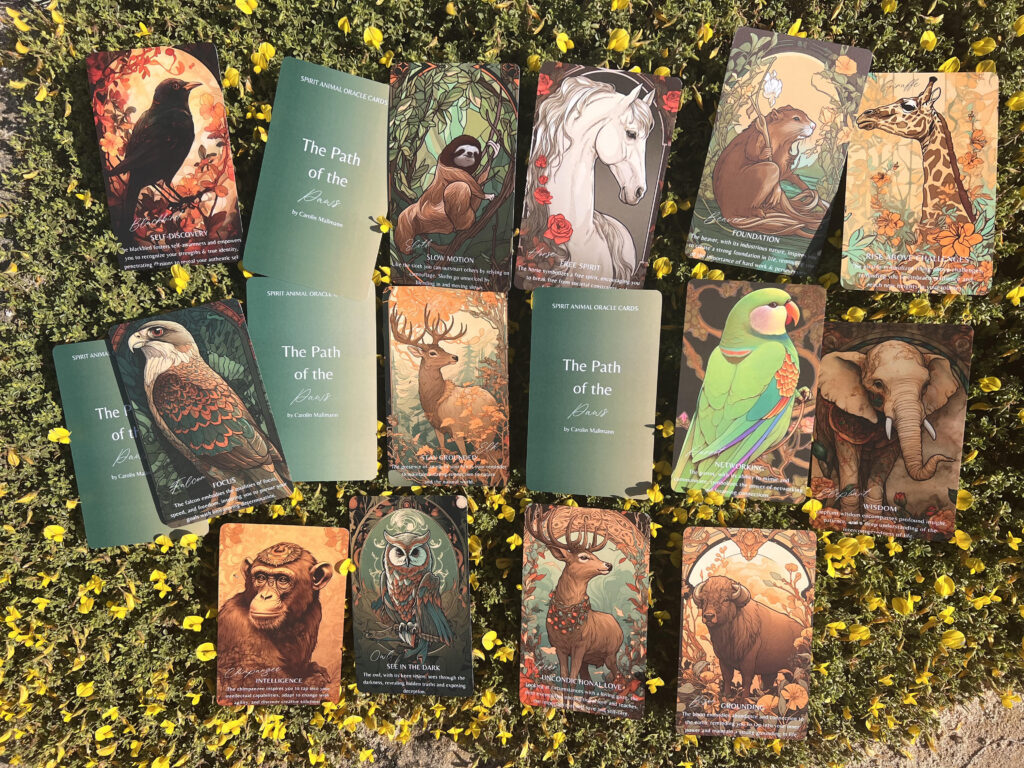
Orca Spirit Animal: Questions People Actually Ask
What does it mean when an orca appears in your life?
It nearly always concerns family — the one you were born into, or the one you have built. The orca arrives when a bond needs to be examined rather than simply honoured. Ask which relationship in your life you have been describing as unconditional when it is, in fact, extremely conditional — and who set those conditions.
Is the orca a good or bad omen?
It is a powerful one, and power is not an omen — it is a condition. Across the traditions that know this animal best it is honoured, related to, and treated with great care. Nothing about it is casual. If the orca has come, something significant is being decided; it is not telling you the outcome, it is telling you that this is not a small matter.
What does an orca in a dream mean?
Read the water and the company. An orca beneath you in deep water points to something in your emotional life that is large, close, and not yet visible — and that is generally not a warning, but a summons to look. An orca leaping in front of you is an invitation to be seen at full size. An orca alone, far from any pod, is usually about you.
Why is the orca connected to leadership?
Because its leadership is the kind almost no human institution rewards: an elder female who no longer produces anything, leading because she holds the memory of where the food was in the hardest year anyone can recall. That is orca leadership — not charisma, not force, but remembered route. It is worth asking who plays that role in your life, and whether you have ever thanked them.
Can the orca be my totem if I live far from the sea?
Yes. Spirit animals are not distributed by geography — what matters is persistence, whether the image keeps returning without your invitation. If you want a structured way to test the connection rather than guess, work through the A–Z spirit animal guide or sit with the Path of the Paws oracle deck.
The orca does not arrive to tell you to leave your family. It arrives to ask whether you have ever once spoken in your own voice while inside it.