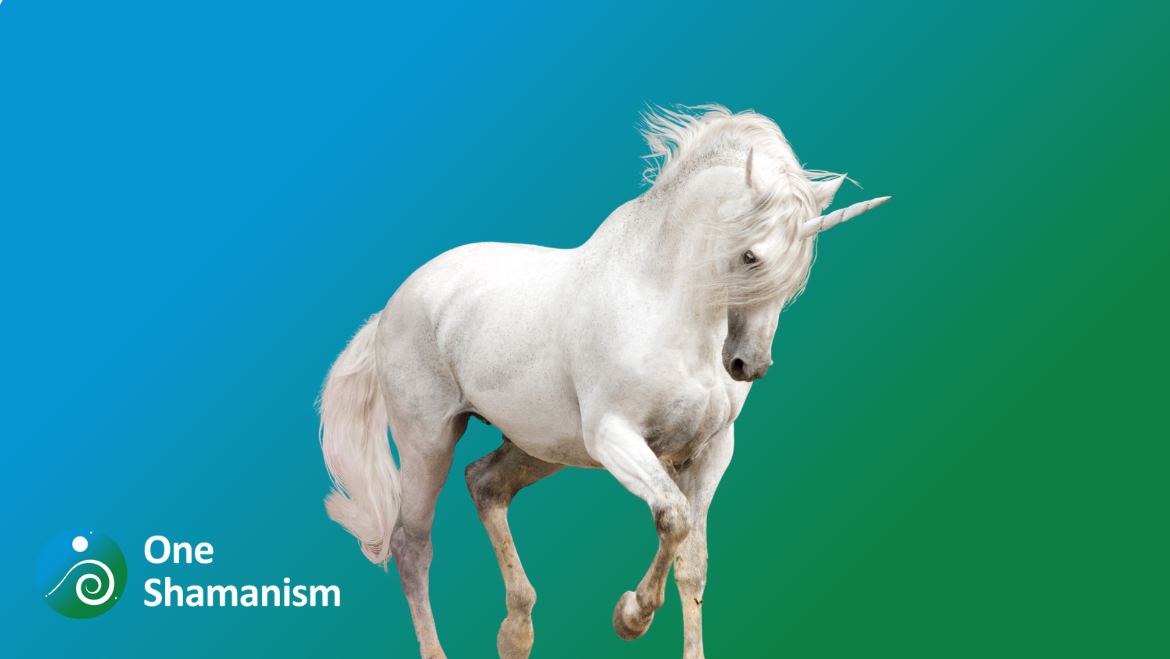
There is a particular hush that arrives when the unicorn steps into a journey. It does not gallop in like a horse or circle like a wolf. It waits at the treeline, and the quality of the light changes — everything goes clean and quiet, and something in the chest that had been held hard and careful begins, almost against your will, to soften. That softening is the whole encounter, and most people are surprised by how much it costs them.
This is about the unicorn spiritual meaning — what it means when this creature keeps returning in your dreams, your journeys, the art you are drawn to, or in that stubborn way an image comes back when it wants something from you. If you arrived looking for a sparkle aesthetic, this is the wrong page. In my practice the unicorn does not come for people who are naive. It comes for the ones who have gone hard — who learned somewhere that wonder is dangerous and hope is embarrassing, and who built a careful cynicism to stay safe. The unicorn is what survived of the part of them that refused to sign that contract.
The Bridge: What the Unicorn Legend Says About Its Meaning
A mythical animal has no biology to anchor it, so its medicine lives in the shape of the legend itself — and the legend is remarkably consistent about three things.
- The horn heals what was poisoned. For centuries the alicorn, the unicorn’s single horn, was believed to purify tainted water and neutralise poison; apothecaries sold ground narwhal tusk as the genuine article. Read as medicine, this is the unicorn’s core gift: the capacity to make what had become toxic drinkable again — to detoxify a situation, a memory, a belief about yourself, rather than simply run from it.
- It cannot be taken by force. In every version of the hunt the unicorn outruns every hound and spear, and can only be approached when someone sits still and waits. The teaching is exact: some things in you will never come out while you are hunting them. Wonder, tenderness, faith — they arrive only when you stop chasing.
- One horn, one point. The single horn is a symbol of integrity in the old sense: undivided, one-pointed, aimed. Unicorn medicine asks whether your life still points at one thing, or whether it has quietly split into many directions that cancel one another out.
Unicorn Symbolism Across Traditions
Medieval Europe: the hunt and the healing horn
The richest material is the set of late-medieval tapestries known as the Hunt of the Unicorn, in which the animal is pursued, captured, and — in the final panel — shown alive again, resting inside a low fenced garden. Christian readers took the unicorn as an image of Christ and the incarnation: the wild and untouchable made gentle in the presence of a maiden. Whatever your beliefs, the pattern is worth keeping. The unicorn appears at the exact seam between the untamed and the sacred, and it is usually captured only to be reborn.
The classical world: when the unicorn was real
The West did not treat the unicorn as a fantasy for most of its history. The Greek writer Ctesias, in the fifth century BCE, described a one-horned wild animal of India whose horn, ground to powder, protected against poison. Medieval and Renaissance Europe believed the creature was real, if rare, which is why the alicorn commanded fortunes. The unicorn is the animal the rational world was certain existed and then slowly decided to stop believing in — and something in that arc is its medicine, too.
East Asia: the qilin, a different creature
The being often translated into English as the Chinese unicorn is properly the qilin — a gentle, chimeric animal that will not tread on a blade of living grass and appears, in the old accounts, at the birth or death of a sage. It is not the European unicorn and should not be flattened into it. What the two share is the role of a herald: a creature whose arrival means something significant is beginning or ending.
Heraldry: the chained unicorn
In Scottish heraldry the unicorn is the national animal, and it is almost always drawn chained. A wild, untamable thing, bound and put on display — the emblem holds both the freedom and the captivity in one image. It is the sharpest warning in the whole tradition, and we will come back to it in the shadow.
The Shadow: When Purity Becomes a Cage
The unicorn has a shadow precisely because its gift is so bright, and in my experience it is one of the most quietly punishing to carry.
- Purity as perfectionism. The gift of seeing the good can curdle into a refusal to touch anything flawed — a life kept so clean it is never actually lived. Spiritual bypassing is unicorn shadow: using the light to avoid the dark instead of to see it.
- The fleeing unicorn. When the animal keeps running away in dreams, the reading I use most often is that the dreamer is chasing their own innocence with a net. Wonder cannot be seized. The harder you hunt it, the faster it goes.
- The chained unicorn. The heraldic image made personal: a genuinely magical person whose wildness has been domesticated into performance — the gifted one who now does wonder on demand, for an audience, for approval. The horn is still there; the freedom is gone.
- Weaponised positivity. Everything is magic becomes a way to avoid grief, anger, and the ordinary labour of repair. A unicorn that is only ever allowed to be pretty has stopped being real.
A unicorn that appears wounded, caged, or with a broken horn in a recurring dream is rarely a bad omen in the superstitious sense. It usually points to exactly this: a capacity for wonder that has been injured, sold, or shut away — and is asking to be let back out.
How to Journey to the Unicorn
Shamanic work is not a substitute for medical or psychological care. If you are new to this, begin with the beginner’s guide to shamanic journeying before attempting the practice below.
- Name what has gone hard in you. Not a wish — a location. Say it plainly: the part of me that stopped believing anything good is this. The unicorn responds to honesty, not to performance.
- Journey to an edge, not a centre. A clearing at the border of a wood, a garden with a gate. The unicorn lives at the seam between the tame and the wild, and it rarely meets you in the open middle of a landscape.
- Do not pursue. This is the instruction people ignore and the one that decides the journey. Arrive, state your intention once, and be still. The unicorn comes to stillness and vanishes from grasping.
- Let it approach, and read the horn. Whole and bright, dull, or broken? The condition of the horn is usually the message — whether your capacity to heal and to wonder is intact, tired, or wounded.
- Ask it to touch the poisoned water. If there is a situation or a memory that has gone toxic, bring it. Watch what the horn does with it. Do not narrate; simply record.
- Ask one question on the way out: what did I decide was too dangerous to hope for?
- Write everything down before you speak to anyone.
Affirmations for Unicorn Medicine
- “I am allowed to keep my sense of wonder in a world that calls it naive.”
- “What was poisoned in me can be made drinkable again.”
- “I stop hunting my own tenderness and let it approach.”
Is the Unicorn Your Spirit Animal?
Check the boxes that resonate with your spirit and current life journey.
Unicorn Spirit Animal: Questions People Actually Ask
What does it mean when you keep seeing unicorns?
Repeated unicorns — in dreams, in images, in journeys — are usually less about the future and more about a faculty you have been neglecting. In practice the unicorn returns when someone has been running on cynicism and competence and has let wonder, faith, or play go quiet. It is asking to be readmitted. Treat it as an invitation to protect your own innocence, not as proof that you are magical and exempt from ordinary work.
Is the unicorn a real spirit animal?
Yes. Spirit animals are not restricted to creatures you could photograph — mythical guides like the unicorn, the dragon and the phoenix carry medicine precisely because they are made of story rather than biology. What matters is not whether the animal exists in a field but whether the image keeps returning to you uninvited. If it does, work with it. For a structured way to test the connection, the A–Z spirit animal guide and the Path of the Paws oracle deck are good places to begin.
What does a unicorn in a dream mean?
Read the horn and the distance. A unicorn that lets you near, or lowers its horn toward you, is speaking about healing and trust becoming available again. A unicorn that flees is usually your own wonder, pursued too hard. A wounded or caged unicorn points to a gift for hope that has been hurt or hidden. Dreams of unicorns tend to arrive at the end of a hard, cynical season, right as something in you is ready to soften.
What is the difference between the unicorn and Pegasus?
They are often confused but carry different medicine. Pegasus, the winged horse, is about flight, inspiration and rising above; its story is explored in the Pegasus spirit animal guide. The unicorn does not fly. It stays on the ground and heals what is here — its power is purity and restoration rather than ascent. If your guide has wings, it is Pegasus. If it has a single horn and will not be caught, it is the unicorn.
The unicorn does not arrive to turn your life into a fairy tale. It arrives to give back the one thing the world talked you out of — the nerve to hope on purpose.