

Spiritual growth is defined as the progressive transformation of a person’s inner life, awareness, and character toward deeper compassion, purpose, and connection with a reality beyond the self. This process is lifelong and multifaceted by nature, touching every dimension of who you are. It shows up in how you treat others, how you handle difficulty, and how clearly you see yourself. Spiritual growth is not exclusive to religious practice. It applies equally to secular seekers, psychological explorers, and those drawn to ancient traditions like shamanic practice.
What is spiritual growth, and how do you recognize it?
Spiritual growth is the ongoing development of your inner life in ways that change how you think, feel, and act. The standard term across psychology and theology for this process is spiritual development, and the two phrases describe the same arc of change. You recognize it not by dramatic revelations but by subtle, steady shifts: more patience under pressure, less need to control outcomes, and a growing ability to sit with uncertainty.
Spiritual growth manifests outwardly in behavior and maturity, not just in private belief or feeling. That distinction matters. A person can hold deep spiritual convictions and still act from fear, ego, or habit. Real development closes the gap between what you believe and how you live.

The signs of spiritual awakening are often quieter than people expect. You may notice that old grievances lose their grip. You may find yourself genuinely curious about people who think differently from you. You may feel a pull toward stillness rather than distraction. These are not dramatic conversions. They are the ordinary evidence of growth working beneath the surface.
What key practices cultivate spiritual growth sustainably?
Sustainable spiritual development depends on small, consistent habits rather than periodic intensity. Starting with 5–10 minutes of daily mindfulness, journaling, or a walk in nature builds the neural and emotional foundation that larger practices require. Large lifestyle overhauls risk collapse within weeks. The nervous system needs repetition, not revolution.
Four core dimensions structure effective practice:
- Self-awareness — Regular reflection through journaling or meditation surfaces the unconscious patterns driving your reactions. Without this, growth stays theoretical.
- Purpose alignment — Clarifying what you value and why you act gives your practice direction. Aimless spirituality tends to drift into performance.
- Mindfulness — Present-moment attention trains you to respond rather than react. Even brief daily practice reshapes how you engage with stress and relationship.
- Integration — Bringing insights from practice into ordinary decisions closes the loop. Spiritual integration is recursive: grounding expands compassion, which fuels inquiry, which deepens clarity, which deepens integration again.
Pro Tip: Start with one practice, not four. Choose the dimension that feels most neglected and commit to it for 30 days before adding anything else. Breadth without depth produces spiritual restlessness, not growth.
Avoiding common pitfalls matters as much as choosing good practices. The most frequent mistake is forcing spiritual growth through sheer willpower. Authentic development emerges through being rather than relentless doing. When practice becomes another performance metric, it stops being spiritual and starts being ego management.
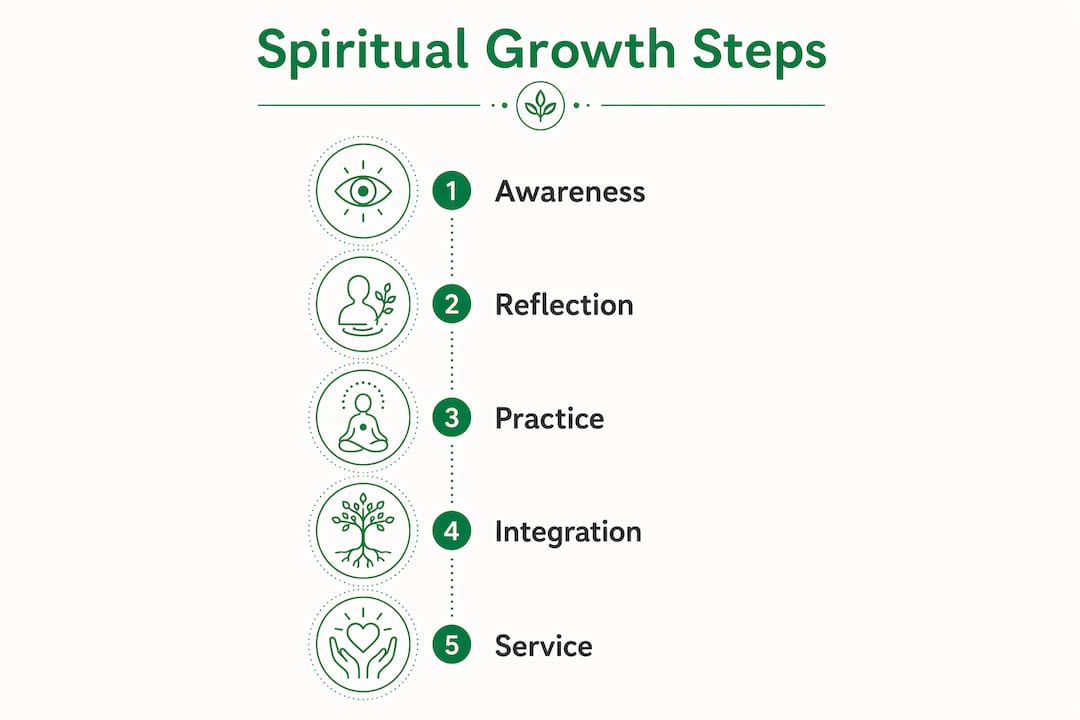
Pro Tip: If your spiritual practice makes you feel worse about yourself most of the time, the problem is not you. The problem is the approach. Shift from self-improvement framing to self-understanding framing and watch the resistance ease.
You can also find practical daily challenges through resources like 24 tiny spiritual challenges that build momentum without demanding a complete life overhaul.
How do definitions of spiritual growth vary across traditions?
The spiritual growth meaning shifts significantly depending on the tradition or framework you bring to it. Each perspective offers something the others lack.
- Christian spirituality frames growth as sanctification, the cooperative process of reflecting Christ’s character through faith, grace, and human effort working together. Growth here is not about earning favor. It is about deepening intimacy with the divine and letting that intimacy reshape behavior.
- Broader spiritual perspectives emphasize expanding awareness beyond the ego. Growth is realization rather than achievement. The self is not climbing toward something it lacks. It is recognizing a unity with a greater reality that was always present.
- Psychological frameworks, particularly those influenced by Carl Jung, treat spiritual growth as the integration of unconscious material into conscious life. The intersection of psychology and ancient wisdom shows that shadow work, myth, and ritual serve the same integrative function across cultures.
- Shamanic traditions approach development through direct relationship with nature, spirit, and the unseen dimensions of reality. Practices like shamanic journeying cultivate a quality of attention that most modern frameworks rarely address: the ability to receive guidance rather than generate it.
What these traditions share is more significant than what divides them. All recognize that growth requires moving beyond the ego’s default operating mode. All treat discomfort as a teacher rather than a problem to solve. All point toward a self that is larger, more connected, and more at peace than the one you started with.
What are common misconceptions about spiritual growth?
The most damaging misconception is that spiritual growth produces a problem-free life. Growth increases your capacity to hold complexity, grief, and ambiguity with peace. It does not eliminate those experiences. A person who has grown spiritually still faces loss, conflict, and uncertainty. They simply carry those experiences differently.
A second misconception confuses growth with spiritual maturity. Growth is the process. Maturity is a quality that develops through sustained engagement with that process over years, not weeks. Expecting maturity from a few months of practice is like expecting physical fitness from two weeks at the gym.
| Misconception | What growth actually involves |
|---|---|
| Growth removes problems | Growth builds capacity to hold difficulty with greater peace |
| Growth is fast if you try hard | Sustained growth requires patience and small consistent habits |
| Growth is performance-based | Authentic growth emerges through surrender, not achievement |
| Maturity equals growth | Maturity is the long-term fruit of sustained, integrated practice |
Pro Tip: When you feel like you are not growing, ask whether you are integrating rather than acquiring. Most stagnation in spiritual practice is not a lack of new input. It is unprocessed experience waiting for attention.
A third misconception treats growth as a fixed destination. Understanding spiritual development as an ongoing process rather than a goal changes everything about how you practice. You stop measuring yourself against an imagined endpoint and start noticing what is actually shifting. That shift in attention is itself a form of growth.
Shamanism’s approach to inner transformation addresses this directly, emphasizing that the step most people delay is not learning more but integrating what they already know.
How does service to others enhance spiritual growth?
Service to others is one of the most underrated accelerators of spiritual development. Teaching, serving, and supporting others creates profound personal transformation, often more effectively than solitary inward practice alone. The reason is structural: serving others forces you to move beyond your own perspective, which is exactly what spiritual growth requires.
The benefits of this outward orientation include:
- Deepened compassion — Regular contact with others’ struggles expands your emotional range and reduces self-absorption.
- Accelerated integration — Explaining or modeling what you have learned cements it in ways that private reflection rarely achieves.
- Mutual ministry — The person being served often teaches the server something irreplaceable about humility, presence, and the limits of expertise.
- Community accountability — Practicing in relationship with others creates the kind of honest feedback that solo practice cannot generate.
The balance between inward and outward practice matters. Purely inward-focused spirituality can become self-referential and insular. Purely outward service without reflection leads to burnout and resentment. The most durable growth happens at the intersection: regular inner practice that flows into genuine engagement with others.
Key Takeaways
Spiritual growth is a lifelong, recursive process that deepens through consistent small practices, honest self-awareness, and genuine engagement with others rather than through intensity, performance, or the pursuit of a problem-free life.
| Point | Details |
|---|---|
| Growth is a process, not a goal | Treat spiritual development as ongoing integration, not a fixed destination to reach. |
| Small habits outperform intensity | Start with 5–10 minutes of daily practice to build sustainable momentum without burnout. |
| Service accelerates development | Engaging with others deepens compassion and integration faster than solitary practice alone. |
| Misconceptions slow progress | Growth increases capacity to hold difficulty; it does not eliminate problems or guarantee maturity. |
| Traditions share core principles | Christian, psychological, and shamanic frameworks all point toward moving beyond ego as the engine of growth. |
What I have learned about growing slowly and staying honest
People often come to spiritual practice expecting acceleration. They want to feel more, understand more, and suffer less, and they want it soon. I understand that impulse completely. What I have found, though, is that the most significant shifts arrive quietly, usually months after the practice that caused them.
The biggest thing I have had to unlearn is the idea that effort equals progress. Spiritual growth rewards attention and honesty far more than discipline and intensity. The person who sits with one uncomfortable truth for a week often moves further than the person who completes a 30-day program without pausing to feel anything.
Patience is not passive. It is the active choice to stay present with what is actually happening rather than rushing toward what you think should be happening. Humility works the same way. The moments I have grown most were the moments I stopped pretending I had it figured out.
My honest advice: be gentler with yourself than you think is warranted. Spiritual development is not a test you pass or fail. It is a conversation you keep showing up for, and showing up is enough.
— Carolin
Shamanic practices that support your path
Shamanism offers a grounded, time-tested framework for people who want to move beyond information and into direct experience of their own inner life.
Shamanism’s community and courses, including “The Elements of Shamanism,” give you structured ways to practice shamanic journeying and connect with the deeper dimensions of your awareness. These are not abstract concepts. They are practical tools that thousands of people have used to shift how they relate to themselves, others, and the natural world. If you are ready to move from reading about growth to actually practicing it, One Shamanism’s community is a place to do that alongside others who take this work seriously.
FAQ
What is the simplest definition of spiritual growth?
Spiritual growth is the ongoing transformation of your inner life, character, and awareness toward greater compassion, purpose, and connection with a reality beyond the ego.
How long does spiritual growth take?
Spiritual growth is a lifelong process with no fixed endpoint. Noticeable shifts in awareness and behavior typically emerge from months of consistent, small daily practices rather than from short-term intensity.
What are the signs of spiritual awakening?
Signs include reduced reactivity to old triggers, greater comfort with uncertainty, increased compassion for others, and a growing sense of connection to something larger than personal concerns.
Does spiritual growth require a religious framework?
Spiritual growth does not require religious belief. Psychological, shamanic, and secular frameworks all describe the same core process of expanding awareness and moving beyond ego-driven patterns.
How does service to others support spiritual development?
Serving others deepens compassion and accelerates integration in ways that solitary practice rarely achieves, making outward engagement one of the most effective tools for genuine inner development.
Recommended
- The Step We Delay Too Long: Embracing Inner Transformation through Shamanism & NLP | One Shamanism
- Spiritual Intrusions: A Shamanic Way to Look at Bad Energy | One Shamanism
- Rise Above Fear: Find Strength in the Spiritual Realm | One Shamanism
- If Society Doesn’t Provide Shamans, Who Will? | One Shamanism