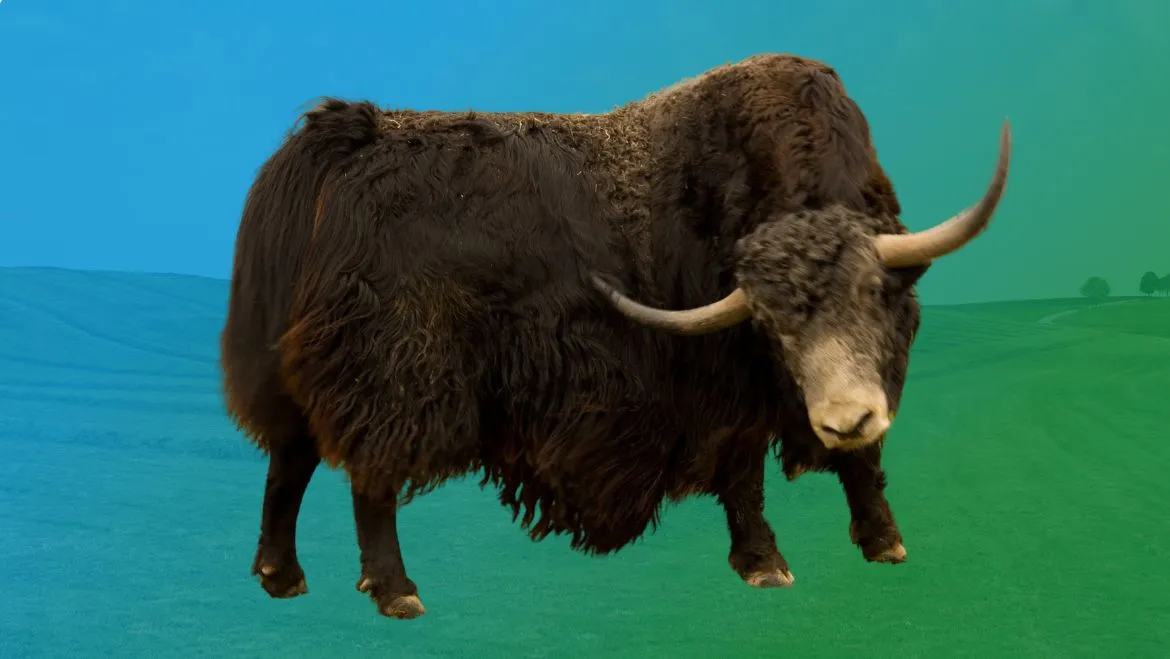
When the yak appears in a shamanic journey, the first thing most people notice is not the animal. It is the change in the ground. The landscape becomes high, thin-aired, cold — and instead of feeling threatened by it, you feel the presence of something that is completely at home there. The yak does not brace against the plateau. It belongs to it. Its breath steams, its coat moves in the wind, and it looks at you with the unhurried attention of a being that has nowhere else it needs to be.
That is the heart of this animal’s medicine. The yak spirit animal is a guide for the harsh season — financial strain, long illness, grief that will not be rushed, any stretch of life that must be endured rather than solved. It does not promise that the winter will be short. It demonstrates, with its whole body, that you are built for winters. In my practice, the yak tends to arrive for people who believe they are at the end of their strength — and its message is rarely “push harder.” It is almost always: slow down to the pace you can sustain, and stay close to your herd.
Yak Spirit Animal Meaning: The Soul of the Plateau
The yak is a creature of immense strength and quiet dignity. Its spiritual medicine is about finding the resources within and around you to not just survive, but to prosper.
- Unwavering strength and endurance: The yak is built for adversity. It is a symbol of ruggedness, perseverance, and the ability to carry heavy burdens. As a spirit animal, it encourages us to tap into our own deep reserves of strength and to face challenges with a steadfast and patient spirit.
- Community and trust: Yaks rely on their herd for survival — for warmth, for protection, for the simple fact of not facing the wind alone. This deep social bond represents the importance of community, trust, and reciprocity. The yak guide teaches that mutual support is not a weakness of the strong; it is how the strong survive.
- Contentment and simplicity: The yak finds all it needs in one of the most demanding environments on earth. It symbolizes contentment, frugality, and the joy found in life’s simple pleasures — encouraging us to find sufficiency in what we have rather than constantly reaching for more.
Why the Yak Thrives Where Others Cannot
The spiritual meaning of an animal should always be anchored in the real animal — and the yak’s biology is its message. Yaks live at altitudes of roughly 3,000 to 5,500 meters, where the air holds a fraction of the oxygen found at sea level. Their bodies are built for exactly this: larger lungs and hearts than lowland cattle, blood adapted to carry oxygen efficiently in thin air, and a dense double coat — a coarse outer layer over soft, insulating down — that lets them rest calmly in temperatures far below freezing.
Here is the detail I find most instructive: the yak struggles at low altitude. Heat and thick air are harder on it than blizzards. It is not a hardy animal in general — it is an animal made precisely for the hard place, and it suffers most when taken out of it. As medicine, this reframes the question people bring to it. The yak does not ask “how do I escape my difficult terrain?” It asks “what if I am built for this terrain — and have been trying to live at the wrong altitude?” For some people that means stopping the fantasy of an easier life elsewhere and committing to where they stand. For others it means the opposite: recognizing they have been forcing themselves to thrive in conditions they were never made for.
The Yak in Tibetan and Himalayan Tradition
In Tibetan culture, the yak is not just an animal; it is woven into the fabric of survival and of spiritual life. For the nomadic herders of the Tibetan Plateau — the drokpa — the yak has traditionally provided nearly everything: milk and butter, meat, wool for the black tents they live in, dung for fuel where no trees grow, and transport across passes no vehicle can reach. A household’s yaks were its wealth, its insurance, and its companions through winter.
The spiritual thread runs through the practical one. Butter lamps made from yak butter burn in Tibetan Buddhist monasteries as offerings of light. In parts of Tibet, the wild yak — the drong, a far larger and fiercer ancestor of the domestic animal — appears in older folk tradition as a powerful presence of the high mountains, treated with respect rather than sentimentality. And among the Sherpa people of Nepal, yak and yak-crossbreed caravans made Himalayan trade and mountaineering possible at all. When festivals honor the yak — and several do, across the Himalayan world — they are honoring a relationship: the understanding that in a landscape that offers nothing easily, survival is something animals and humans do together.
The Shadow Side of Yak Medicine
Endurance is a gift until it becomes an identity. This is where the yak’s medicine turns, and it is worth looking at directly.
Carrying can become who you are. The yak is a burden-carrier by nature — and people who carry yak medicine are usually the dependable ones, the ones everyone leans on. The shadow appears when you can no longer tell the difference between the loads that are yours and the loads you picked up because no one else would. A yak in a journey or dream that appears exhausted, over-loaded, or unable to rise is almost never about weakness. It is about inventory: something on your back does not belong to you.
Endurance can become avoidance. The capacity to withstand hard conditions can quietly become a reason never to change them. Some winters must be endured; others are simply familiar. The shadow-yak stands in the storm out of habit, long after a sheltered valley has opened nearby. If you are proud of how much you can take, it is worth asking — gently — whether the taking is still necessary.
The herd can become a wall. Loyalty to the group is yak medicine at its warmest. But when belonging requires you to shrink — when the herd’s pace, opinions, or comfort always outrank your own direction — the same instinct that protects you starts to erase you. A yak appearing alone, apart from its herd, sometimes carries exactly this question: where does the group end and you begin?
A Practice: Setting Down the Load
This is a simple grounding ritual for working with yak energy during a demanding season. It can be done as a shamanic journey or as a quiet visualization.
- Arrive on the plateau. Close your eyes and let the landscape become high, open, and cold — not hostile, just vast. Feel the ground under you as solid rock beneath thin grass.
- Let the yak come to you. Do not search. The yak moves slowly; give it time. Notice its breath, its weight, the steadiness of it.
- Name what you are carrying. One by one, place each burden — each responsibility, worry, and obligation — onto the ground between you and the animal. Say each one out loud if you can.
- Watch what the yak picks up. In this practice, the yak will often move toward certain loads and ignore others. What it takes up is what you are truly meant to carry this season. What it leaves on the ground deserves an honest conversation.
- Walk at its pace. Before returning, walk beside the yak for a while — deliberately, slowly. This is the pace you are being asked to keep. Thank the animal and come back.
Your Connection to the Yak: Questions Answered
What does it mean if the yak is my spirit animal?
If the yak is your spirit animal, you carry deep reserves of strength, loyalty, and resilience. Your path is about building a stable, meaningful life through patient work and strong relationships — being a steadfast presence for your community while finding contentment in a life of purpose rather than accumulation.
What does it mean to dream of a yak?
Yak dreams usually speak to security and endurance. A calm herd suggests harmony in your community; a solitary yak in a storm may reflect isolation, urging you to lean on your relationships. An overloaded or exhausted yak points to burdens that are not yours to carry. A yak staring directly at you often asks you to reconsider a stubborn position.
How can I embody the yak’s energy?
Practice perseverance at a sustainable pace rather than in bursts. Nurture your closest relationships with trust and reciprocity. Find genuine pleasure in simple, repeated things — warmth, food, shared quiet. And when facing a long challenge, stop asking how to end it quickly and start asking how to move through it steadily.
Is the yak a good spirit animal to have?
There are no better or worse guides — only the one your season requires. The yak is a profound companion for long hauls: rebuilding, caregiving, slow healing, patient work toward distant goals. If your life currently demands endurance more than speed, few spirit animals serve you better. Its steadiness pairs well with the related medicine of the ox spirit animal.
Is the Yak Your Spirit Animal?
Check the boxes that resonate with your spirit and current life journey.
In what area of your life is the Yak’s spirit of steadfast endurance helping you the most right now?