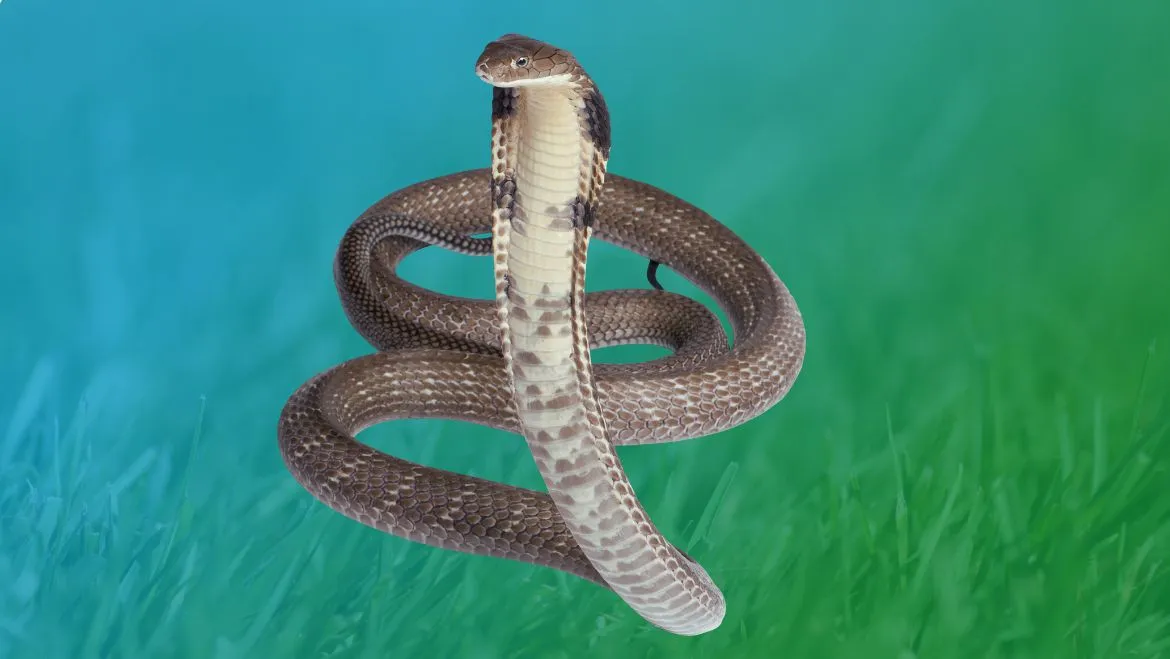
The cobra is one of the few spirit animals people are genuinely afraid to meet. In journeys it does not circle, it does not hide, it does not wait to be noticed. It rises — slowly, vertically, until it is at eye level — and then it holds. And the first instinct, almost without exception, is to back away. What people describe afterwards is the moment they realise the cobra is not threatening them. It is showing them something. The fear does not disappear at that point. It changes into something closer to recognition.
This article is about what the cobra means when it appears — in a journey, in a dream, in a run of encounters you cannot explain away. Not the snake in the grass: the one that has been rising in your inner life, and will not lower itself until you look at it.
In my practice the cobra arrives for people who have spent years managing their own intensity — who have been told, in a hundred different ways, that they are too much, and who have believed it long enough to become exhausted by the containment.
Cobra Spirit Animal: Meaning and Message
The cobra’s medicine is dignity under pressure. Not aggression, and not dominance — something rarer and harder. When a cobra is threatened it does not flee and it does not attack. It enlarges itself and waits. The entire display is a request: see what I am, and let this not be necessary.
That is what the cobra asks of the person it comes to: stop shrinking in rooms where you feel uncertain. Stop pre-emptively making yourself smaller to manage other people’s comfort. The cobra’s power is not in the bite. It is in the rising. Most cobra encounters in nature end with nobody harmed — which is precisely the point that gets lost in the mythology of the deadly snake.
From the Animal to the Meaning: Cobra Spiritual Meaning, Grounded
The hood is not armour. It is communication. There are no bones in it — it is skin stretched over elongated ribs, and it exists for one purpose: to be seen. The cobra invests its most distinctive anatomy not in killing but in warning. Everything about its rise is an attempt to resolve the encounter without venom. Sit with that if you are someone who has been called intimidating: the display is what a creature does instead of striking.
It must lift a third of its body off the ground to do it. A rearing king cobra can bring itself level with a standing adult’s face. This costs energy and it costs cover — the moment it rises, it becomes visible, exposed, unable to flee quickly. Standing at full height is a vulnerable act. Anyone who has ever finally said the true thing in a room knows exactly what that feels like.
Its venom is a modified saliva — and it is used as medicine. Cobra venom is not a separate weapon bolted onto the animal; it is a refinement of the substance that digests. And it is not only destructive: cobra venom components have been studied and used for analgesia, and antivenom is manufactured from the venom itself. The cure is made from the poison. This is not a metaphor I have imposed on the animal. It is literally how the medicine is produced.
It is deaf to the flute. The famous image of the charmed cobra is a misunderstanding — snakes hear almost nothing airborne. The cobra is not swaying to music. It is tracking the movement of the instrument. It is watching the threat. Its attention is on the thing that is actually moving, not the thing making the noise — which is as good a description of discernment as any tradition has produced.
Cobra Symbolism Across Traditions
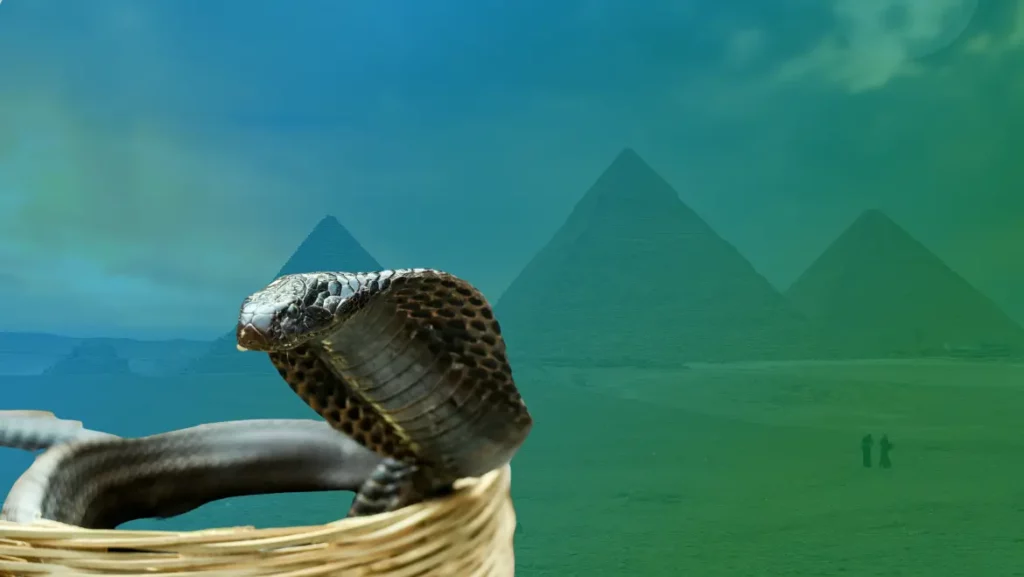
Ancient Egypt. The uraeus — the rearing cobra on the pharaoh’s brow — was not ornament. Wadjet, the cobra goddess of Lower Egypt and one of the oldest deities in the pantheon, was understood as a living protective force positioned at the forehead, facing outward, ready to spit fire at what threatened the rightful ruler. Note where she sits: at the point of vision. The cobra in Egypt is authority in its protective aspect.
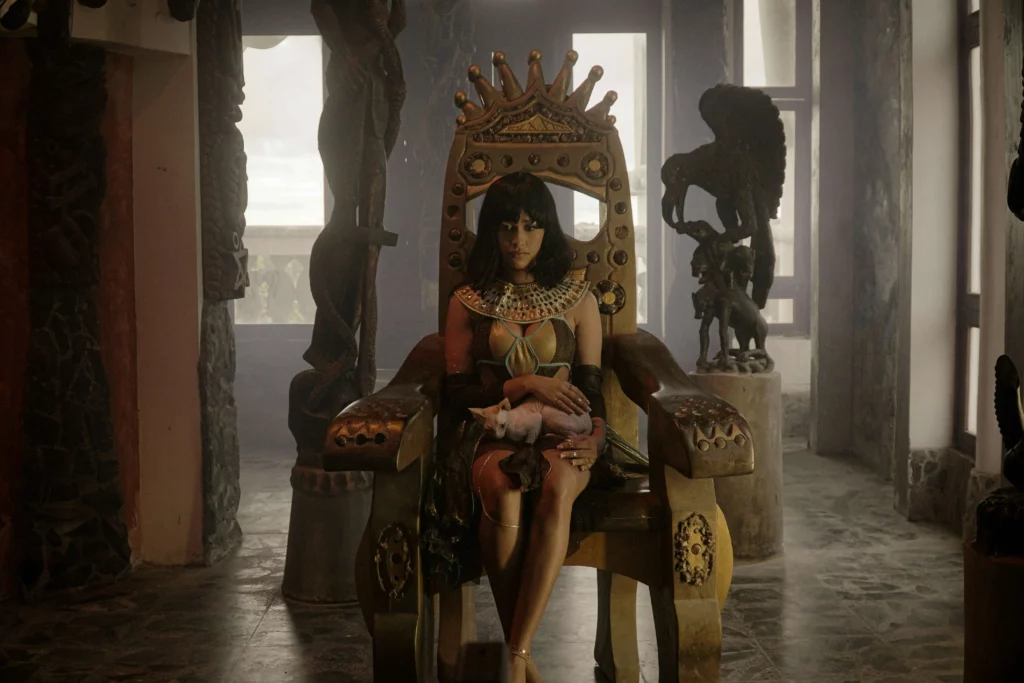
Cleopatra’s death by asp — whether historical fact or Roman literary invention, and scholars are genuinely divided — carries its own logic regardless. To choose the cobra was to exit through the emblem of one’s own sovereignty rather than be paraded through Rome. Venom as a door, not a defeat.
Hindu tradition. Shiva wears the cobra around his throat — at the exact place where speech is either released or swallowed. Vishnu rests on the coils of Shesha between the cycles of the world. And Kundalini, the primordial energy at the base of the spine, is described as a coiled serpent whose rising is the awakening. Here the cobra is divine energy in its transformative aspect.
Buddhism. Mucalinda, the naga king, is said to have raised his hood over the meditating Buddha to shelter him from a storm — the same anatomy that terrifies, used entirely as protection. It is one of the most precise images in any tradition of what power looks like when it has nothing to prove.
Southeast Asia. The naga balustrades at Angkor Wat guard the causeway between the ordinary world and the sacred precinct. In Thai and Khmer tradition, nagas are bound to rain, to water, to the continuity of life. The cobra as the guardian of the threshold.
Egypt, India, Cambodia — no shared origin, and the same conclusion. The cobra is not simply dangerous. It is what stands in front of what matters.
The Shadow of Cobra Medicine
The cobra has a sharper shadow than almost any other guide, and it does not look like cruelty. It looks like honesty.
The strike disguised as truth-telling. The cobra’s gift is directness — the capacity to see through pretence and name what is happening. Its shadow is the person who has learned that their perception is accurate and uses it to wound with precision, then calls it candour. The difference is simple and it is not subtle: the real cobra warns first. If your honesty always arrives without warning and always lands where it hurts most, that is venom, not clarity.
The hood that never lowers. A cobra rises, resolves the encounter, and comes back down. A person in the cobra’s shadow stays permanently reared — permanently braced, permanently ready, unable to be approached without display. This is not sovereignty. It is armour that has fused to the body.
The swallowed venom. The far more common shadow, and the one I see most: the person who has decided their intensity is poison and has spent twenty years containing it. It does not go anywhere. It turns inward and becomes contempt for oneself, or it leaks out sideways in ways that cannot be owned. Suppressed venom is still venom. The cobra does not ask you to eliminate it. It asks you to hold it deliberately, at the front of your body, where you can see it.
The cobra that bites you in a dream. Alarming, and rarely an attack. Something is being introduced into your system that you would not have accepted in gentler form. The useful question is not why is it hurting me but what is it injecting, and what part of me was never going to take it any other way?
How to Journey to the Cobra Spirit Animal
Allow forty minutes. Do not do this on a day you are already angry — the cobra is not a place to discharge, it is a place to hold.
- Name your venom before you begin. Write one sentence: the quality in me that I have been told is too much is … Directness. Anger. Ambition. Appetite. Be specific. This is the material of the journey.
- Descend toward stone and warmth. Enter the Lower World through rock, ruin, a sun-warmed threshold. The cobra is a creature of heat and of stillness, not of forest and motion.
- When it rises, do not step back. This is the entire practice, and it is harder than it sounds. Hold your ground. Do not approach it either. Meet it at eye level and stay.
- Rise with it. If you feel the impulse in your own spine to lengthen, to lift, to take up more vertical space — follow it. Cobra medicine lands in the spine and the throat. Let the body do what it wants to do.
- Ask one question: what am I calling poison that is actually medicine? Then stop talking. The cobra does not answer quickly and it does not answer twice.
- Integration — the cobra pause. For the next week, before you respond to anything that provokes you, be completely still for three breaths. Not to suppress the reaction: to let it clarify. The cobra’s power is entirely in the interval between the provocation and the movement.
The Path of the Paws
42 hand-illustrated oracle cards, one for each animal guide — drawn from the same practice these articles come from. A way to sit with an animal instead of only reading about it.
Order your deck →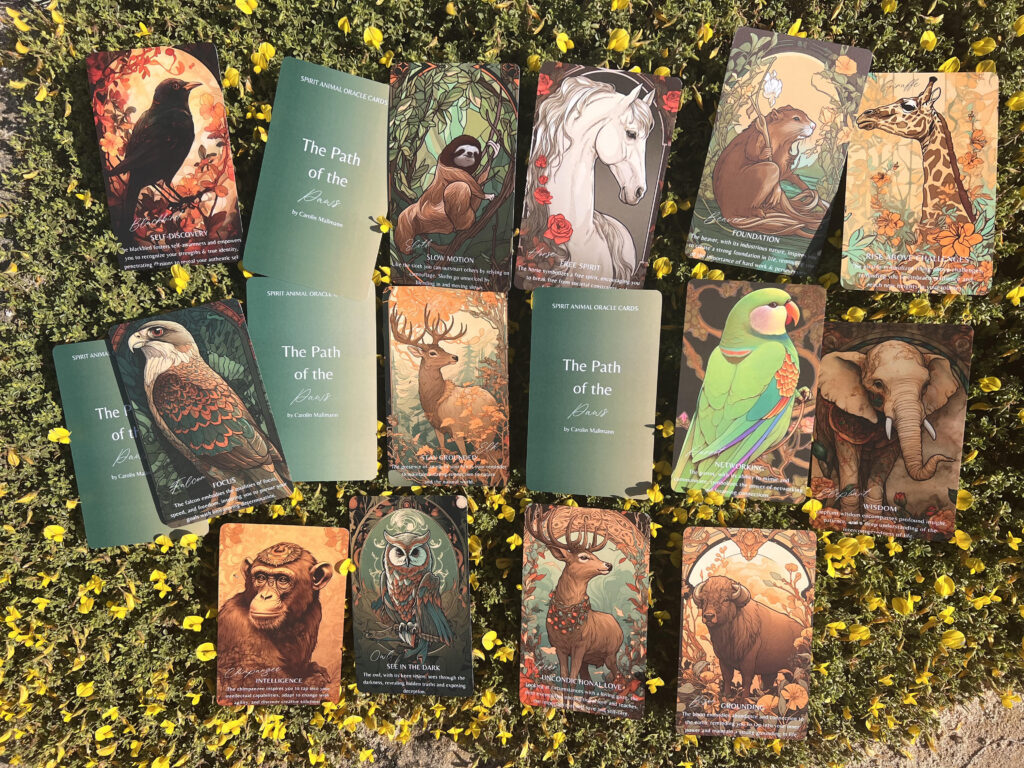
Cobra Spirit Animal FAQ
What does it mean when a cobra appears in your life?
It generally means you are in a situation that is asking you to stop making yourself smaller. The cobra does not arrive for people who need to be softer. It arrives for people who have been soft for so long that they have lost access to their own authority.
Is the cobra a good or bad omen?
Neither, though it is almost always read as bad — which says more about our relationship with power than about the animal. In Egypt it sat on the crown. In Buddhist tradition it sheltered the Buddha. The cobra indicates that something in you is rising, and that the rising will be uncomfortable for whoever benefited from it staying down.
What does a cobra in a dream mean?
Read the posture. A cobra rearing and holding is showing you your own contained power. A cobra striking usually points to something you have suppressed that is forcing its way out. A cobra you are trying to hide or keep in a container is almost always a quality of your own you have decided is unacceptable — and it is not staying in the box.
What is the difference between cobra and snake spirit animal?
The snake spirit animal is about shedding — releasing a layer of identity that has finished. The cobra is about rising — claiming the authority you already hold. Same family, different instruction: one asks you to let something go, the other asks you to stand up.
How do I know if the cobra is my spirit animal?
It tends to claim people who have been managing themselves for a very long time, and who feel a physical response — usually in the spine or the throat — when it appears. To work with it deliberately, use the A–Z guide to spirit animals, draw from the Path of the Paws oracle deck, or take it step by step in the four-week spirit animal course.
The cobra does not ask you to be dangerous. It asks you to stop pretending you are not powerful — and then to be extremely careful with what you find. Rise. Hold. And do not strike anything you have not first warned.