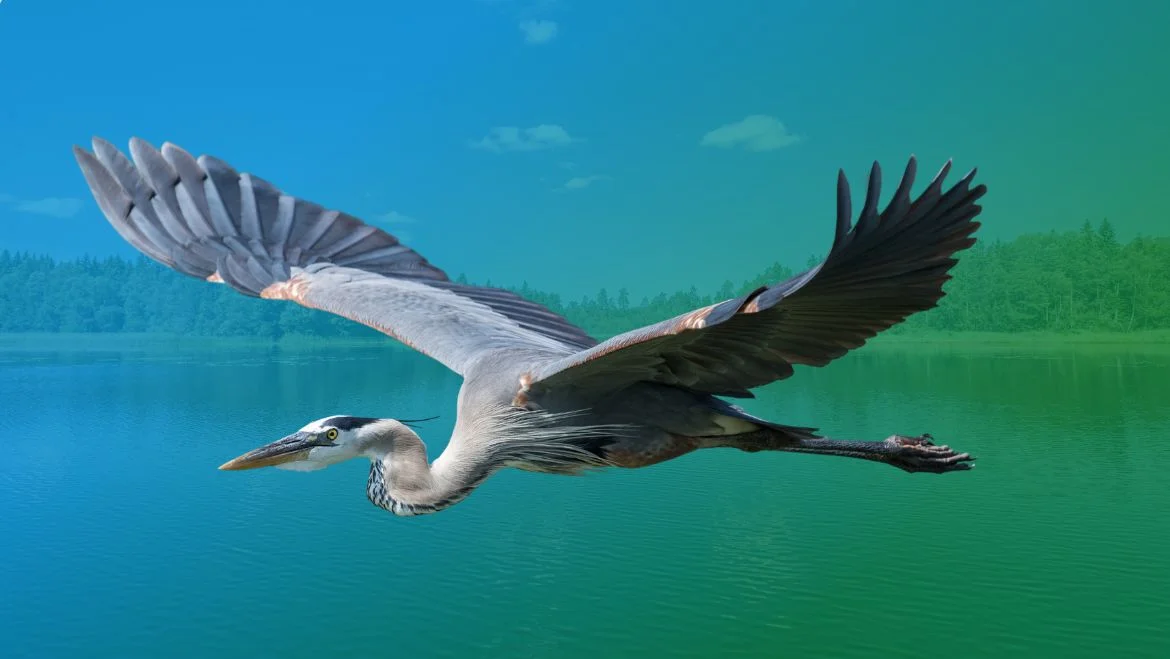
The first time the heron truly stops you, it does it by doing almost nothing. You come across it at the edge of the water — a tall grey-blue shape, one leg lifted, absolutely motionless, its whole attention poured into the surface in front of it. Everything around it is moving: the traffic, the wind, your own restless mind. The heron is not fighting any of that. It is holding a pocket of complete stillness, and waiting for a single, exact moment. And then — faster than you can register — the neck uncoils, the bill enters the water, and it is done. That is the whole teaching, delivered in one movement: the stillness was never passivity. It was the most concentrated action there is.
This page is about the blue heron spirit animal — what it means when this bird keeps arriving in your dreams, your journeys, or at the edges of a life that has become too loud. It is not about wetland ecology. In my practice, the heron comes to people who have confused speed with progress, and who are exhausting themselves reacting to everything because they have forgotten how to wait for the right thing.
The Bridge: What the Real Bird Teaches About Blue Heron Spiritual Meaning
Symbolism that is not anchored in the real animal is decoration. So begin with what the heron actually does.
- Its stillness is a hunting strategy, not a rest. A great blue heron can stand motionless for a very long time, conserving everything, until the exact instant a fish is within reach. Nothing about that stillness is idle — it is the most alert state the bird has. The heron teaches that immense power is stored in the refusal to react, and spent only when the moment is genuinely right. If your life is a series of quick responses, the heron is not impressed. It is waiting for you to stop.
- The neck is spring-loaded. A specialised vertebra lets the heron hold its neck in that elegant S-curve and then release it like a coiled spring, striking with astonishing speed and accuracy. The grace and the lethality are the same mechanism. What looks like beauty is precision under tension.
- It hunts alone. You will almost always see a heron by itself, confident in its own ability to feed itself, needing no flock to do the work. The heron’s medicine is self-reliance — the capacity to stand in your own company, trust your own skills, and not mistake solitude for loneliness.
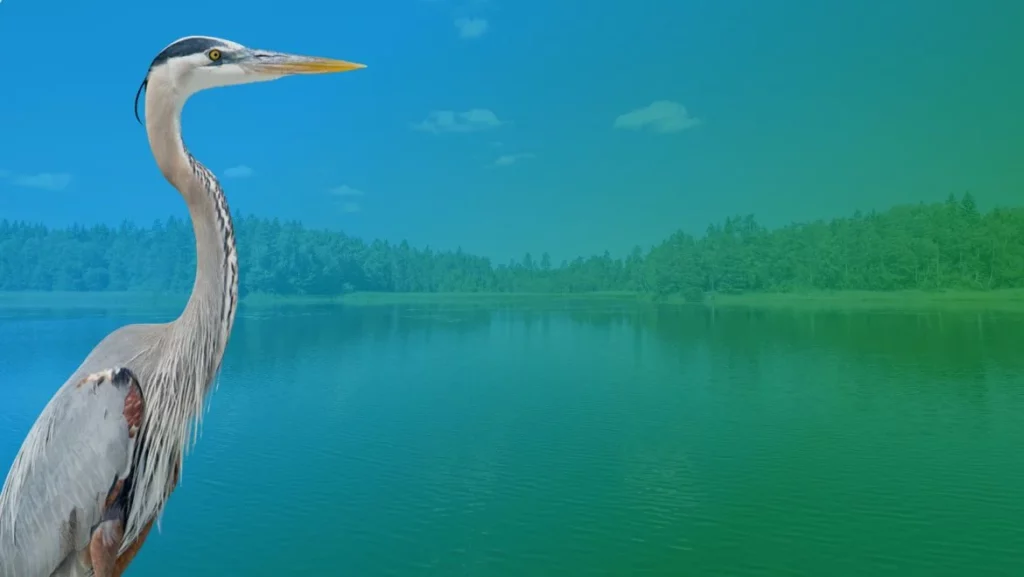
- It lives in three worlds at once. Feet in the water, standing on the earth beneath it, wings ready to take the air — the heron is a genuinely liminal creature. Water is the realm of emotion and the subconscious; earth is grounding and stability; air is intellect and perspective. The heron shows how to descend into feeling without drowning, stay grounded while doing it, and then take the insight and let it fly.
Blue Heron Symbolism Across Traditions
The heron belongs to no single tradition — fitting for a bird that belongs to no single element — but wherever people lived alongside water, it acquired meaning, and the meanings converge on stillness, self-possession and the crossing between worlds.
Egypt: the Bennu, the heron that is the original phoenix
The earliest form of the phoenix appears to have been modelled on a heron. The Egyptian Bennu — a heron-like bird associated with the sun, with creation, and with the rising of the Nile flood — was said to have brought itself into being and to stand on the primordial mound at the beginning of the world. Read that slowly, because it corrects the popular image: the bird everyone associates with rising from fire was originally a creature of stillness and water. The Bennu does not explode into renewal. It stands, and waits, and the new day comes. The full arc of that rebirth is in the phoenix spirit animal guide.
Greece: the bird sent as a sign
In the Iliad, when Odysseus and Diomedes set out on a night mission, Athena sends a heron across their path in the dark — unseen, but heard — as an omen of favour. It is a small, precise detail, and it says something exact about the heron: it is a messenger you perceive at the edge of your senses, in the dark, when you are between one state and another. The heron confirms that you are on the right path at exactly the moment you cannot see it clearly.
Japan: the heron at the threshold of the uncanny
Japanese folklore holds the aosagibi — the “blue heron fire,” a tradition in which old herons were said to glow with a pale light in the dark. Whatever one makes of it, the association is telling: the heron sits at the boundary where the ordinary world thins into something stranger. It is a bird of dusk, of the water’s edge, of the hour and the place where categories stop being reliable — which is precisely why it makes such a clear guide for the in-between times in a human life.
The Shadow of the Blue Heron
Patience and self-reliance are the heron’s gifts, and each one has a precise failure mode that looks, from the outside, exactly like the gift.
- Waiting that has become avoidance. The heron’s stillness is total readiness — it is about to strike. Its counterfeit is the person who calls their inaction patience, waiting for a perfect moment that is never quite here because the waiting has become the point. The honest question: am I poised to act, or am I frozen and calling it calm? A heron standing still in a dream, doing nothing while the fish swim past, is usually asking exactly this.
- Self-reliance that has hardened into isolation. The heron hunts alone by nature. In a person, that same trait can quietly become the refusal to ever be helped, the belief that needing anyone is a failure. Self-sufficiency built on an old wound is not strength. It is a solitary bird that has forgotten other water exists.
- Stillness used to stay above your own feelings. The heron stands in the water — in the realm of emotion — without drowning. The shadow version never actually gets its feet wet: composure used as a way of never being touched, serenity that is really distance. If nothing ever moves you, you are not the heron. You are a person standing on the bank.
- The heron that cannot strike, or cannot fly. A heron appearing wounded, grounded, or unable to catch anything tends to arrive for someone whose gift for timing and precision has been taken from them — by exhaustion, by a role, by a situation that keeps them permanently reactive. It is not a warning about the world. It is a picture of a capacity in you that has been overdrawn.
How to Journey to the Blue Heron
The heron answers questions about timing and self-trust, and its practice is built around stillness rather than searching. If this kind of work is new to you, begin with the step-by-step guide to finding your spirit animal. Shamanic work supports, and never replaces, medical or psychological care. Allow about thirty minutes.
- Name the water you are standing in. Before you begin, write one sentence: the situation I keep reacting to instead of waiting on is … The heron needs a specific pool, not a general request.
- Enter at the water’s edge. Find yourself at a still shoreline at dawn or dusk — the heron’s hours. Feel the ground under your feet and the water at their edge. Do not go in. Stand where the three worlds meet.
- Match its stillness. When the heron appears, do not approach it and do not speak. Become as still as it is. This is the entire practice, and it is harder than it sounds — notice how quickly you want to move, and stay anyway.
- Watch what it waits for. Notice what the heron ignores — all the movement it lets pass — and what it finally strikes at. That discrimination is usually the answer you came for: not “act” or “wait,” but which thing is actually worth the strike.
- Ask which of the three worlds needs you. Water (a feeling you are avoiding), earth (a place you are ungrounded), or air (a perspective you have lost)? The heron will show you where you are out of balance.
- Integrate by not-reacting, once. Within the week, choose one situation you would normally answer immediately — and deliberately wait. Not forever; until the right moment is obvious. Then act once, cleanly. That single held breath is the heron’s whole medicine.
Blue Heron Spirit Animal: Questions People Actually Ask
What does it mean when a blue heron appears in your life?
A repeatedly appearing heron usually points to timing and self-reliance. It tends to arrive for people who are exhausting themselves reacting to everything, and its message is not “do more” — it is “be still enough to see which single thing is actually worth acting on.” It is also a frequent guide for a season that asks you to stand in your own company and trust your own skills.
Is the blue heron a good or bad omen?
Overwhelmingly a good and reassuring sign — in Greek tradition Athena sent one as a mark of favour, and in Egypt the heron-formed Bennu was a symbol of renewal and the returning sun. But it is an omen that asks something of you: it favours patience, precision and self-trust, and it tends to appear when those exact qualities are being called for.
What does a heron in a dream mean?
Watch what it is doing. A heron standing perfectly still speaks to a patience you are being asked to hold, or to test. A heron striking cleanly points to a moment for decisive, precise action. A heron in flight often marks the end of a period of waiting — the insight is ready to be carried somewhere. A wounded or grounded heron points to your own timing being overdrawn.
What is the difference between a spirit animal, a power animal, and a totem?
A spirit animal is usually a long-term guide, tied to your soul’s ongoing lessons. A power animal tends to arrive for a specific season or challenge, lending its strength while you need it — the heron often comes this way, for a stretch that demands patience. A totem is a collective symbol for a family or community rather than an individual. The heron can appear in any of these roles.
How do I know if the blue heron is my spirit animal?
Persistence is the test — whether the bird keeps returning without your invitation, in dreams, in journeys, in unexpected encounters at the water’s edge. For a structured way in rather than guesswork, work through the A–Z spirit animal guide, or sit with the Path of the Paws oracle deck and let the animal find you.
The heron does not rush, and it does not fret about the fish it lets pass. It stands in the meeting place of water, earth and air, holds its stillness like a held breath — and strikes once, exactly, when the moment is finally real.