You hear the blue jay before you see it, and you usually hear it as a complaint. That harsh, ringing jay-jay-jay cutting across a quiet wood is not a song. It is an announcement. And when it finally arrives in a journey it arrives the same way — loudly, at the front of the visual field, entirely unbothered by whether you were ready. People almost always describe the same small irritation: it would not let me settle. That refusal is the first thing the blue jay has to teach.
This page is about the blue jay spiritual meaning — what it means when this bird keeps appearing in your dreams, your journeys, or in the persistent way an image returns when it wants something from you. It is not a field guide. In my practice, the blue jay does not arrive for people who talk too much. It arrives for people who have gone quiet in exactly the place where their voice was most needed — and who have started to mistake that silence for keeping the peace.
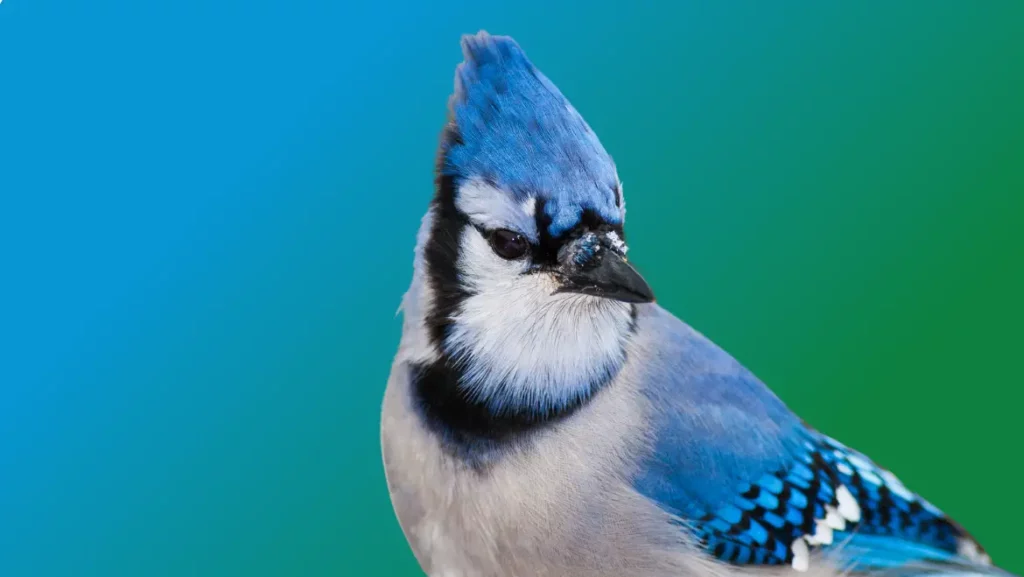
The Bridge: What the Real Bird Teaches About the Blue Jay Spirit Animal
Every honest piece of animal medicine is anchored in the actual creature, and the blue jay is more interesting than the “good communicator” label it usually gets.
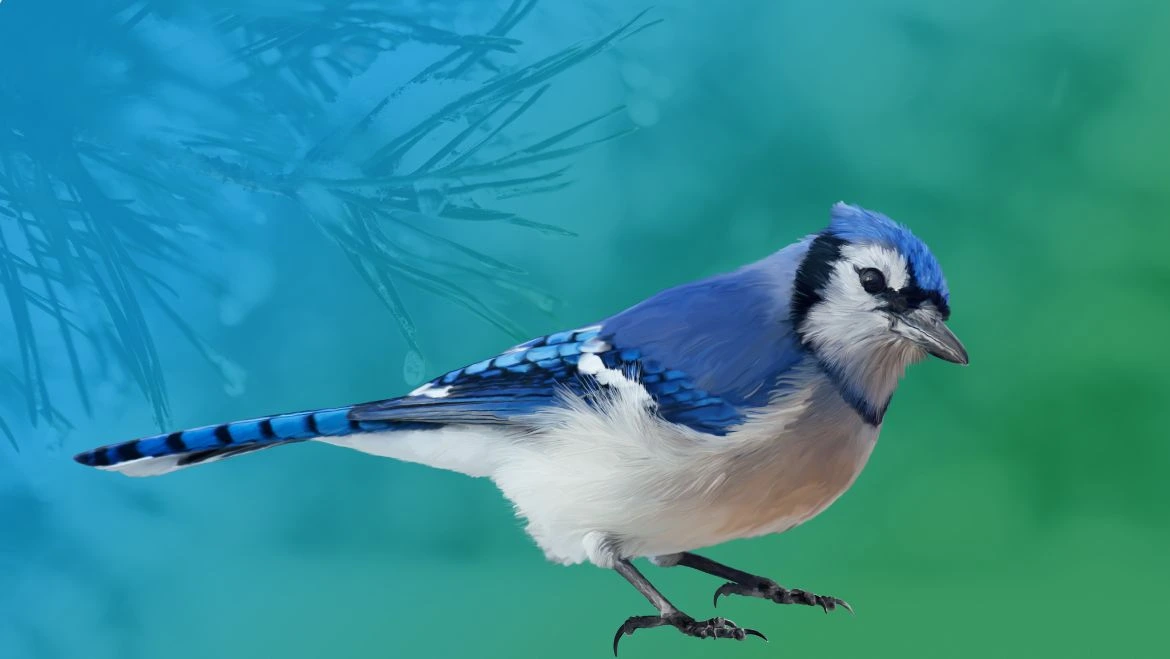
- It is not blue. There is no blue pigment in a blue jay’s feather. The colour is structural — microscopic architecture that scatters light so that we see blue. Grind the feather up and the blue disappears. The most striking thing about this bird is not a substance it contains, but a way it has of catching the light. Hold that if you have ever been told your vividness was “too much”: it is not a coating you can be asked to remove. It is how you are built.
- It cries hawk on purpose. The blue jay is a gifted mimic, and its most famous trick is imitating the scream of a red-shouldered hawk. Sometimes it does this to clear a feeder of rivals. But it also does it to warn the wood that a real predator is near. The same voice that manipulates is the voice that protects — and the bird does not always let you know which one you are hearing. That ambiguity is the blue jay’s whole moral question.
- It plants forests. Blue jays cache acorns by the thousand, burying them across miles and forgetting enough of them that oak woodlands quite literally follow the jays north. This is a bird whose loud, quarrelsome surface hides a slow, patient, generative work it will never see finished. Do not mistake the noise for the whole animal.
- It mobs what threatens the nest. A jay will harass a hawk, an owl, a cat, a person — screaming, dive-bombing, refusing to be quiet until the threat leaves. It is small and it does this to things far larger than itself. Blue jay medicine is not gentle assertiveness. It is a creature willing to be obnoxious in defence of what it loves.
Put those together and the blue jay stops being a cheerful symbol of “communication.” It becomes a precise question: where is your voice needed as an alarm, and where have you been keeping it down to avoid being the loud one?
Blue Jay Symbolism Across Traditions
The blue jay belongs to eastern North America, and its symbolic history sits there rather than in the pan-global grab-bag it is often assigned to. It is worth being accurate rather than expansive.
The corvid family it belongs to
The blue jay is a corvid — kin to the crow, the raven and the magpie — and it inherits the whole family reputation for intelligence, memory and mischief. Across many cultures the corvids are the birds that carry messages between worlds and are never entirely trustworthy while doing it. The blue jay is the corvid dressed in daylight colours: the same sharp mind, the same trickster streak, wearing blue instead of black. If you have met the blackbird or the raven and found them too sombre, the jay is the one that carries the same cleverness with the volume turned up and the mood turned bright.
Indigenous North America: the boundary between honesty and trickery
Among a number of Indigenous peoples of the blue jay’s range, the jay appears in story as a talker, a trickster and an incorrigible show-off — sometimes helpful, sometimes the cause of the trouble. I name this loosely and carefully, because these are distinct nations with distinct stories that are not mine to flatten or claim. But the recurring shape is worth sitting with: the jay is the character whose gift with words is exactly what gets it into difficulty. The bird that can say anything has to decide what is worth saying, and the old stories are honest that it does not always choose well.
Colour and clarity
Blue, across a great many traditions, is the colour of the throat and of speech — the register of clear expression, of the word said plainly. A bright blue bird that is also one of the loudest voices in the wood is almost too neat a symbol for honest communication. But the symbol has an edge the greeting cards leave off: clarity is a power, and a bird that can imitate any voice can also imitate sincerity. The jay holds both.
The Shadow: When the Voice Becomes a Weapon — or a Wall
A guide this bound up with the voice has a shadow that lives, precisely, in the throat — and it runs in two opposite directions.
- The false alarm. The jay cries hawk to clear the feeder. In a person, this is the raised voice used not to warn but to win — manufactured urgency, manufactured outrage, the crisis announced so that everyone else scatters and you get what you were after. The most common misunderstanding I encounter is that loudness is the same as honesty. It is not. Ask whether your alarm is protecting the flock or clearing your rivals.
- The mimic who has lost their own call. A jay can sound like anything. The shadow of that gift is the person who has become so good at matching the room — the right tone for the boss, the family, the friend group — that they can no longer locate the voice that is actually theirs. If you can perform sincerity in five registers and cannot remember which one is you, this is the work.
- Swallowed alarm. The more painful shadow, and the one I see most. The person who saw the hawk — the bad decision, the dishonesty, the harm being done to someone — and did not scream, because screaming would have made them the difficult one. The jay does not have this option; a silent jay is a dead nest. If you have been quiet in the exact place your alarm was needed, the blue jay has arrived about that, and it is not a gentle visit.
- Territory that has hardened into hostility. Fierce defence of the nest is real medicine. Its distortion is the person who mobs every perceived intruder — who treats disagreement as invasion and cannot tell a hawk from a guest.
A blue jay that appears screaming or dive-bombing you in a recurring dream is very rarely an enemy. In my experience it is your own withheld alarm, arriving with force because the polite route was closed for too long. A blue jay that is silent, caged, or unable to call points the other way — to something true you have been physically holding down. And a blue jay mimicking a voice that is not its own tends to arrive when a person has been performing a self for so long that they have lost the thread back to the real one.
How to Journey to the Blue Jay
Shamanic work is not a substitute for medical or psychological care. If you are new to this, begin with the step-by-step guide to finding your spirit animal before working with the practice below. Allow about twenty minutes.
- Name the unsaid thing before you begin. Not “help me communicate better.” Rather, one plain sentence: the thing I have not said, and to whom, is … The jay responds to a specific silence, not a general wish.
- Journey to a woodland edge. Not deep forest, not open field — the boundary where trees meet clearing, which is exactly where the jay lives. Let a steady drumbeat carry you and wait at that margin.
- Listen for the call before you look. The blue jay is heard first. When the call comes, notice its quality: is it the harsh alarm, the soft “whisper song” jays use among themselves, or a borrowed voice? Each is a different message.
- Ask it which voice you are using. Ask the jay to show you where in your life you are crying hawk to clear the feeder, and where you have gone silent while the nest is threatened. Do not argue with what it shows you.
- Follow it to a buried acorn. Ask to be shown the slow, generative thing you are doing that no one has noticed — the forest you are planting without applause. The jay is not only its noise, and neither are you.
- Return and use the voice once. Within forty-eight hours, say the one true thing you named at the start — plainly, at normal volume, without the accumulated charge of months. That is the practice. Everything else is commentary.
Affirmations for Blue Jay Medicine
- “I raise my voice for what I love, not to win.”
- “My vividness is not a coating I can be asked to remove. It is how I catch the light.”
- “I can be honest and kind in the same sentence.”
The Path of the Paws
42 hand-illustrated oracle cards, one for each animal guide — drawn from the same practice these articles come from. A way to sit with an animal instead of only reading about it.
Order your deck →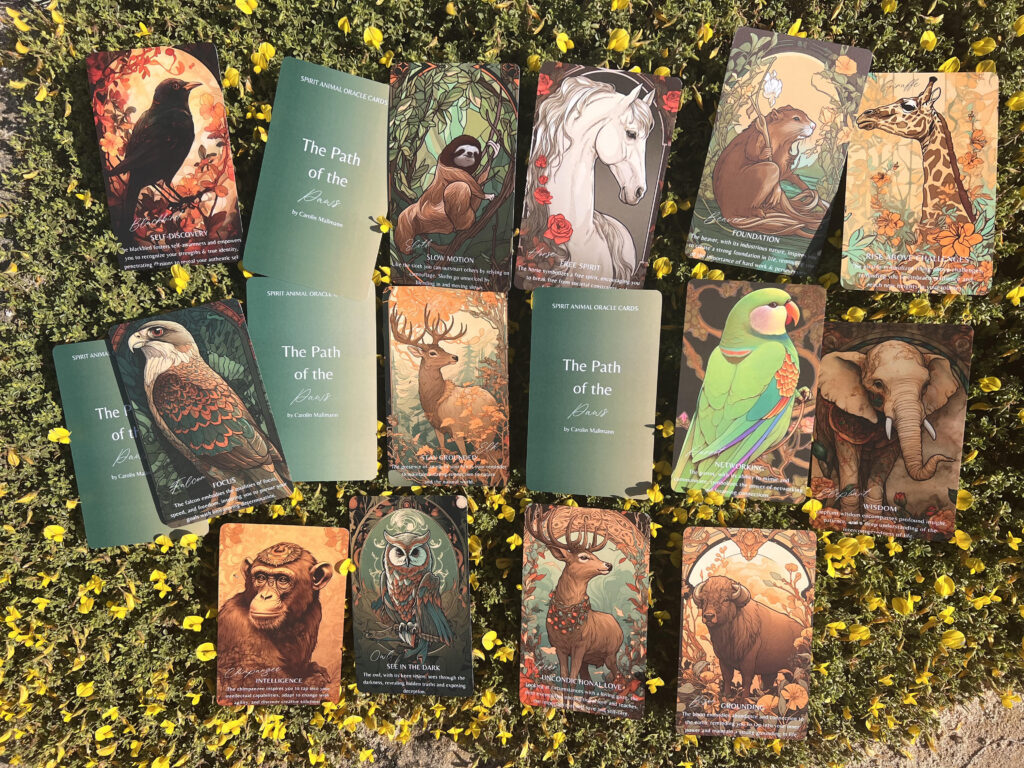
Blue Jay Spirit Animal: Questions People Actually Ask
What does it mean when a blue jay appears in your life?
It is almost always a message about your voice — and specifically about where you have been using it wrongly or not at all. The blue jay does not arrive to make you more talkative in general. It arrives pointing at one particular thing you need to say, or one alarm you have been swallowing, and it is not subtle about it.
Is the blue jay a good or bad omen?
Neither, and the folklore is genuinely split — jays are read as bold protectors and as noisy troublemakers, sometimes in the same region. That contradiction is the honest answer. The blue jay does not predict an outcome. It reflects how you are using your voice: as protection, as manipulation, or not at all.
What does a blue jay in a dream mean?
Read what is happening to its voice. A jay calling clearly usually points to something you need to say out loud. A silent or caged jay points to something you are holding down. A jay screaming at you is often your own suppressed alarm, and a jay mimicking another bird points to a self you have been performing rather than living.
What is the difference between the blue jay and the blackbird or raven as a spirit animal?
They are corvid cousins with different registers. The raven deals in death, prophecy and deep intelligence; the blackbird in the quiet, liminal song at the edges of the day. The blue jay is the daylight one — louder, brighter, more social, and more concerned with the daily politics of who gets heard and who gets protected. If the bird that came to you was blue and unmissable, that distinction is the message.
How do I know if the blue jay is my spirit animal?
Persistence, not preference — whether the bird keeps returning without your invitation. For a structured way to test the connection rather than guess, work through the A–Z spirit animal guide or sit with the Path of the Paws oracle deck and let the animal find you.
The blue jay does not arrive to make you louder. It arrives to ask whether the loudest thing in you has been aimed at the right target — and whether the truest thing in you has been allowed to make a sound at all.