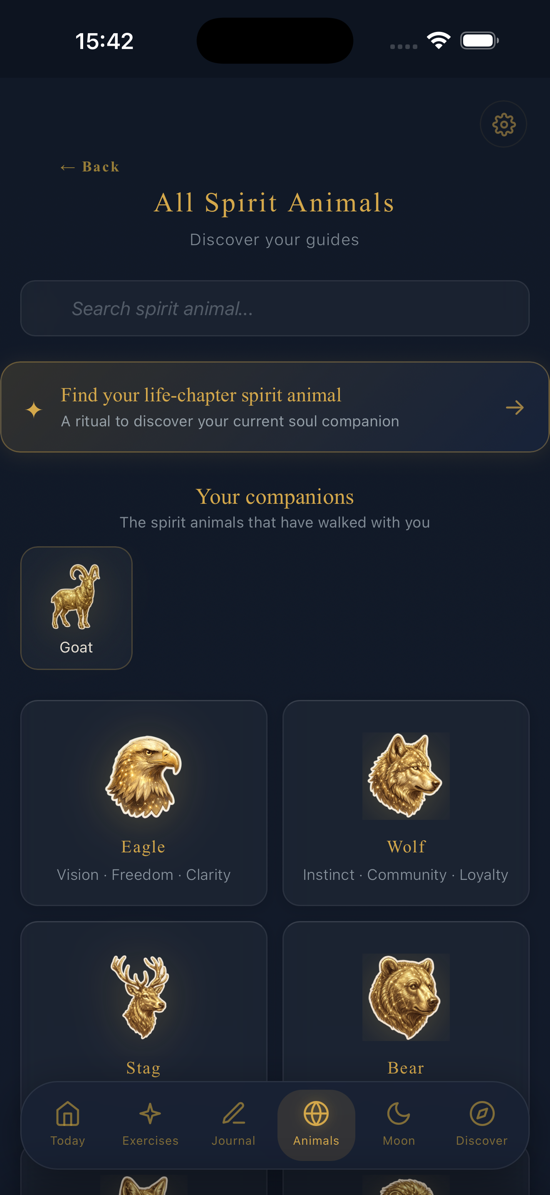
Most people who practise shamanically have more than one spirit animal. In the core shamanic view you usually carry one main power animal for a longer stretch of life, plus a handful of other allies who come for a season, a task or a single journey. There is no fixed number, and a bigger collection is not a sign of a deeper practice.
A spirit animal, also called a power animal, is a helping spirit that appears in animal form and lends you its qualities: its instinct, its protection, its particular way of moving through the world. It is not a personality type and not a favourite animal. It is a relationship. And like every relationship, the question is not how many you have, but how well you know the ones you do.
How Many Spirit Animals Can You Have at Once?
Most practitioners work with one main power animal and two to five secondary allies at any given time. Some traditions speak of a guardian animal that stays for life, others of animals that arrive and leave with the seasons of your life. Both descriptions point at the same experience: one steady presence, several situational helpers.
Michael Harner, who gathered these practices into what is now called core shamanism, described the power animal as a guardian that can change over a lifetime. Many indigenous traditions recognise several helping spirits for different domains: one for healing, one for protection, one for the work you do in the world. The number varies. The structure does not.
| Type of ally | How many, typically | How long it stays | What it does |
|---|---|---|---|
| Main power animal | One | Years, sometimes a lifetime | Carries your core power and protection |
| Seasonal allies | Two to five | Months to a few years | Supports a phase: grief, a move, a new role |
| Task allies | One per task | A single journey or ceremony | Helps with one specific piece of work |
| Ancestral or place spirits | Varies | Tied to lineage or land | Connected to your family line or to where you live |
Why Do Some People Meet So Many Animals?
Because not every animal that shows up in a journey is a power animal. Many are scenery, memory or the mind filling a silence. Learning to tell the difference is the actual skill, and it takes longer than collecting names.
In the classic core shamanic test, an animal is offered to you as a power animal when it shows itself willingly four times, from different angles, in the same journey. That old rule exists for a reason. It filters out the flicker of images the mind produces when it wants something to happen.
- An ally comes back. It answers questions. It is still there next week when you did not call it.
- A visitor appears once, delivers something, and goes. Honour it and let it leave.
- Scenery is the bird that flies past in the journey landscape. It means no more than a tree in the background.
- Wishful thinking is the animal you hoped for. Wolf and Eagle appear far more often than chance would explain.
If your list keeps growing every week, that is usually a sign that you are meeting scenery, not allies. It can also point at something else, which is worth naming honestly.
Is Collecting Spirit Animals a Problem?
It becomes a problem when the collection replaces the relationship. Naming twenty animals and knowing none of them well leaves you exactly as unsupported as naming none.
I see this often with people who come to a session after years of reading. They can list their animals. Then I ask what their main one asked of them last month, and there is a long pause. The animals were information, not company. Nothing was ever given back.
Reciprocity is what turns a sighting into a relationship. You dance the animal, you make space for it, you keep the agreement you made in the journey. An ally you feed stays. An ally you only inventory tends to go quiet, and quiet allies are a real thing: this is one of the ways power loss begins.
Can Your Spirit Animals Change Over Time?
Yes, and they usually do. Power animals come for a chapter of your life, do the work that chapter needs, and step back when it is finished. Their leaving is not a failure or a punishment.
A Bear that carried you through an illness may loosen its grip once you are well. A Fox that taught you to move carefully through a difficult workplace has little to teach once you have left it. What often happens next is not emptiness but a handover: the old ally becomes distant and warm, and a new one starts turning up at the edges of your journeys and your dreams.
The main power animal is the most stable of them. Many people carry the same one for decades. If yours suddenly feels absent, that is worth attention rather than panic. Journey and ask. If it does not answer, a power animal retrieval with an experienced practitioner is the usual next step.
How Do You Know Which One Is Your Main Power Animal?
Your main power animal is the one that is present when you did not ask for it, across years and across very different situations. Everything else is secondary, however striking it looked in the journey.
- It shows up in journeys you took for entirely unrelated reasons.
- It appeared long before you had any language for this work, often in childhood.
- Its qualities are recognisably yours, including the difficult ones.
- You feel steadier after contact, not more excited.
- It says no to you sometimes. Allies that only ever flatter are usually your own voice.
Quizzes and birth date calculators cannot do this for you, for reasons worth understanding: see whether spirit animal quizzes are accurate. The only reliable method is journeying, repeated over time, written down.
How Do You Deepen the Relationship Instead of Adding More?
Choose one animal and work only with that one for a full moon cycle. Depth comes from repetition with a single ally, not from variety.
- Journey to it weekly with one clear question rather than a general visit.
- Dance it for five minutes. Move the way it moves. This is the oldest way of feeding a power animal, and the most effective.
- Learn the real animal. How it hunts, sleeps, raises young. The biology teaches the medicine.
- Keep one page per journey in a notebook, with the date. Patterns appear across months that you cannot see in a single session.
- Give something back. An act in ordinary life that honours what it asked for. Not a decoration on a shelf.
If you want to know what a particular animal carries before you begin, the Spirit Animals A to Z holds detailed portraits of each one: meaning, messages, shadow and practice.
Frequently Asked Questions
Can you have two main power animals at the same time?
It happens, though it is less common than people assume. Usually one of the two turns out to be a strong seasonal ally rather than a second guardian. Give it a year of journeying before you decide.
Is it bad to have only one spirit animal?
No. One well known ally is worth more than a dozen names on a list. Many experienced practitioners work with a single power animal for most of their lives.
Can you lose a spirit animal?
Yes. Allies withdraw when an agreement is broken, when the chapter they came for is over, or during long periods of exhaustion and neglect. The shamanic response is a power animal retrieval.
Do animals I see in nature count as spirit animals?
Not automatically. A repeated, unusual encounter can be a genuine signal, especially if the same animal is also showing up in journeys and dreams. A single sighting is usually just an animal living its life.
Can children have spirit animals?
Children very often have a strong, uncomplicated connection to one animal, long before they have words for it. Many adults, when they journey for the first time, meet the animal they already loved at six.
How many spirit animals should a beginner work with?
One. Meet your power animal, then stay with it for at least three months before you go looking for anyone else.
If you are unsure how many allies you actually carry, stop counting and start visiting. The answer arrives on its own, usually within a few months, and it is almost always smaller and warmer than the list you were keeping.