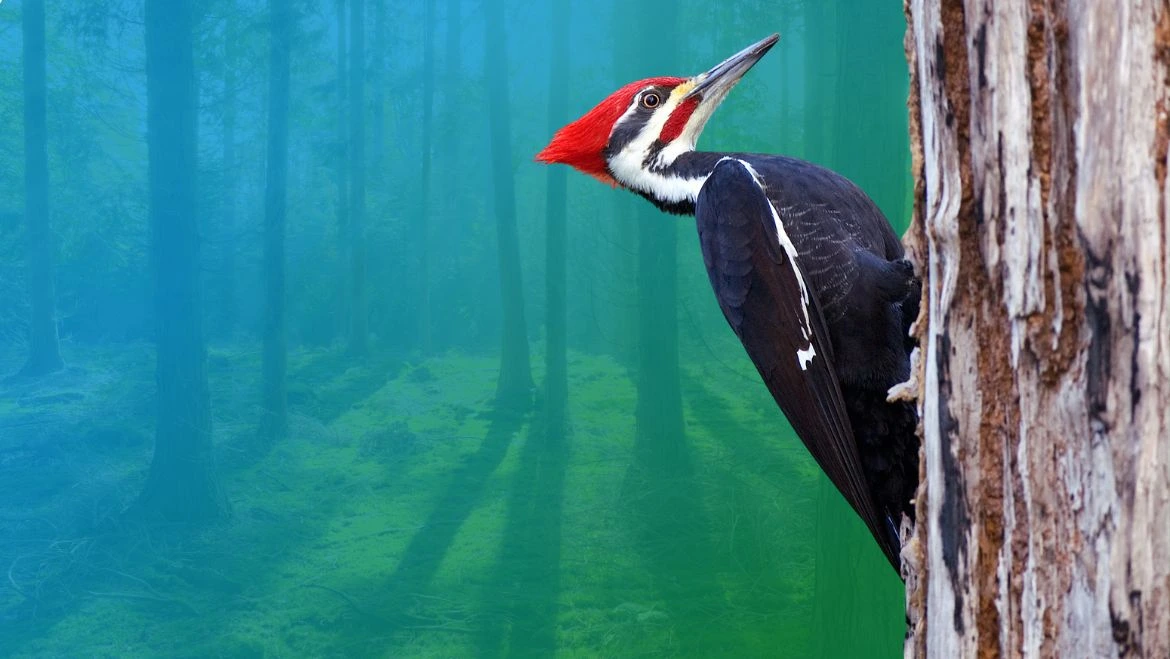
You rarely see Woodpecker first. You hear him. On a journey, the Woodpecker spirit animal almost always announces himself as sound before shape — a hard, insistent drumming that seems to come from inside your own skull rather than from the forest around you. Clients describe a pressure at the crown of the head, a vibration running down the sternum, and then a strange, sudden clarity, as if a fog had been knocked loose. It is not a gentle arrival. Woodpecker knocks.
In more than two decades of shamanic and coaching work, I have noticed that Woodpecker comes to a very particular kind of person at a very particular moment: someone who has been circling the same problem for months, gathering information, waiting for certainty, doing everything except the one thing that would actually break it open. Woodpecker’s medicine is rhythmic, repeated, unglamorous effort applied to a single point. He does not ask you to be inspired. He asks you to strike the same spot again tomorrow. This article is what I have learned about his message — his biology, his symbolism, his shadow, and how to work with his drumbeat in practice.
From Beak to Psyche: The Bridge Between Woodpecker Biology and Woodpecker Medicine
Honest spirit-animal work always starts with the real bird. The spiritual message is not bolted on top of the biology — it grows out of it.
A woodpecker can strike a tree upwards of ten thousand times a day, at decelerations that would concuss almost any other creature. He survives it because of design, not toughness: a beak that absorbs and redirects shock, a skull built to distribute impact, and a hyoid bone — the tongue’s anchor — that wraps all the way around the back of the skull like an internal seatbelt. The lesson is precise and rarely noticed: sustained impact is only survivable when your structure supports it. People who take on relentless effort without building the internal architecture to hold it do not become woodpeckers. They break.
Three further habits translate directly into medicine:
- He listens before he strikes. The drumming you hear is often not excavation at all — it is percussion, tapping to locate the hollow galleries where insects move beneath the bark. Woodpecker medicine is diagnostic: find the hollow place first, then commit the effort. Most people do the reverse and exhaust themselves against solid wood.
- He drums to be heard. Territorial drumming is communication, chosen deliberately for resonant surfaces. Woodpecker teaches you to announce yourself clearly rather than hoping to be noticed.
- He excavates homes for others. The cavities he abandons become nests for owls, martens and bees. He is a keystone species — his relentless work becomes shelter for creatures who could never have made it. When Woodpecker appears in a client’s journey, I always ask: what are you building that others will one day live inside?
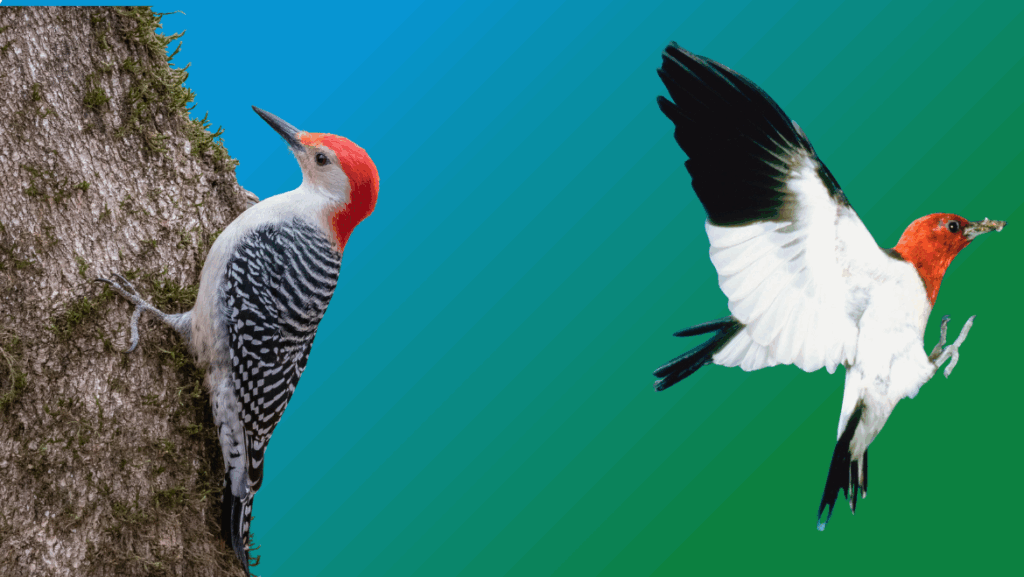
Woodpeckers thrive in wildly different habitats — deep coniferous forest, open deciduous woodland, parks and gardens with old trees. The Green Woodpecker feeds on the ground, in open landscapes dotted with trees; the Black Woodpecker needs old, tall timber. That adaptability is part of the totem: the rhythm stays the same, the terrain changes.
Core Symbolism & Historical Context of the Woodpecker
The Woodpecker is one of the oldest drum-and-thunder birds in the European imagination, and the traditions agree with each other far more than they usually do.
Rome: Picus, the Bird Who Would Not Yield
In Roman myth, Picus was a king turned into a woodpecker by the sorceress Circe after he refused her advances and stayed loyal to his beloved Canens. Ovid tells it as a story of transformation as punishment — but read it as a shamanic text and it says something else entirely: the man who would not be moved became the bird who does not stop striking. Picus was also a prophetic bird sacred to Mars, and, alongside the she-wolf, was said to have fed the infants Romulus and Remus. The woodpecker sits at the root of Rome’s own founding — fidelity, prophecy and stubbornness in one body.
Norse and Baltic: The Drummer of Storms
Across northern and Baltic Europe the woodpecker’s drumming was read as an earthly echo of thunder, and the bird was associated with the thunder gods and with the coming of rain. Folk belief held that his hammering could split wood, break stone, even open what was locked. This is the origin of the persistent European tradition of the woodpecker as a bird who knows how to open sealed things — and, spiritually, it is exactly why he shows up when something in your life has become impenetrable.
The Heartbeat and the Drum
There is a reason the drum is the central technology of shamanic practice on nearly every continent: rhythmic sound reorganises consciousness. Woodpecker is nature’s own drummer, and in my practice I treat him as a teacher of the trance state itself. When he appears repeatedly, it is frequently a sign that a person’s journeying practice needs more discipline and less mood — a real, steady beat rather than an occasional inspired session.
A note on respect: woodpecker traditions among Indigenous peoples of North America are living, specific and belong to their communities. Where I reference them, I do so as an outsider acknowledging their depth, not as a claim to their ceremonies. My own practice sits in a European lineage, and I name that plainly.
Spiritual Messages & Abilities of the Woodpecker Power Animal
- Persistence: the willingness to return to the same task, at the same hour, without applause.
- Discernment: tapping first to find the hollow — effort placed where it will actually break through.
- Rhythm: the medicine of routine, cycles and the drumbeat as a doorway to trance.
- Opportunity: Woodpecker finds what is hidden beneath the surface of a situation others walked past.
- Voice: drumming to be heard; the end of waiting to be noticed.
- Shelter-building: work whose real fruit is the home it leaves behind for others.
The Shadow Aspect: The Warning Medicine of the Woodpecker
Woodpecker is not a fortune cookie. When he arrives reversed, blocked, or in a recurring nightmare, he is showing you something you will not enjoy — and that is precisely his worth.
- Hammering at solid wood. The most common Woodpecker shadow I meet in sessions is a person applying enormous, admirable, exhausting effort to something that was never going to open — a relationship that ended years ago, a career that hollowed out, a version of themselves they have outgrown. Persistence is only a virtue when it is aimed. Ask honestly: am I being tenacious, or am I refusing to admit this is finished?
- Compulsive noise. The drumming that will not stop becomes rumination — the same thought struck ten thousand times a day, the same argument rehearsed at 3 a.m. If Woodpecker appears in a nightmare as an unbearable, endless knocking, he is usually mirroring an obsessive loop, not prophesying disaster.
- Damage disguised as diligence. Woodpecker can also hollow a living tree until it falls. Workaholism, over-training, spiritual bypassing through relentless practice — these all wear his mask. If your discipline is quietly destroying the structure that carries it, that is not his medicine. That is his warning.
- The silent or blocked bird. When Woodpecker appears turned away, mute, or unable to strike, the reading in my practice is almost always suppressed voice: something true that you have decided not to say. He will not speak again until you do.
Genuine shadow work with Woodpecker is rarely dramatic. It usually means stopping one thing you have been forcing, and starting one thing you have been avoiding.
Practical Shamanic Work: Journeying with the Woodpecker
This is the journey I give clients who are stuck — the ones who have been “working on it” for a year and moved nothing. Allow thirty minutes. Do not do it while distracted or intoxicated.
- Set a diagnostic intention. Not “give me strength” but something Woodpecker can actually answer: “Where am I hammering at solid wood, and where is the hollow place I have not tapped?”
- Build the container. Dark room, blanket, a steady drumbeat of roughly four beats per second for 15–20 minutes. Cover your eyes. Let the beat do the work — do not chase visions.
- Go up, not down. Woodpecker is a middle- and upper-world guide. Travel up the trunk of a real tree you have touched with your own hands, climbing the bark until the canopy opens.
- Ask, then listen for the knock. State your intention aloud and wait. Ask any bird who comes three times whether it is here for your highest good.
- Follow the sound to the tree. Woodpecker will lead you to a specific trunk. Put your hand on it. Which part sounds hollow? That hollow is your answer, and it is rarely the thing you expected.
- Ask for the beat. Before you leave, ask him for a rhythm — a number of strikes, a tempo, a phrase. Clients receive things like “three, every morning”. Take it literally.
- Thank him and return the way you came, at the callback beat. Write everything down before you speak to anyone.
The Ten-Minute Drum: Integrating Woodpecker Medicine
A journey without integration is entertainment. Woodpecker medicine, more than any other, lives or dies in what you do next. Within 48 hours:
- Name the solid wood. Write one sentence: “I have been striking ______ for ______ months, and it has not opened because ______.” Then stop striking it, for one week, as an experiment.
- Name the hollow. Write the one task that genuinely frightens you because it might actually work.
- Set the rhythm. Ten minutes. Same time each day. Same task. Not an hour when you feel inspired — ten minutes whether you feel anything or not. This is the entire teaching, and it is why people ignore it.
- Mark the beat physically. Before you begin each day, tap your sternum four times with your fingertips, slowly, and say the one sentence you received on the journey. The body learns rhythm faster than the mind learns resolve.
- Count in weeks, not days. Woodpecker does not measure progress by how the wood looks after one strike.
If you are new to this work, begin with the fundamentals of shamanic journeying before attempting shadow contact — and if you would like guidance in finding your spirit animal, that is precisely the work I do with clients.
Dreaming of a Woodpecker
Context decides meaning. A woodpecker drumming steadily in the distance generally signals that your effort is landing, even if you cannot yet see the result — keep going. A woodpecker climbing into a hollow points to a need for shelter, retreat and reconnection with your own inner life. A woodpecker knocking at your window or your door is, in my experience, one of the most consistent dream images there is: a message you have been declining to open. And a woodpecker whose knocking becomes unbearable is not a threat — it is the sound of something you already know, refusing to be ignored any longer.
Incorporating Woodpecker’s wisdom into your daily life is not about becoming relentless. It is about becoming rhythmic — and letting steady, well-aimed work do what bursts of intensity never manage.
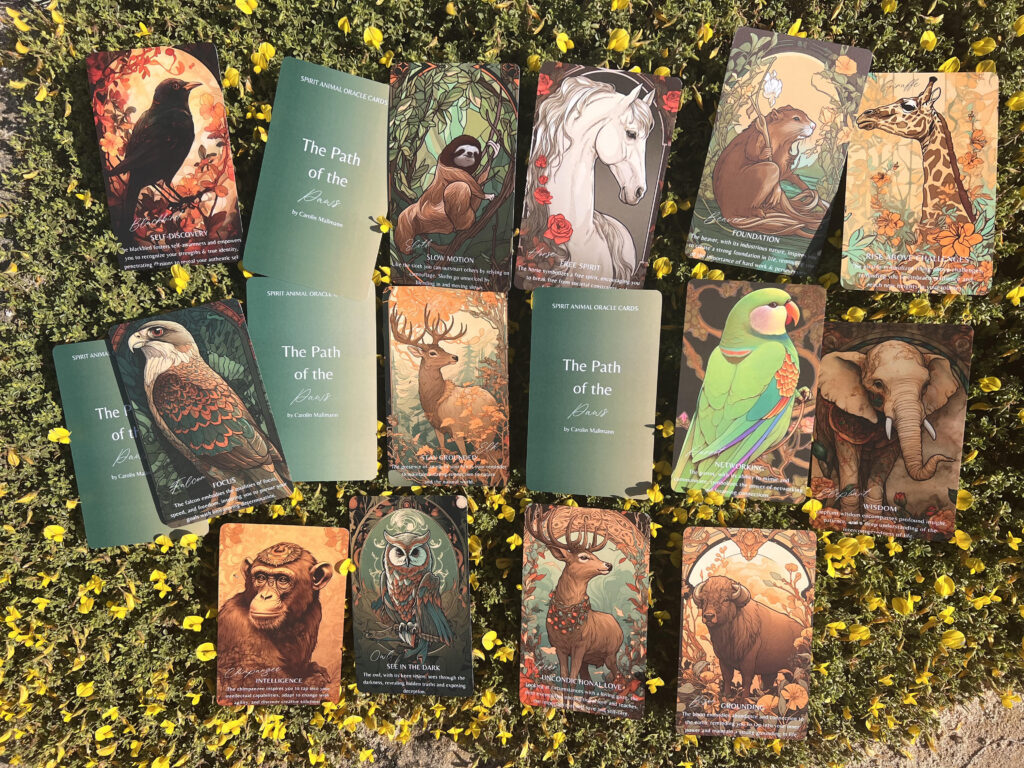
The Path of the Paws 🐾 Oracle Cards
The connection with animals has always been a deep, human ability. It guides us on our individual path – to our inner identity and to a fulfilling life.
“The Path of the Paws” is a unique oracle card deck that invites you on a journey of self-discovery and spiritual connection to your power animals.
Discover 42 beautifully designed Oracle Cards
About the Author — Carolin Mallmann
I am Carolin Mallmann, founder of One Shamanism and author of The Path of the Paws. For over two decades I have worked with people as a coach, certified NLP practitioner and shamanic practitioner, guiding thousands of one-to-one sessions and training students internationally in shamanic journeying, spirit animal work and shadow integration. Everything I write here comes from lived practice — my own journeys, my teachers, and the real, sometimes uncomfortable experiences of the clients I sit with. I do not promise miracles, and shamanic work is not a substitute for medical or psychological treatment. What I can offer is an honest, grounded path back to your own instincts. Read more about my background and practice here.