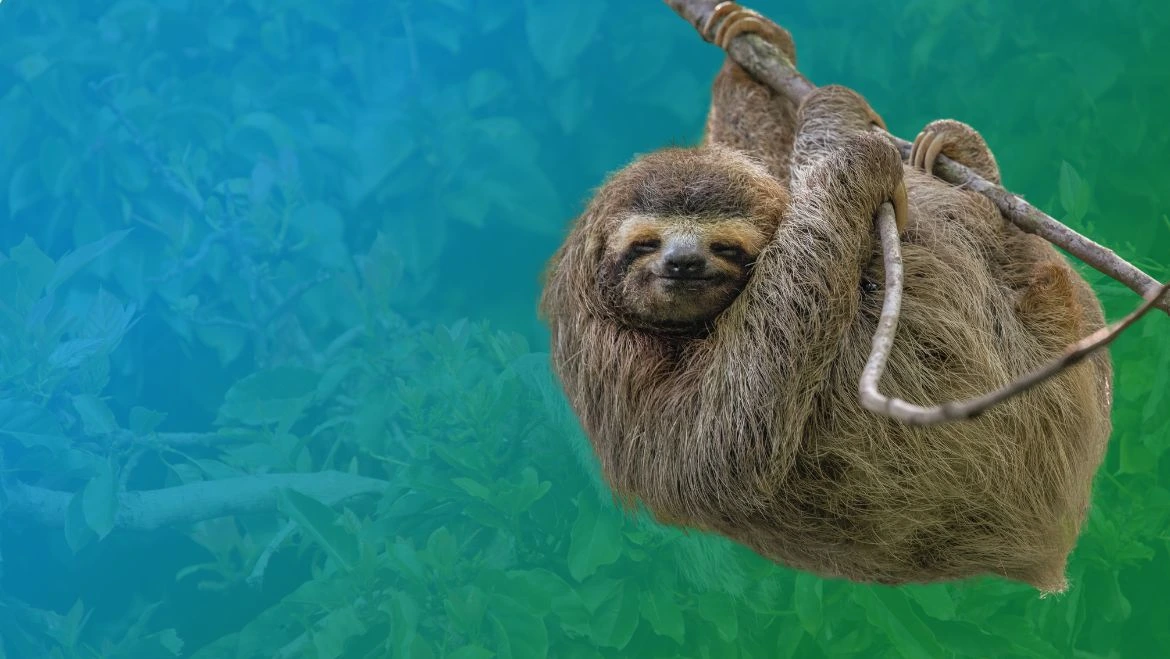
On a journey, the sloth does not arrive. It is simply already there — hanging in the canopy, unbothered, watching you with a patience that feels almost like amusement. It does not come down to greet you. It does not perform. And the longer you stay with it, the more a strange discomfort rises in you: the discomfort of being in the presence of something that has absolutely nowhere to be. Most people meet the sloth and immediately want it to do something. That impulse is the first thing it has come to show you.
This page is about the sloth spiritual meaning — what it means when this slow, still creature keeps appearing in your dreams, your journeys, or at the edges of an exhausted week. It is not a page about rainforest biology. If you came for animal facts, you are in the wrong place. If the sloth has been hanging quietly at the edge of your inner life, stay.
In my practice, the sloth does not arrive for lazy people. It arrives almost exclusively for the opposite — for people who have filed rest under “later,” who treat stillness as something to be earned once the endless work is finally done, and who are quietly running their bodies into the ground while calling it discipline.
The Bridge: What the Real Animal Teaches About the Sloth Spirit Animal
Honest animal medicine begins with the living creature, and almost everything people believe about the sloth is a misreading. Its slowness is not weakness. It is one of the most disciplined survival strategies in the forest.
- Its slowness is precision, not laziness. The sloth eats leaves — one of the poorest fuels available — and has evolved the slowest metabolism of almost any mammal to survive on it. Every movement is costed. The sloth is not doing less than it could; it is doing exactly as much as its energy honestly allows. When it arrives for someone who is spending energy they do not have, that is the entire correction.
- Stillness is its camouflage. The sloth’s main predators — big cats and eagles — hunt by detecting movement. By moving almost imperceptibly, the sloth becomes invisible. Its safety comes from not reacting. There is a whole teaching in that for people whose instinct is to move, fix and respond to everything the moment it appears.
- It hosts a whole ecosystem. The sloth moves so slowly that algae grows in its fur, giving it a greenish camouflage and feeding insects that live nowhere else. Its stillness literally becomes a home for other life. Read as medicine: what you dismiss as doing nothing may be quietly sustaining more than you know.
- It comes down for the one necessary risk. About once a week the sloth makes the slow, dangerous climb to the forest floor to relieve itself — the most exposed, vulnerable act of its life. It does not avoid the risk. It simply refuses to take it more often than it must. The sloth is not avoidant. It is exact about when to be exposed.

Sloth Symbolism Across Traditions
Honesty first: the sloth has almost no ancient global mythology. It lives only in the forests of Central and South America, and medieval Europe never met it. So rather than invent a tradition it does not have, it is worth looking precisely at the few places it genuinely appears.
Amazonia: the forest guardian and the giant ancestor
Across parts of the Amazon, the deep forest is understood to have its guardians — and the enormous mapinguari of Amazonian folklore is often described in terms that echo the extinct giant ground sloth, a slow, powerful being of the interior that punishes those who take from the forest carelessly. Whatever its origin, the shape of the story is instructive: the slow creature is not the weak one. It is the keeper of the place, and it is not to be hurried or crossed.
The Christian West: the sloth as “sin” — and why that is a misreading
The one place the sloth looms large in Western culture is as the name of a deadly sin. But the medieval sin of acedia was never really about slowness — it described spiritual apathy, the inability to care, a listlessness of the soul. Somewhere along the way the innocent animal was blamed for a human failing it does not share. The real sloth is not apathetic at all. It is deeply engaged with its own survival, simply on a timescale we have lost the ability to respect. Reclaiming the sloth from that slander is part of its medicine.
The modern teaching: the animal that rest culture found
The sloth’s newest symbolic role is barely a generation old: in a culture exhausted by its own pace, it has quietly become the emblem of rest, of slow living, of the right to move at a sustainable speed. This is not sentimentality. It is a real correction to a real sickness — and the sloth carries it precisely because its slowness has never once been an accident.
The Shadow of the Sloth
A guide that only flatters you is a fortune cookie. The sloth’s shadow is real, and it is the exact opposite of the shadow most people expect — because the sloth’s gift and its trap look almost identical from the outside.
- Rest that has curdled into avoidance. The sloth conserves energy for what matters — and its shadow is the person who has stopped moving toward anything at all. The honest test is one the animal itself passes weekly: it still comes down to do the one hard, exposed thing. If your “slowness” never once includes the necessary risk, that is not sloth medicine. It is hiding.
- “Going with the flow” as a refusal to steer. Acceptance is a genuine strength. But there is a version of it that is really just the abdication of every decision — drifting, and calling the drift peace. The sloth is not passive; it is exact. It knows precisely which branch it is moving toward.
- The inertia of depression wearing the mask of calm. This is the most important distinction I make with clients who bring me this animal. Real rest restores you; you come back from it with more. The heaviness that keeps you still and takes more the longer it lasts is not rest, and the sloth is not endorsing it. If stillness has stopped giving anything back, that is a signal to seek support, not a spiritual path.
- Slowness as a way of never being caught out. Some people move slowly so they can never be blamed for a wrong move. That is not the sloth’s patience; it is fear in disguise. A sloth stranded on the ground, unable to climb, or frozen in a dream, usually points here — to a stillness that has stopped protecting you and started stranding you.
The Path of the Paws
42 hand-illustrated oracle cards, one for each animal guide — drawn from the same practice these articles come from. A way to sit with an animal instead of only reading about it.
Order your deck →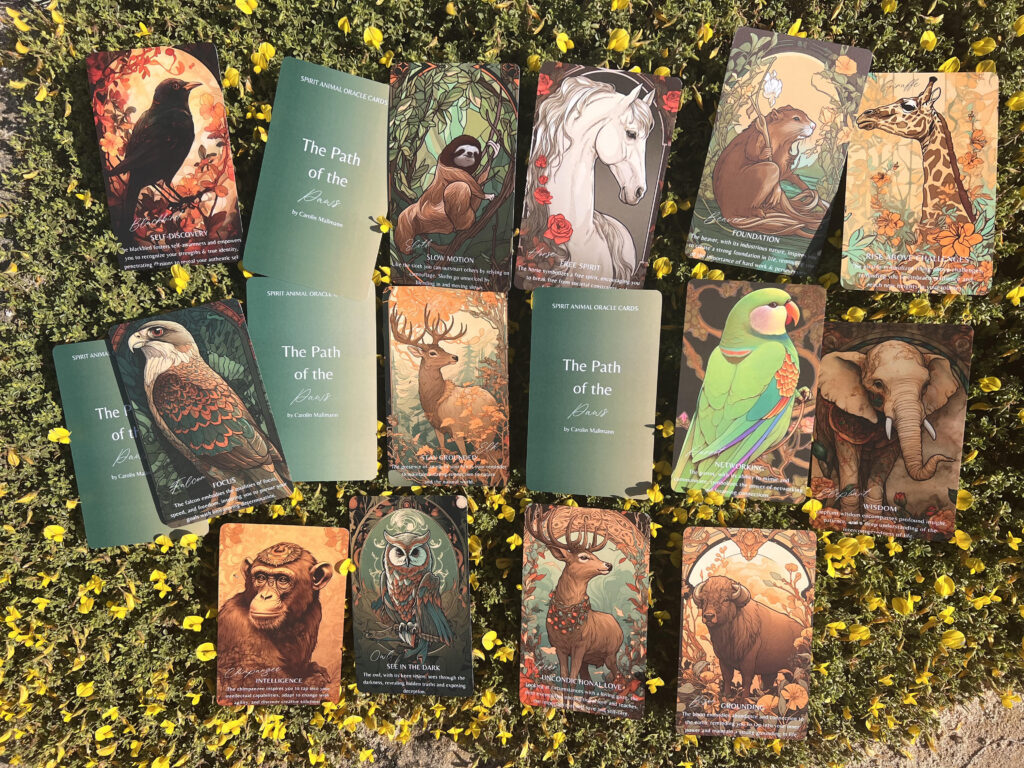
How to Journey to the Sloth
Shamanic work is not a substitute for medical or psychological care — and if what you are feeling is not tiredness but a heaviness that will not lift, please treat that with real support first. If you are new to journeying, begin with the step-by-step guide to finding your spirit animal and return here.
- Ask a sloth-shaped question. Not “help me relax” but: where am I spending energy I do not actually have — and what am I afraid will happen if I stop?
- Enter through the canopy, slowly. Let a steady drumbeat carry you up into a warm forest and find the sloth already hanging there. Do not climb toward it in a hurry. Match its pace on the way up; the slowing down is half the medicine.
- Do not ask it to move. Hang beside it. Notice how quickly the urge rises to make something happen, and let that urge pass without obeying it. What the sloth teaches, it teaches through stillness, not through action.
- Ask what is worth coming down for. The sloth descends once a week for the one thing that genuinely requires the risk. Ask it to show you your equivalent — the single exposed, necessary act you have been avoiding by staying busy with everything else.
- Practise one real rest this week. Not collapse, not scrolling — a deliberate hour of doing nothing useful, chosen on purpose. If your first reaction is that you do not have the time, that reaction is the diagnosis, and the sloth has just done its work.
Affirmations for Sloth Wisdom
- “My pace is a strategy, not a failure. I move at the speed my energy honestly allows.”
- “Not reacting is sometimes the strongest thing I can do.”
- “I rest to be restored — and I still come down for what truly matters.”
Sloth Spirit Animal: Questions People Actually Ask
What does it mean when a sloth appears to you?
It almost always points to pace and energy — and specifically to the gap between how fast you are moving and how much fuel you actually have. The sloth does not arrive to make you lazy. It arrives when your life has become all motion and no rest, to remind you that slowing down is not a reward you earn but a condition of surviving the distance.
Is the sloth a good or bad omen?
Good, and gentle — one of the least threatening guides there is. But it is an omen that asks a real question in return: whether your stillness is restoring you or stranding you. The sloth blesses genuine rest and quietly refuses to bless avoidance dressed up as peace.
What does a sloth in a dream mean?
Watch where it is. A sloth resting easily in the canopy is usually a call to slow down and trust that things are progressing without being forced. A sloth stranded on the ground, unable to climb, points the other way — to a stillness that has stopped protecting you, or an exhaustion that has gone past rest and needs care.
What is the spiritual meaning of the sloth’s slowness?
Its slowness is precision, not idleness. The sloth moves exactly as much as its energy allows and no more, and its safety comes from not over-reacting to the world. Spiritually, it models a life measured against your true resources rather than against the pace others expect — and the discipline to conserve what you have for what genuinely matters.
How do I know if the sloth is my spirit animal?
It tends to claim people who are gentle, patient and quietly depleted — often the ones who look calm while running on empty. Look for repetition you cannot explain away. To work with it deliberately, walk through the A–Z guide to spirit animals, sit with the Path of the Paws oracle deck, or read the snail spirit animal next if slowness and inner sanctuary are the thread you are pulling on.
Is the Sloth Your Spirit Animal?
Check the boxes that resonate with your spirit and current life journey.
The sloth will not tell you to try harder. It will show you that the slowest animal in the forest is also one of the most enduring — because it never once spends what it does not have, and it always comes down for what truly matters.