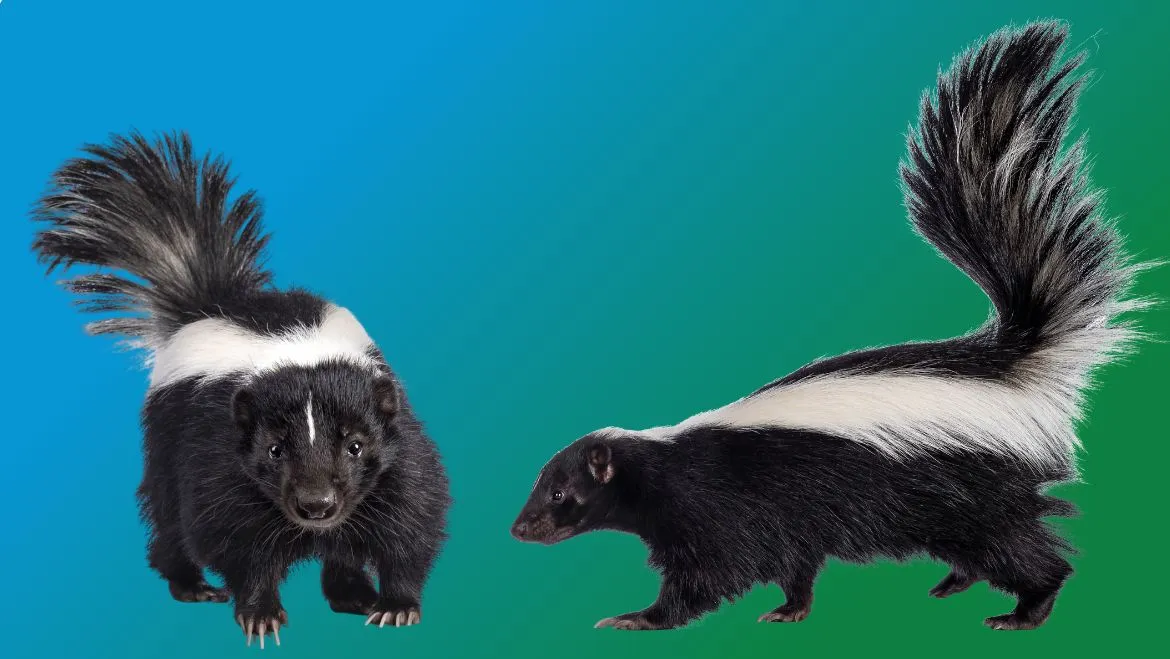
The skunk is the one guide that clears a space before it ever does anything. On a journey it does not lunge and it does not hide — it turns, lifts its tail, and waits, and the whole scene rearranges itself around that pause. Everything gives it room. People come back from meeting it slightly embarrassed, because the skunk has a composure they recognise as something they lost somewhere: the ability to be small and completely unbothered at the same time.
This page is about the skunk spiritual meaning — what it means when this animal keeps appearing in your dreams, your journeys, or at the edges of your waking life — not about its diet or its den. And it is a guide almost everyone underestimates, because it looks like a nuisance. In my practice, the skunk arrives for people who have been over-explaining themselves — apologising for taking up space, negotiating their own boundaries down to nothing, and then wondering why they feel walked over.
The Bridge: What Skunk Biology Teaches About the Skunk Spirit Animal
Honest animal medicine starts with the real creature, and almost everything the skunk has to say grows out of how it actually defends itself.
- It warns before it acts. A skunk does not spray on sight. It stamps its front feet, raises its tail, hisses, and only sprays when every clear signal has been ignored. Skunk medicine is the boundary that is announced, not hidden — the clean warning given in time, so that what follows is a consequence rather than an ambush.
- Its defence works by reputation. Most predators leave a skunk alone without either side ever making contact. The black-and-white coat is a promise the animal rarely has to keep. The medicine is that a boundary respected in advance means you almost never have to enforce it — your clarity does the work your anger would otherwise have to.
- It is unhurried. A skunk ambles. It does not flee, because it does not need to. That slow, deliberate walk is not arrogance — it is the calm of an animal that knows exactly what it is carrying and has nothing to prove.
- Its weapon is a last resort, and it is costly. A skunk holds only so much spray and takes days to replenish it. It cannot afford to use it carelessly. The medicine is discernment — real boundaries are not fired at everything that moves; they are spent rarely, and they mean something because of it.
When the skunk appears as your guide, the question it carries is usually: where have you stopped warning people clearly — and started either swallowing everything or exploding without notice?
Skunk Symbolism Across Traditions
The skunk is a creature of the Americas, and its symbolic life is rooted there rather than spread thin across the whole world. I would rather say less and say it accurately than invent a global mythology the animal never had.
The name itself carries the teaching
The English word skunk comes from an Algonquian language of the north-eastern woodlands — a word carried into English from the peoples who lived alongside the animal long before Europeans arrived. Its scientific name, Mephitis mephitis, simply means “noxious vapour,” said twice. Between the two names you already have the animal’s whole reputation: a being defined, in the outside world’s eyes, entirely by its defence. Part of skunk medicine is refusing to be reduced to that — to be known for how you protect yourself rather than for what you actually are.
Native American traditions of North America
Across a number of Native American peoples who share the skunk’s range, it appears with a consistent thread: it is treated as an animal of self-respect and of a power that does not need to raise its voice. These are living traditions belonging to specific nations, and I reference them as an outsider acknowledging their depth rather than claiming their stories or ceremonies. The recurring teaching is that the skunk commands respect precisely because it does not seek confrontation — its dignity is not aggression, and its warning is not a threat but a courtesy.
The modern reading: reputation and presence
In our own culture the skunk has become shorthand for the thing nobody wants near them, and that discomfort is instructive. We are uneasy with people who hold firm boundaries without apology, and we tend to call them difficult. The skunk reframes that entirely: presence is not aggression, and a clear boundary is a form of honesty. The person who tells you plainly where the line is has done you a kindness. It is the ones who never warn you — and then quietly withdraw, or suddenly detonate — who are harder to live beside.
The Shadow: When the Warning Never Comes
Skunk medicine has a shadow at both ends, because the animal’s whole gift is timing — and timing is exactly what people lose when boundaries have gone wrong.
- The boundary that is never spoken. The most common distortion I meet with this animal is the person who has swallowed every warning — who says yes when they mean no, absorbs the encroachment, and keeps the tail down long past the point of self-respect. The spray does not disappear when it is not used. It builds.
- The ambush. The opposite shadow: no stamp, no hiss, no warning — just the sudden, disproportionate discharge, weeks of tolerance ending in one scene that leaves everyone stunned. The skunk does not work that way, and it names the pattern in us that does.
- Spraying at everything. The over-defended version — boundaries fired reflexively, warmth kept permanently out of range, every approach treated as an intrusion. A skunk that used its spray on every passing creature would end up defenceless and alone. So does a person.
- Living inside your own defence. When the reputation becomes the whole identity, you disappear behind it. People know the warning and never meet the animal.
A skunk that appears in a dream with its tail already raised often points to a boundary you have been overriding — yours or someone else’s — that is about to make itself felt. A skunk you are afraid to walk past can mark a person or situation you already know to give space to, and have not. And a skunk simply ambling calmly across your path is the gentlest version of the message: you are allowed to move through the world unhurried and unbothered, taking up exactly the room you take up.
How to Journey to the Skunk
Shamanic work is not a substitute for medical or psychological care. If you are new to this, begin with the beginner’s guide to shamanic journeying before attempting the practice below.
- Set a skunk-shaped intention. Not “make me tougher.” Rather: “Show me the boundary I have been refusing to say out loud.” The skunk answers that with unusual precision.
- Journey to dusk. The skunk is a creature of twilight — go to the edge of day, a quiet garden or woodland at the hour when things settle. Do not chase it. Let it amble into view at its own pace.
- Watch how it holds space. Notice that nothing crowds it. Feel what your own body does near that calm — where it braces, where it wants to apologise. That reaction is the diagnosis.
- Ask it to show you your warning. Where in your life have you skipped the stamp and the hiss? Where do you go from silent to explosive with nothing in between? Let it show you the missing middle step.
- Practise the tail, not the spray. In the journey, rehearse the warning itself — the clear, early, unangry “no” or “not that.” The skunk’s power is almost entirely in the signal that makes the weapon unnecessary.
- Afterwards, give one real warning this week. Name one line, calmly and in advance, to someone who has been crossing it. Small and specific. That single clear sentence is how skunk medicine takes root.
Affirmations for Skunk Medicine
- “I say where the line is before it is crossed, not after.”
- “My calm is not weakness. I have nothing to prove and nothing to hide.”
- “I move through the world unhurried, taking up exactly the room I take up.”
Skunk Spirit Animal: Questions People Actually Ask
What does it mean when a skunk crosses your path?
It is almost always a message about boundaries and self-respect. The skunk tends to arrive for people who have been letting themselves be crowded, and it comes to remind them that a clear, early warning is not aggression — it is honesty. Read it as a nudge to say plainly where your line is, before it gets crossed rather than after.
Is the skunk a good or bad omen?
A good one, though rarely a comfortable one. The skunk is not a warning of danger from outside; it is an invitation to reclaim your own presence. Its only bad news is for the habit of self-erasure — the skunk has no patience for it, and that is precisely why it is worth listening to.
What does a skunk in a dream mean?
Read what it is doing. A skunk with its tail raised usually points to a boundary being overridden that is about to make itself felt. A skunk you are afraid to pass often marks a person or situation you already know to give space to. A skunk ambling calmly is the gentle version: permission to move through your life unbothered and unhurried.
How do I know if the skunk is my spirit animal?
Persistence, not preference — whether the image keeps returning uninvited. People who carry skunk medicine often struggle with the same pair of things: saying no early, and being at ease taking up space. For a structured way to test the connection rather than guess, work through the A–Z spirit animal guide or sit with the Path of the Paws oracle deck and let the animal find you.
Where in your life is the skunk asking you to raise the tail — to give the clear warning before, not the explosion after?