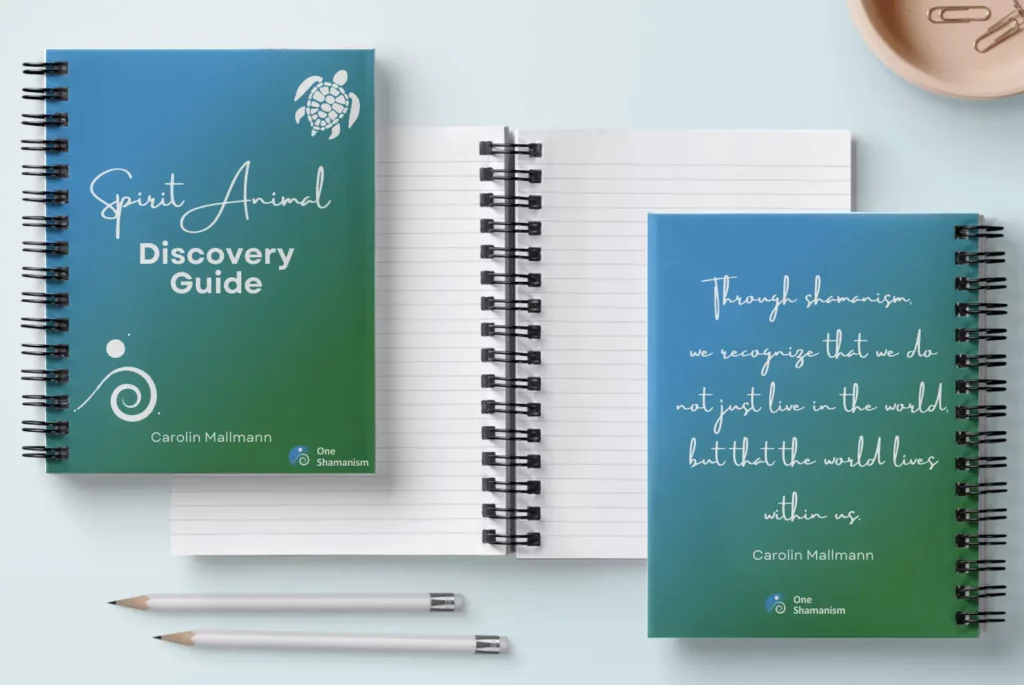
Working with a spirit animal supports the psyche because it uses three things psychology already knows are useful: inner images, distance from the problem, and a figure on your side when things get hard. Shamanic cultures never called it imagery, self-distancing or resource work. They simply did it, for thousands of years, with a drum and an animal.
Below are seven reasons a spirit animal can be good for your mind. For each one I tell you what the research shows, and where it shows nothing yet. Spirit animal work does not need hype. It stands on its own, as long as you stay honest about what it can do.
How does spirit animal work affect the psyche?
When you work with a spirit animal, you picture it, speak with it, move like it or meet it on a shamanic journey. To your brain, all of that is work with mental imagery, and imagery reaches your emotions more directly than thoughts in words. There is a second effect too. The moment an animal tells you something about your situation, you are looking at that situation from outside. You are no longer stuck in the middle of it.
You do not have to believe in a spirit world for these effects to happen. I work as a shamanic practitioner and I train people in NLP, and from both sides I see the same thing: the animal gives your inner life a shape you can talk to.
| Reason | What happens | How well it is studied |
|---|---|---|
| 1. Images move feelings | Imagery triggers stronger emotion than words | Well, several lab experiments |
| 2. Distance from the problem | You see your situation from outside | Well for self-distancing, not for animals specifically |
| 3. An inner helper | A safe figure stays with you | Established practice in trauma therapy |
| 4. The drum | The brain turns inward | Small, early studies |
| 5. Animals calm you | Less stress around animals | Well for real animals, open for imagined ones |
| 6. The body learns too | Posture changes mood | Practice and NLP experience |
| 7. A steady rhythm | Small rituals give you something to hold | Practice experience |
1. Images reach your feelings faster than words
You can tell yourself a hundred times that you are safe. Picture a bear standing broad and calm behind you, and your body notices the difference straight away.
Psychologist Emily Holmes and her colleagues showed in experiments that people react more strongly to the same information when they imagine it as a picture than when they put it into a sentence. This research also supports a clinical method called imagery rescripting, in which painful memories are changed in the imagination. A 2017 meta-analysis of 19 studies with 363 adults found the method promising, although most of those studies were small.
Spirit animal work is not imagery rescripting. It does use the same route, though. It speaks to your feelings through images rather than arguments, which is why an animal often gets through where good intentions no longer do.
But images are only half of it. The other half is who is speaking.
2. The animal gives you distance from your problem
Ask your spirit animal what it thinks of your situation and you answer yourself, but from a different place. The fear feels smaller, because you are looking at it from the outside.
Ethan Kross and his team measured this. Across seven studies with 585 people, those who talked to themselves in the third person or by their own name during a stressful task felt less distress, ruminated less and saw the task as a challenge rather than a threat. Narrative therapy, developed by Michael White and David Epston, works along similar lines: it separates the problem from the person so the person can stand up to it.
A spirit animal is a very old way of doing the same thing. It stands outside you, so it can say things you would never allow yourself to say. Nobody has studied this with animal figures specifically. What is well documented is that self-distancing helps people handle stress.
Distance is not always enough, though. Then it helps to have someone who stays with you.
3. You gain an inner helper who stays with you
Inner helper figures are a standard part of imagination-based trauma therapy. The German psychiatrist Luise Reddemann made them widely known: people picture a safe place and beings who are on their side. An animal is a natural choice for many people.
A spirit animal does the same job. It is a figure that knows you, stands with you and can be called when things get hard. In my own work I keep seeing the same thing: in a crisis, people rarely need a technique first. They need to feel they are not alone. You often only notice how much that matters when the connection breaks. Shamanism calls that power loss.
To be honest about the evidence: the helper figure on its own has not been tested separately from the therapy around it. And with serious trauma it belongs with a trained professional.
In shamanic practice you do not usually meet your helper out of nowhere. You travel to it.
4. The drum shifts how your brain works
The classic way to meet a spirit animal is the shamanic journey, carried by a steady drumbeat. In 2016 a research team led by Michael Hove put fifteen experienced shamanic practitioners into a brain scanner while they listened to drumming, once in trance and once without.
In trance, brain regions linked to inner experience worked together more closely, and the hearing areas became less tied to the outside world. The researchers suggest this may help people stay with an inner train of thought for longer. A separate 2016 study in London looked at group drumming with people using mental health services. After ten weeks, depression and anxiety had eased in the drumming group but not in the comparison group, and the drummers still showed the improvement three months later. The groups were small and not randomly assigned.
Both studies are small, and the second one is about social drumming rather than journeying. Still, they point to the drum doing more than setting a mood. If you want to start journeying safely, read Is Shamanic Healing Safe? first.
So why an animal, and not an angel or a wise old man?
5. Animals calm your nervous system
We respond to animals with our bodies. In 2012 Andrea Beetz, Kurt Kotrschal and colleagues reviewed the research on contact between people and animals. The best supported effects were lower stress (measured through cortisol, heart rate and blood pressure), less anxiety and better mood. They proposed the bonding hormone oxytocin as a possible explanation.
These findings are about real animals: the dog on your lap, the horse in the field. Whether an imagined animal has a similar effect has not been studied. I think it is likely that some of it carries over when you picture your animal vividly. I cannot prove it.
That is one more reason to get to know the living animal. My first power animal was the roe deer. Whenever I see one between the trees in the hills where I live in Portugal, the connection is there at once, no drum needed.
There is also a way in that skips the head altogether.
6. Your body learns the animal’s strength
In many shamanic traditions the spirit animal is danced. You move for a few minutes the way it moves: heavy and slow like a bear, alert like a fox, wide like an eagle. The first time it feels silly. Afterwards you are usually calmer and stand a little taller.
NLP works with the same link. Change your posture, your breathing and your pace, and your state changes with them. The animal gives you a picture that is far easier to remember than an instruction like “drop your shoulders, breathe slower”. Before a hard conversation, think of your bear, and your body knows what you mean. You will find more simple practices in How to Honor Your Spirit Animal.
None of this works if you only do it once, though.
7. A steady rhythm gives you something to hold on to
Steadiness rarely comes from big moments. It grows out of small things done every day. A short hello to your animal in the morning and one question in the evening take a few minutes, and they give you time with yourself before the day takes over.
That is why I made The Path of the Paws. Every morning the app shows you a spirit animal, its message and a small practice for the day. It also has meditations, drum journeys and a private journal. It is free on iPhone and Android. You can read more on the app page.
If you do not know your animal yet, start with how to find your spirit animal, step by step. And if you would like company along the way, we drum and journey together every Monday evening in the free Lightkeepers’ Hearth circle.
Where the limits are
No large study has looked at spirit animal work as a whole. The research quoted here covers the separate mechanisms underneath it. That they work together in shamanic practice is my experience from more than a decade of teaching, and the experience of many traditions. It is not proof in the scientific sense.
Spirit animal work can sit alongside therapy. It does not replace it. If you are very unstable right now, perceive things other people do not, or tend to lose yourself when you journey, please do not journey alone. Work with an experienced guide, or wait until you are steadier, and talk to your therapist or doctor if you are unsure.
If you want to go deeper with your animal over several weeks, the Spirit Animal Online Course takes you through journeying and daily practice step by step.
Frequently asked questions
Is spirit animal work backed by science?
Not as a whole. Several building blocks are well supported: imagery triggers stronger emotion than words, self-distancing reduces stress, and contact with real animals is calming. There are early, small studies on drumming and trance. How these pieces work together in spirit animal practice has not been studied yet.
Do I have to believe in spirits for my spirit animal to help me?
No. The psychological effects, meaning imagery, distance and an inner helper, happen even if you see your animal as part of your own mind. Many of my students start there and find their own view over time.
Can a spirit animal help with anxiety?
It can support you, especially in the moment. Picturing your animal beside you gives you some distance and makes you feel less alone. An anxiety disorder still needs professional treatment. The animal is a companion to that care, not a replacement for it.
How is a spirit animal different from a helper figure in therapy?
Psychologically they are very close. The difference is the frame. A helper figure in therapy is part of a treatment plan. A spirit animal comes from a spiritual tradition in which it is a being in its own right, and you keep a relationship with it.
How often should I work with my spirit animal?
Short and daily beats long and rare. One minute in the morning keeps the connection alive. A longer journey once a week deepens it.
Who should not do shamanic journeying alone?
Anyone in an acute mental health crisis, anyone who has experienced psychosis, and anyone who dissociates easily. Talk to your doctor or therapist first, and journey only with someone experienced in holding these situations.
Sources
- Holmes, E. A., Mathews, A., Mackintosh, B. and Dalgleish, T. (2008). The causal effect of mental imagery on emotion assessed using picture-word cues. Emotion, 8(3), 395 to 409.
- Morina, N., Lancee, J. and Arntz, A. (2017). Imagery rescripting as a clinical intervention for aversive memories: A meta-analysis. Journal of Behavior Therapy and Experimental Psychiatry, 55, 6 to 15.
- Kross, E. et al. (2014). Self-talk as a regulatory mechanism: How you do it matters. Journal of Personality and Social Psychology, 106(2), 304 to 324.
- White, M. and Epston, D. (1990). Narrative Means to Therapeutic Ends. New York: W. W. Norton.
- Hove, M. J. et al. (2016). Brain network reconfiguration and perceptual decoupling during an absorptive state of consciousness. Cerebral Cortex, 26(7), 3116 to 3124.
- Fancourt, D. et al. (2016). Effects of group drumming interventions on anxiety, depression, social resilience and inflammatory immune response among mental health service users. PLOS ONE, 11(3), e0151136.
- Beetz, A., Uvnäs-Moberg, K., Julius, H. and Kotrschal, K. (2012). Psychosocial and psychophysiological effects of human-animal interactions: the possible role of oxytocin. Frontiers in Psychology, 3, 234.
Written by Carolin Mallmann, shamanic practitioner and NLP trainer, founder of One Shamanism. This article is for personal growth and does not replace psychotherapy or medical care. If you are in crisis, please contact a doctor, a therapist or a local crisis service.
When did your spirit animal last help you through something hard, and what did it feel like? Tell me in the comments. I read every one.