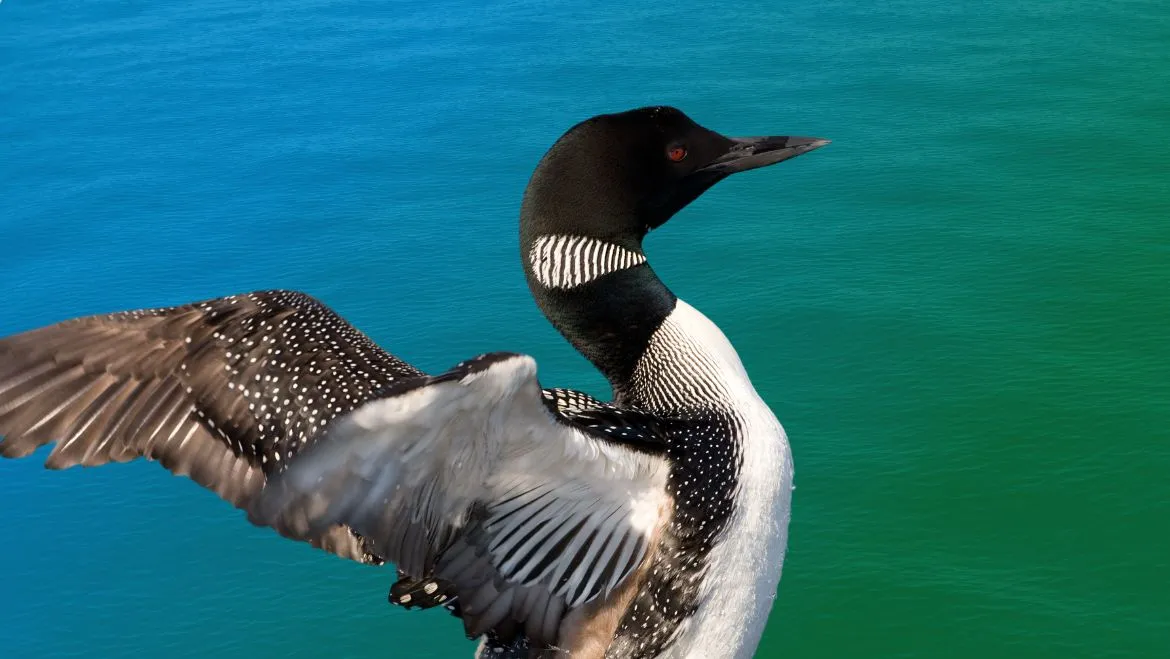
The loon does not arrive in shamanic space the way most birds do. It does not perch, and it does not circle overhead. It surfaces. One moment the water is empty, and the next it is simply there, low in the water, red-eyed, watching — and then, before you have finished registering it, it tips forward and is gone under, leaving nothing but a ring on the surface and the memory of that call. What people report afterwards is almost never the bird. It is the sound, and the sudden certainty that there is something underneath them they have been refusing to look at.
This page is about the loon spiritual meaning — what it means when this bird keeps calling across your dreams, your journeys, or the quiet of your own mind. Not its migration range. In my practice, the loon does not come for people who are lost on the surface. It comes for people who already know there is something at the bottom of the lake, and have built an entire life around not diving for it.
The Bridge: What Loon Biology Teaches About the Loon Spirit Animal
Almost everything the loon has to teach is written into a body built for a single purpose: going down. It is one of the few birds engineered against its own kind’s instinct to stay aloft.
- Its bones are solid, not hollow. Nearly every other bird has air-filled bones to stay light and airborne. The loon has dense, solid bones that make it heavier — because weight is what lets it sink and dive. The loon is built to go under while everything around it is built to stay up. If your gift has always felt like the opposite of what you were supposed to be, start here.
- It can dive deep and stay under. Loons hunt by sight, chasing fish tens of metres down and holding their breath for a minute or more. It does not skim the surface for what floats up. It goes to where the fish actually are. The medicine is the willingness to go to the source rather than wait at the top for scraps.
- Its legs are set far back on its body. This makes it a superb diver and an almost helpless walker — on land the loon can barely move. It is magnificent in the depths and clumsy in the shallows. People who carry loon medicine are frequently the same: profound in deep water, awkward on the small talk of dry land.
- It needs a long runway to rise. A loon cannot launch from a puddle. It must run across open water, sometimes for a hundred metres, before it can lift into the air. It cannot take off from a small place. Neither, if this is your animal, can you — and mistaking a small pond for a failure of your wings is one of the oldest errors this bird corrects.
When the loon surfaces as your guide, the question it carries is usually some version of: what is at the bottom that you have been circling for years without diving for — and what would it take to finally go down and bring it up?
Loon Symbolism Across Traditions
The loon belongs to the cold lakes of the northern hemisphere, and its symbolic history sits there — with the peoples who have shared those waters for millennia. I would rather be accurate about a few traditions than vague about many.
The earth-diver: the bird that brings up the world
Across a wide belt of northern cultures — from Finno-Ugric and Siberian peoples to many nations of North America — there is a creation story known to folklorists as the earth-diver. In the beginning there is only water. A diving bird plunges to the very bottom and returns with a single beakful of mud, and from that scrap of matter, hauled up from the deepest place, the whole world is made. In more than one telling, that bird is a diver — a loon. This is the loon’s oldest and truest medicine: that what a world is built from has to be carried up from the very bottom. Nothing real is made from what was floating conveniently on the surface.
Ojibwe: the loon as a voice of leadership
Among the Ojibwe (Anishinaabe), the loon — mang — gives its name to one of the clans, and the Loon Clan is traditionally associated with leadership and with the work of speaking for the people. I mention this carefully, because it belongs to a living people and is not a symbol set for general borrowing. But the principle inside it is worth sitting with: the voice that leads is the one that has been to the depths and can speak from them. The loon’s authority, in this reading, is not loudness. It is depth made audible.
The four calls: a language of the deep
The loon has four distinct calls, and once you know them the bird stops sounding eerie and starts sounding precise. The long, rising wail is contact across distance — where are you? The tremolo, the laughing sound, signals alarm or agitation. The yodel is the male’s territorial declaration. The soft hoot is intimacy, used close-up between mates and with chicks. That range is itself the teaching: the same throat that cries out across an empty lake also murmurs to its young. Depth of feeling is not one note. It is a full language, and the loon uses all of it.
The Shadow: When Depth Becomes Drowning
The loon has one of the more serious shadows of the water birds, precisely because its gift is so genuine. The line between diving and drowning is thin, and this animal lives right on it.
- Going down and not coming back up. The whole point of the dive is the return — the mud has to reach the surface for a world to be made of it. The shadow is descent with no resurfacing: rumination that calls itself reflection, a sinking into feeling that never brings anything back. If you dive and never surface, that is not depth. It is drowning, and it is worth naming honestly.
- Solitude weaponised. Loons are territorial and often alone on their breeding lakes, and the medicine of self-containment is real. But “I need my depth, I need my space” can quietly become a wall — a way of never letting anyone near the bottom of you. The most common distortion I meet with this animal is a person using the language of depth to justify a life of disconnection.
- The call that pushes people away. The loon’s cry is beautiful and it is also, to some, unbearably lonely. Expressed as shadow, it is a way of crying out that keeps others at exactly the distance that guarantees no one comes. The sound says find me and is pitched so that no one can.
- Absorbing the water’s poison. Loons are an indicator species — they accumulate the mercury and pollution of the lakes they live in, and they sicken when the water does. People with this medicine are frequently the sensitive ones who absorb the toxicity of a family or a workplace and mistake it for their own. If the loon has arrived while you are quietly carrying a system’s poison, that is the message.
A loon appearing trapped under ice in a dream is one of the clearest images of a depth that has become a trap rather than a resource — feeling frozen over, unable to surface for air. A loon calling and calling with no answer speaks to a cry for contact that has been pitched, often unconsciously, so that it cannot be answered. And a loon unable to take off — running and running across the water without rising — points to a season of genuine flightlessness, and asks whether you are in a pond too small to launch from.
How to Journey to the Loon
Shamanic work is not a substitute for medical or psychological care, and the loon’s territory — deep feeling, grief, the unconscious — is exactly the territory where that matters most. If you are new to this, begin with the beginner’s guide to shamanic journeying first.
- Journey to a still lake at dusk. Northern water, cold and dark, the light going. The loon does not belong to bright open savannah or busy shorelines. Go to the quiet lake and wait at its edge.
- Follow the call, do not chase the bird. You will hear it before you see it. Do not thrash toward it. Let the wail locate you. The loon comes to stillness and vanishes from pursuit.
- Ask it what is at the bottom. This is the heart of the practice. Name, as precisely as you can, that you know there is something down there — and ask the loon to show you what. Then be prepared for it to dive, expecting you to follow.
- Go down with it — and set an intention to come back up. Before you descend, fix the return. “I am going to the bottom, and I am bringing one thing back to the surface.” The loon dives to return, never to stay. Structure your journey the same way.
- Bring up one beakful. Not the whole lakebed. The earth-diver surfaces with a single mouthful of mud, and that is enough to make a world. Ask what one thing you are meant to carry up this time, and leave the rest for another dive.
- On the way out, ask about your voice. “What am I trying to say that I keep pitching so no one can answer?” The loon’s four calls are a reminder that depth is meant to be communicated, not only endured.
Affirmations for Loon Medicine
- “I am built to go under. My weight is not a flaw — it is what lets me reach the depths.”
- “I dive to return. Whatever I go down for, I bring back up.”
- “I let my call be one that can actually be answered.”
Loon Spirit Animal: Questions People Actually Ask
What does it mean when you hear a loon call?
A loon’s call arriving at a meaningful moment is usually a summons inward and downward. In the traditions that know this bird, its voice opens a channel between the surface world and the depths. The reading is rarely “good news is coming” — it is closer to “there is something under the surface asking for your attention, and it will keep calling until you dive.”
Is the loon a good or bad omen?
Good, but demanding. The loon is not a malevolent sign anywhere I know of — it is sacred across the northern cultures that live with it. What makes it feel heavy is that it deals in depth, grief and the unconscious, and it tends to arrive exactly when you would rather stay on the surface. It is a kind omen that asks a hard thing.
What does a loon in a dream mean?
Watch what the water is doing. A loon diving cleanly and surfacing points to healthy descent — you are able to go into your depths and return. A loon trapped under ice or unable to surface speaks to feeling frozen over or stuck in your own depths. A loon calling into an empty lake usually points to something you are trying to express and unconsciously keeping unanswerable.
What does the loon symbolise spiritually?
At its core: depth that returns with something. The loon is the earth-diver, the bird that goes to the very bottom and carries up the material a world is made from. Spiritually it stands for emotional depth, intuition, the courage to descend into what is under the surface, and — crucially — the discipline to come back up and make something of what you found.
How do I know if the loon is my spirit animal?
Persistence, not preference. If the call keeps returning uninvited — in dreams, in journeys, in the strange pull of the sound — take it seriously. People who carry this medicine often feel more at home in deep water than in the shallows of ordinary social life. For a structured way to test the connection, work through the A–Z spirit animal guide or sit with the Path of the Paws oracle deck and let the animal find you. If it is water and stillness you are drawn to, you may also recognise yourself in the blue heron.
The loon does not call to pull you under. It calls to remind you that you already know what is down there — and that you were built, uniquely, to go and bring it back.