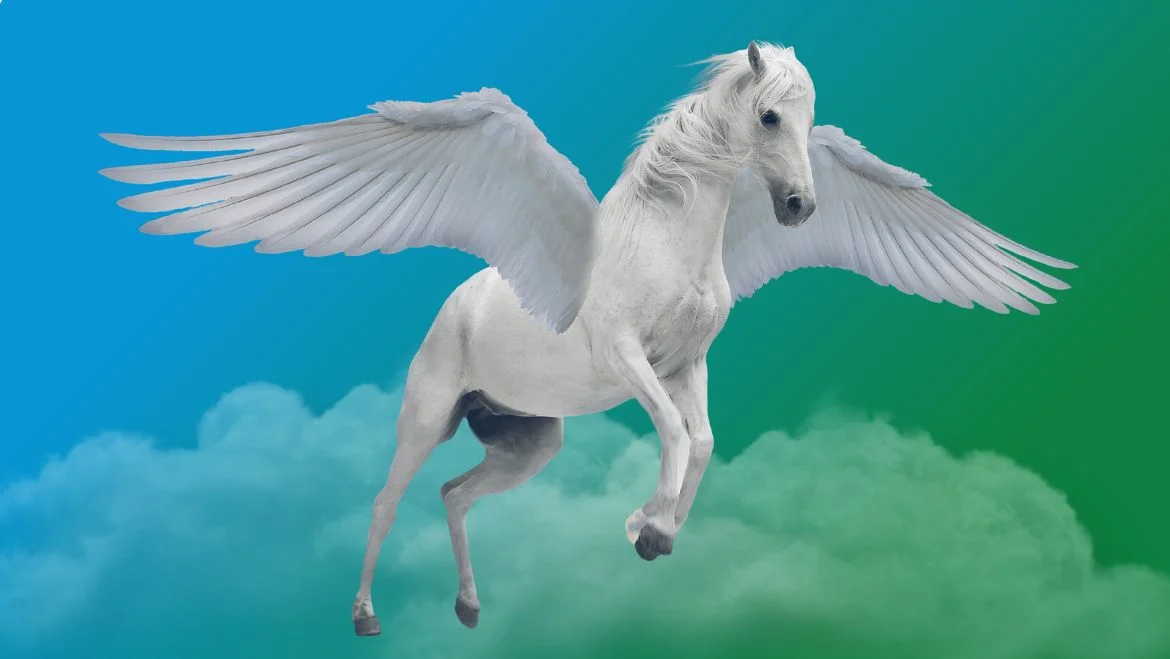
There is a particular way Pegasus arrives in a journey, and it is almost never the soft, greeting-card version. People do not describe a gentle white horse drifting down to meet them. They describe a downdraft — a sudden movement of air, a largeness overhead — and then the animal is simply there, close, breathing, wings still half-open. What they report afterwards is not delight. It is a strange, tearful relief, as if something they had given up on was still alive after all.
This page is about the Pegasus spiritual meaning — what it means when the winged horse keeps appearing in your dreams, your journeys, or the images that will not leave you alone. It is not about mythology trivia. In my practice, Pegasus does not come to people who want to escape their lives. It comes to people who have just been through something — a loss, a collapse, a confrontation with their own worst material — and who do not yet realise that they came out of it carrying wings.
The Bridge: What the Myth of the Pegasus Spirit Animal Actually Encodes
Pegasus has no biology to anchor it — it is a mythical creature. But a good myth is built with the same precision as an animal’s body, and every detail of this one carries the medicine.
- It is born from a severed head. Pegasus springs from the blood of Medusa at the moment Perseus cuts her down. This is not decoration. The winged horse does not appear before the monster is faced — it appears out of the wound. If Pegasus has come to you, the myth is telling you where it came from: something in you was confronted, and this is what was released.
- It is a horse first, and a horse is a ground animal. Pegasus is not a bird. It is a creature of muscle, weight and gallop that also happens to fly. The medicine is not disembodiment. It is a grounded power that has been given lift — which is very different from floating away.
- Where its hoof strikes, a spring opens. The Hippocrene, the fountain of the Muses, is said to have burst from the ground under Pegasus’s hoof. Inspiration, in this image, is not something you reach up for. It is released downward, by contact, where the animal’s weight meets the earth. You do not get inspired by leaving the ground. You get inspired by landing hard on the right spot.
- It cannot be taken by force. Bellerophon only rides Pegasus with the golden bridle Athena gives him — wisdom, not domination. And when he later tries to ride it up to the seat of the gods out of pride, he is thrown. The horse keeps going; the man falls. Pegasus lends its lift; it does not belong to your ego.
Pegasus Symbolism Across the Greek World and Beyond
Pegasus belongs to a specific tradition, and it is worth being accurate rather than sweeping. Its home is Greek, and its meaning is richest when it is read there first.
Greek myth: the horse of the aftermath
In the Greek material Pegasus is bound up with the Muses, with the hero Bellerophon, and with the slaying of the Chimera — a monster of mismatched parts. Pegasus is the ally of the second stage of the hero’s story: not the descent into danger, but the flight that becomes possible once the danger has been met. It is consistently the animal of what comes after the ordeal, which is exactly why it so often arrives for people who feel they have just barely survived something.
The constellation: fixed in the sky
Pegasus was set among the stars as a constellation, and this is its own teaching. The winged horse does not vanish back into legend; it is placed permanently in the night sky as a marker. Wherever cultures have looked up and named that great square of stars, the message has been the same: what rises out of a genuine transformation is not temporary. It becomes part of the map you navigate by.
The wider winged-horse motif
Winged and sky-crossing horses appear well beyond Greece — from the swift steeds of Vedic imagination to the flying horses of Central Asian and Persian story. I will not flatten these distinct traditions into one symbol, because they are not one thing. But the recurring instinct is worth naming: across cultures, human beings have reached for the image of a horse that can leave the ground to describe the moment when ordinary strength suddenly becomes something more. That instinct is what Pegasus makes vivid.
From Greek pottery to Renaissance painting to the logos of the modern world, Pegasus has been used again and again as the emblem of aspiration. Strip the decoration away and the same core remains: it is the figure of what is released when you stop running from the thing and turn to face it instead.
The Path of the Paws
42 hand-illustrated oracle cards, one for each animal guide — drawn from the same practice these articles come from. A way to sit with an animal instead of only reading about it.
Order your deck →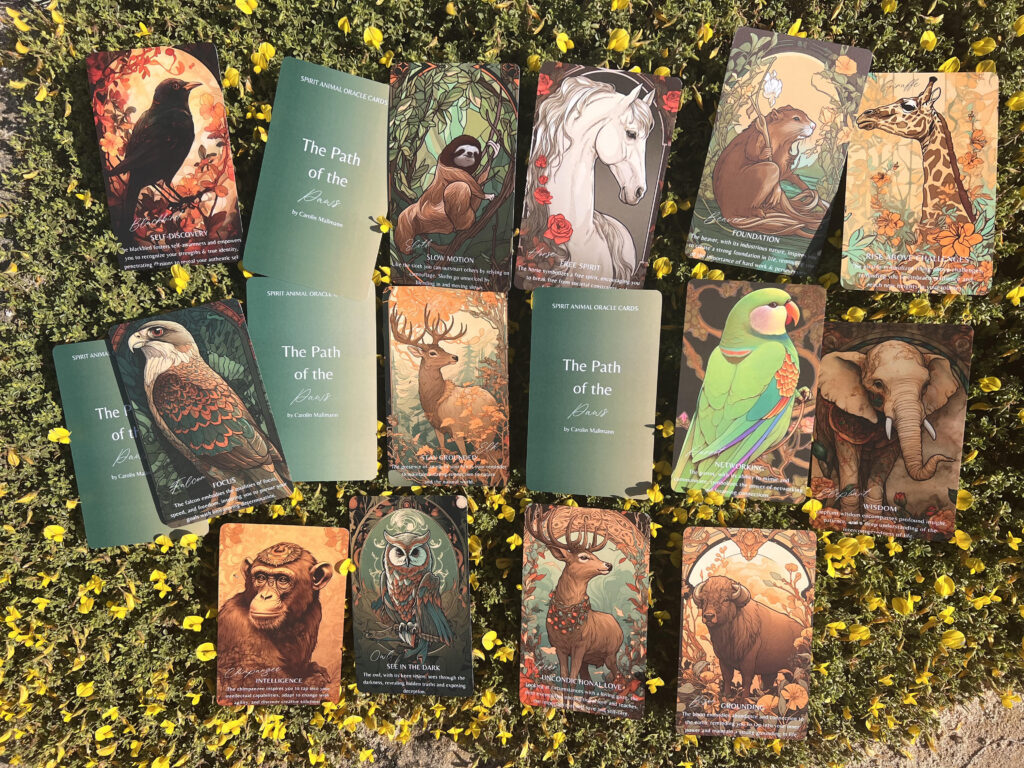
The Shadow: When the Wings Become an Escape Hatch
Pegasus is one of the most flattering guides to receive, and that is precisely why its shadow is so easy to miss.
- Flight as avoidance — spiritual bypass. This is the distortion I encounter most often with this animal. The wings become a way of never landing: endless inspiration, endless vision, endless rising above the mundane — and no contact with the hard, specific ground where a life is actually built. Pegasus is a horse. A horse that never touches down is not free. It is stranded in the air.
- Bellerophon’s fall. The rider who tries to force Pegasus up to the throne of the gods is thrown, and spends the rest of his life limping and alone. The shadow here is using genuine inspiration to inflate the ego — mistaking the gift for a personal greatness you are owed. The horse will not carry that, and the fall is long.
- Wings without the wound. Some people want Pegasus without Medusa — the lift without the confrontation that produces it. In my experience that produces a brittle, performed version of inspiration that collapses under any real pressure, because nothing was actually faced. The wings are real only when the head has been cut off.
- The caged or grounded winged horse. When Pegasus appears in a dream unable to fly — penned, wounded in the wing, or tethered — it usually points to a real creative or spiritual capacity that has been shut down, often by someone who found it inconvenient. This is a grief image, and it deserves to be taken seriously rather than explained away.
How to Journey to the Pegasus Spirit Animal
Shamanic work is not a substitute for medical or psychological care. If you are new to this, begin with the beginner’s guide to shamanic journeying before attempting the practice below.
- Name what you have just come through. Pegasus is the animal of the aftermath, so do not journey to it from the middle of a crisis. Name the Gorgon you have already faced: “The thing I confronted is …” The horse responds to that honesty.
- Journey upward, from solid ground. Most guides in this tradition are met by descending. Pegasus is an Upper World animal — but start with your feet on real earth, a hillside or open field, and let it come down to you. Do not launch yourself into the sky reaching for it.
- Do not seize it. Remember the golden bridle. You do not grab this animal. You wait, you show it your intention, and you let it decide whether to lower its head to you. Grasping produces nothing here.
- If it lifts you, watch where it goes — and watch when you want more. Notice the exact moment your mind reaches for altitude out of pride. That impulse is Bellerophon’s, and it is the most useful thing the journey will show you.
- Find the spring. Before you return, ask Pegasus to show you where its hoof strikes the ground in your own life — the specific, unglamorous place where contact would release inspiration. That location is the whole point of the journey.
- Integration: land one thing. Within the week, take a single piece of the vision and put it on the ground — one concrete, finishable action. Pegasus medicine dies in people who stay airborne. It takes root in the ones who land.
Affirmations for Pegasus Medicine
- “What rose in me came out of what I faced. The wings are made of the wound.”
- “I am a horse before I am a flight. I keep my feet on the ground I take off from.”
- “Inspiration is released where I make contact, not where I escape.”
Pegasus Spirit Animal: Questions People Actually Ask
What does it mean when Pegasus appears to you?
It almost always marks the aftermath of something difficult. Pegasus is the animal of what rises once a confrontation is over — a loss survived, a fear faced, a monster met. Its appearance is less “you are about to soar” and more “you have already been through the part that earns the wings, and you have not noticed them yet.”
Why do I keep dreaming of a winged horse?
A recurring winged-horse dream usually points to a creative or spiritual capacity that is asking to be let off the ground. Read what the horse is doing: flying freely suggests the capacity is live and available; grounded, caged or injured suggests it has been suppressed and is asking to be released. Write the dream down before you interpret it.
Is Pegasus a good omen?
Yes — but it is an omen with a condition attached. Pegasus brings inspiration and freedom, and then it waits to see whether you will ground them or use them to float away from your life. An omen you never land is just a pleasant feeling. The good news is real; it simply asks to be built on.
What is the difference between Pegasus and the horse spirit animal?
The horse spirit animal carries freedom, power and partnership on the ground. Pegasus is that same power given lift — inspiration, transcendence, and the capacity to rise after transformation. If the animal that came to you was unmistakably winged, that detail is the message, not an accessory.
How do I know if Pegasus is my spirit animal?
Persistence, not preference — whether the winged horse keeps returning uninvited, particularly after periods of upheaval. For a structured way to test the connection rather than guess, work through the A–Z spirit animal guide, sit with the Path of the Paws oracle deck, or take the journey work step by step in the four-week spirit animal course. If a purely mythical guide keeps arriving, the unicorn spirit animal is worth reading alongside this one.
Is Pegasus Your Spirit Animal?
Check the boxes that resonate with your spirit and current life journey.
Pegasus does not arrive to carry you out of your life. It arrives to show you that the thing you just survived did not break you — it gave you lift. The only question it leaves you with is whether you will use the wings to leave the ground for good, or to finally reach the part of your life you could never get to on foot.