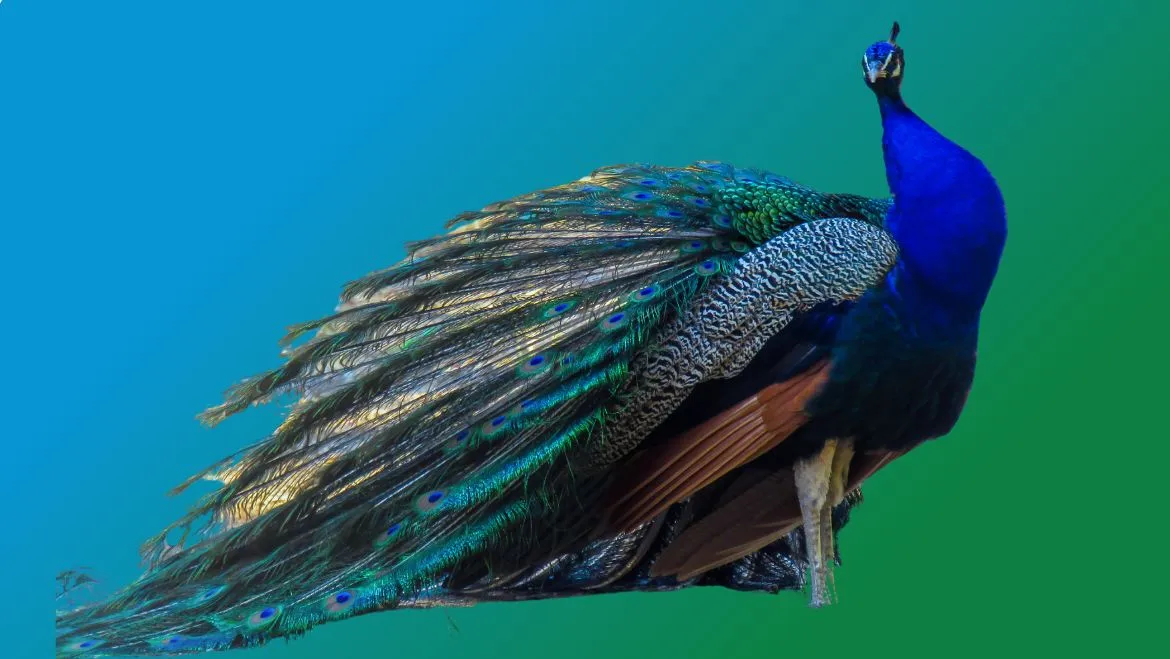
The peacock does not creep into a journey. It arrives — and the first thing most people feel is an odd mixture of awe and embarrassment, as if they have been caught wanting to be seen. That reaction is the whole teaching in miniature. The peacock comes for people who have spent a long time making themselves smaller, dimming their colour so as not to take up too much room, and it stands in front of them fully unfurled, entirely unapologetic, asking a single quiet question: why are you hiding what you were given?
This page is about the peacock spiritual meaning — what it means when this bird keeps appearing in your dreams, your journeys, or the strange persistence of an image that will not leave. It is about meaning, not ornithology. If you came to identify the bird in your garden, you are in the wrong place. If the peacock has been showing up in your inner life, stay.
The Bridge: What Peacock Biology Teaches About the Peacock Spirit Animal
Honest animal medicine is anchored in the real creature, and the peacock is far stranger and more instructive than the postcard version suggests.
- Its tail is an honest signal, and it is costly. That enormous train is metabolically expensive and makes the bird more visible to predators. The peacock cannot fake it — only a genuinely healthy bird can afford to grow and carry it. Peacock medicine is the courage of real visibility: showing your true colours knowing it costs something and makes you exposed.
- It grows the display back every year. The peacock moults its spectacular train after each breeding season and grows it again from nothing. Its beauty is not a fixed possession but a cycle of renewal — you are allowed to shed how you shine and remake it.
- Its call is an alarm, not a song. The peacock’s loud, startling cry is a warning that carries across distance. The most glamorous bird is also a sentinel. Its voice is not decoration; it is the willingness to sound the alarm and be heard, even when the sound is not pretty.
- Those are not just feathers — they are eyes. The train is covered in eye-shaped markings, the ocelli. Across many traditions this made the peacock the bird of the watchful, all-seeing gaze. To wear the eyes is to be seen and to see clearly at once.
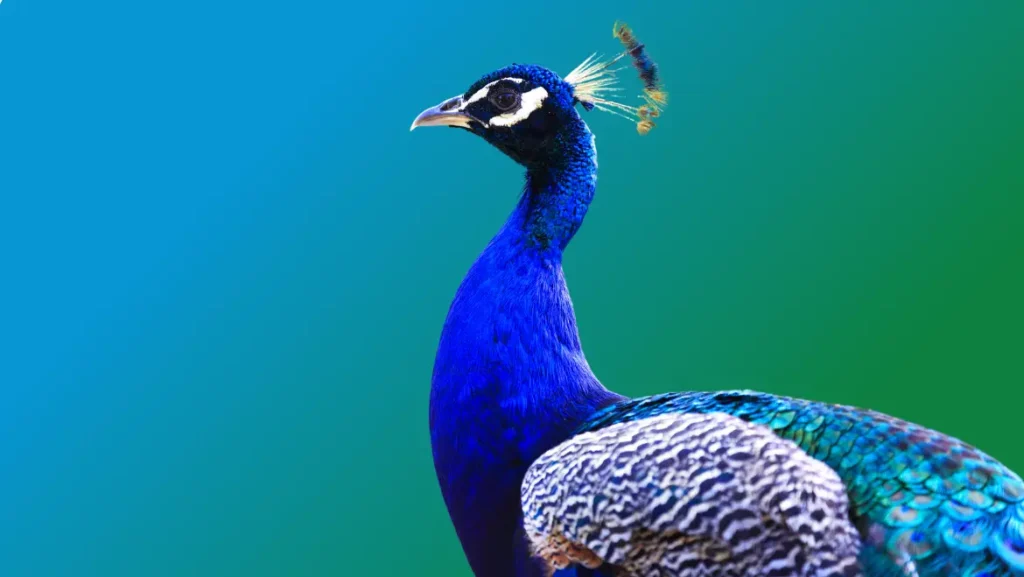
Peacock Symbolism Across Traditions
Wherever the peacock has lived alongside people, it has been read as a bird of royalty, immortality and the transmutation of poison — and the last of those is the thread most guides leave out.
India: the bird that eats poison and turns it to beauty
In Indian tradition the peacock is sacred and everywhere — associated with Saraswati, goddess of wisdom, ridden by Kartikeya, and worn by Krishna in his crown of peacock feathers. The oldest teaching attached to it is that the peacock kills and eats snakes and is unharmed by their venom. Whether or not the zoology is exact, the symbol is precise: the peacock is the one who takes in poison and transmutes it into the beauty of its own train. This is the deepest layer of peacock medicine — the capacity to metabolise what would poison someone else and turn it into something radiant.
Greece and Rome: the hundred eyes of watchfulness
In Greek myth the peacock belongs to Hera, and the eyes on its tail are the hundred eyes of the watchman Argus, set into the feathers after his death so that his watchfulness would never be lost. The peacock became the emblem of the all-seeing, the vigilant, and — through Rome — of imperial dignity. The eyes are a reminder that true visibility runs both ways: to be seen is also to see.
Early Christianity and Persia: immortality and the throne
Early Christian art used the peacock as a symbol of resurrection and eternal life, partly from the old belief that its flesh did not decay and partly from that yearly renewal of the train. In Persian tradition the peacock flanks the Tree of Life and gives its name to the royal Peacock Throne. Across all of it the peacock stands for something that endures, renews, and is worthy of being seen — not vanity, but dignity that has earned its display.
The Path of the Paws
42 hand-illustrated oracle cards, one for each animal guide — drawn from the same practice these articles come from. A way to sit with an animal instead of only reading about it.
Order your deck →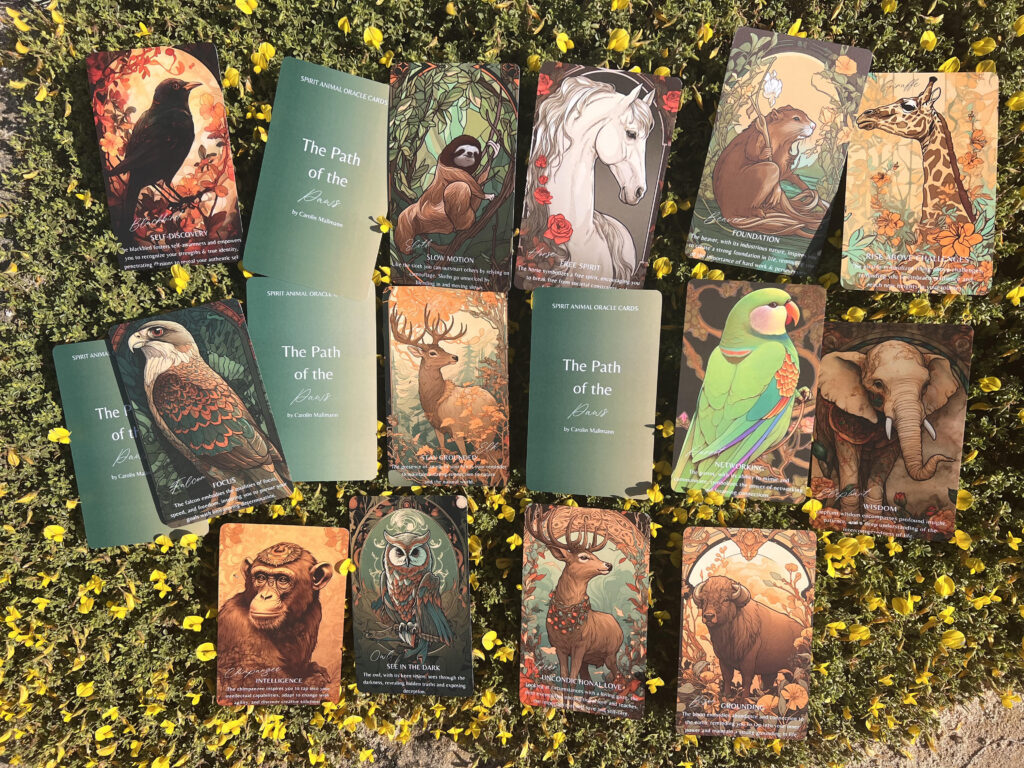
The Shadow of Peacock Medicine
The peacock is the easiest animal in the world to reduce to “vanity,” and that lazy reading hides a shadow that is both more painful and more interesting.
- Display as armour. The most common peacock shadow I meet is not arrogance — it is the person who performs radiance to hide how unseen they feel. The tail becomes a shield: dazzle everyone so that no one looks closely enough to find the frightened bird behind it. If you are always “on,” the peacock is asking who is allowed to see you switched off.
- Worth measured by admiration. When the whole sense of self depends on being looked at, a day without applause feels like a threat. Genuine peacock medicine displays because it is healthy; the shadow displays because without the gaze it disappears.
- The dimmed peacock. The opposite distortion, and just as common: the person who folds the train away entirely, convinced that to be seen is to be arrogant. Hiding your colour is not humility. It is the peacock refusing to be a peacock — and it costs the world the beauty it was meant to carry.
- A peacock that cannot call. When people dream of a peacock that is mute, caged, or dragging a broken train, the reading in my practice is usually a voice or a gift that has been shamed into silence — something bright in them that was punished for showing, and has learned to stay folded.
How to Journey to the Peacock
Shamanic work is not a substitute for medical or psychological care. If you are new to journeying, begin with the step-by-step guide to finding your spirit animal before working with the practice below.
- Name what you have been hiding. Before you begin, say it plainly: “The part of me I keep folded away is …” The peacock works with what has been dimmed.
- Enter a bright, open place. Let a steady drumbeat carry you to a garden, a courtyard, a sunlit clearing — the peacock does not come to shadowed, hidden ground.
- Let it unfurl in front of you. Do not look away. Watch the eyes on the train open toward you and notice what rises — longing, shame, resistance. That reaction is the message.
- Ask two questions: “What in me is ready to be seen?” and “What poison have I swallowed that you can help me turn into something worth showing?” Then stay quiet and receive.
- Integrate by being visible once. Within the week, do one small, deliberate thing you would normally dim — share the work, wear the colour, say the true thing out loud — and notice that the sky does not fall. That is how peacock medicine takes root.
Peacock Spirit Animal: Questions People Actually Ask
What does it mean when a peacock appears to you?
It usually means something in you is ready to be seen — a gift, a truth, a colour you have been keeping folded away. The peacock tends to arrive for people who have made themselves small, and it asks them to risk visibility. Less often, when pride has tipped into performance, it arrives to ask what the display is defending against.
Is the peacock a good omen?
Yes, and a rich one. Across traditions the peacock signals renewal, dignity, immortality, and the power to transmute poison into beauty. It is one of the more hopeful guides. Its only caution is the one built into its own nature: know the difference between showing your true colours and performing to be admired.
What does a peacock feather symbolize?
The eye-marked feather is the emblem of watchfulness, protection, and the all-seeing gaze — the hundred eyes of Argus in Greek myth, and a mark of the sacred and the royal across India and Persia. As a personal symbol it tends to mean clear sight and the courage to be visible: to see and to be seen at once.
What does a peacock in a dream mean?
Read its state. A peacock displaying in full speaks of confidence and a gift ready to be shown. A mute, caged, or broken-tailed peacock usually points to something bright in you that was shamed into silence. A peacock simply watching you, its many eyes open, is asking whether you are willing to be truly seen.
If the peacock has been unfurling in your inner life, treat it as an invitation to stop dimming. To meet the wider range of guides, explore the A–Z spirit animal guide, or sit with the Path of the Paws oracle deck and let the peacock find you.