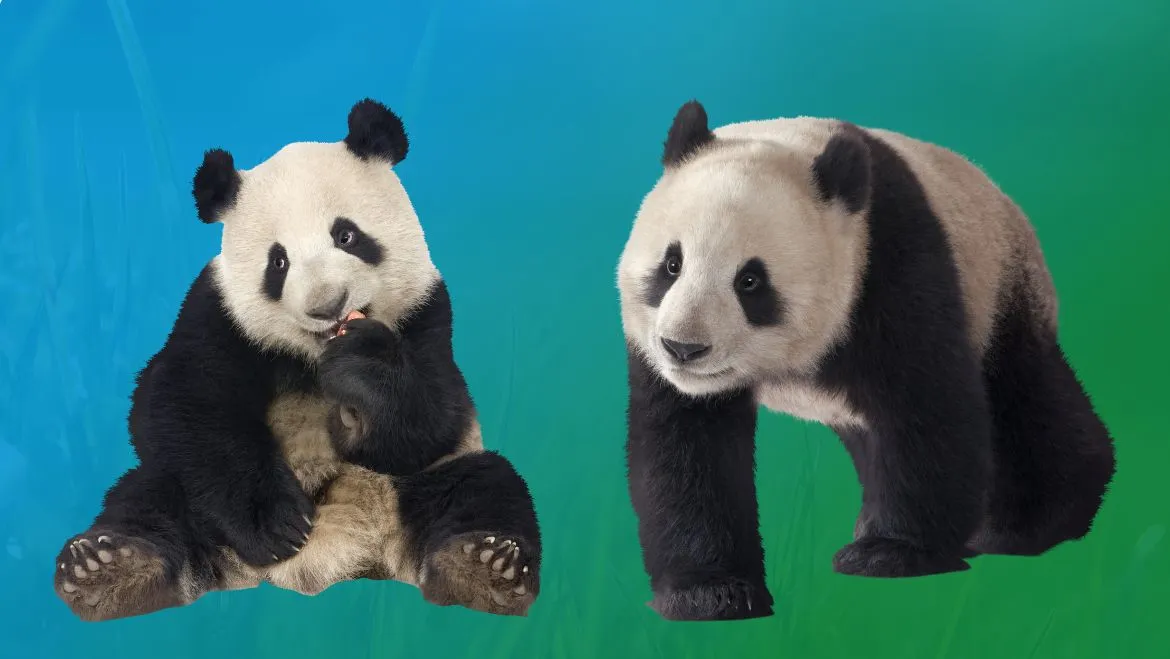
The panda arrives in a journey the way it moves through a bamboo grove: without hurry, without apology, and without the slightest interest in whether you are impressed. People expect it to feel cuddly. It does not. What they report instead is a peculiar, heavy stillness — the sense of being in the presence of something very large that has decided, deliberately, to be calm. The calm is the striking part, and it is almost always misread.
This page is about the panda spiritual meaning — what it means when this black-and-white bear keeps appearing in your dreams, your journeys, or your attention. It is not a wildlife profile. In my practice, the panda comes for people who are burning themselves out and calling it dedication — people who have confused constant motion with worth, and who need to learn that the panda’s peace is not the absence of effort. It is the result of a very particular discipline.
The Bridge: What Panda Biology Teaches About the Panda Spirit Animal
The panda’s serenity is not a personality trait. It is a survival strategy, and once you understand the biology, the medicine stops being a greeting card and becomes something you can actually use.
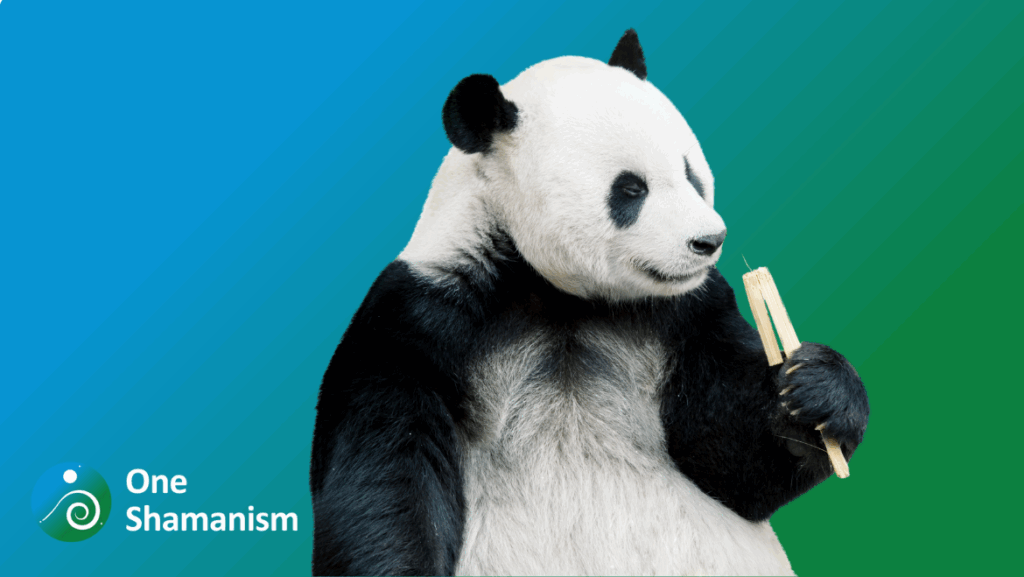
- It is a carnivore that chose bamboo — and pays for it every day. The panda has the digestive system of a bear, but it lives almost entirely on a plant it can barely process. To survive, it must eat for ten to sixteen hours a day and conserve energy the rest of the time. Its famous calm is not idleness. It is the strict energy budget of a creature doing something difficult with limited means. If the panda has come to you, it may be asking whether your stillness is discipline or collapse.
- It grew a thumb it was never given. The panda’s “pseudo-thumb” is an enlarged wrist bone that lets it grip bamboo — an improvised tool evolved to meet an impossible diet. The medicine is resourcefulness under constraint: making the exact instrument your situation requires, out of what you already have.
- Its black and white are contrast, not decoration. The panda’s colouring is thought to help with both camouflage in patchy snow and shade and with signalling to other pandas. It lives, literally, as a creature of held opposites. This is where the enduring association with balance comes from — not as a slogan, but as a body.
- It is solitary and it defends its space. Pandas are not the passive teddy bears of the internet. They live largely alone, hold territories, and a mother panda is formidably protective. Gentleness in this animal is chosen, not owed. It can say no. It simply prefers not to have to.
Panda Symbolism and Cultural Context
The panda’s symbolic home is China, and it is worth being precise about what is old and what is recent rather than blending them into a vague “ancient wisdom.”
China: rarity, peace and the national treasure
In China the giant panda is treated as a national treasure and, for much of the modern era, as an emblem of peace and goodwill — the animal sent abroad as a gesture of friendship rather than power. Its rarity is part of its meaning: this is a creature that exists in a narrow band of mountain forest and nowhere else, and that fragility is inseparable from how it is revered. The panda’s medicine carries this too — that what is gentle and rare must be actively protected, not assumed to be safe.
The balance of opposites
The panda’s black-and-white body has made it a natural emblem for the harmony of opposites, and the comparison to the Taoist principle of complementary forces — light and dark, action and rest, yielding and holding — is one people reach for constantly. I use it carefully: the panda is not an ancient Taoist symbol so much as a living illustration of a Taoist truth. The animal genuinely embodies the idea that strength and softness are not opposites to be chosen between, but a pair to be held at once. That is the heart of what it teaches.
The Shadow: When Gentleness Becomes an Excuse Not to Show Up
The panda is one of the most sentimentalised animals alive, which is exactly why its shadow is so rarely named.
- Self-care that has curdled into withdrawal. The panda’s medicine of rest and nourishment is real. Its shadow is the person who has turned “protecting my peace” into a wall — declining every difficulty, every hard conversation, every request, and calling the avoidance self-care. Genuine rest returns you to your life. Withdrawal quietly removes you from it.
- Gentleness used to avoid conflict. A real panda can defend itself and does. The shadow version uses softness as a strategy for never having to hold a boundary — keeping everyone comfortable so that no one is ever disappointed, and slowly disappearing in the process. If your peacefulness leaves you resentful, it is not peace.
- The energy budget mistaken for permission to do nothing. The panda rests because it must, to survive a hard diet. The distortion is using “low energy” as a permanent identity rather than an honest limit — conserving so completely that nothing is ever built. Conservation is for a purpose. Ask what yours is currently funding.
- The caged or listless panda in a dream. A panda that appears behind bars, or too depleted to eat, often points to a gentle and valuable part of you that has been kept in conditions too small for it — a role, a relationship, a life with no room to roam. This is a grief image, and it deserves to be taken seriously rather than soothed away.
How to Journey to the Panda Spirit Animal
Shamanic work is not a substitute for medical or psychological care. If you are new to journeying, begin with the beginner’s guide to shamanic journeying.
- Set a panda-shaped intention. Not “help me relax.” Rather: “Show me where my calm is discipline, and where it has become hiding.” The panda responds to that distinction with unusual honesty.
- Journey to high, cool bamboo forest. Mist, steep mountain slopes, dense green. Do not go looking for the panda. Sit down in the grove and let it come to you at its own pace — which will be slow.
- Watch it eat. This is the practice most people skip. Sit with the panda while it does the long, patient, unglamorous work of feeding itself. Notice what rises in you — boredom, restlessness, the urge to make something happen. That reaction is the diagnosis.
- Ask to be shown your bamboo. What is the thing that actually nourishes you — and are you giving it the hours it needs, or feeding yourself on scraps between obligations? The panda will show you the difference plainly.
- Ask where it would say no. Let the panda show you the one boundary you have been too “gentle” to hold. It knows how to be soft and immovable at once; that is the exact lesson.
- Integration: protect one hour. Within the week, defend one hour for genuine nourishment — not collapse, not scrolling, but the bamboo the journey named — and, separately, hold one small boundary you have been avoiding. That pairing is panda medicine in practice.
Affirmations for Panda Medicine
- “My calm is a discipline, not a retreat. I rest so that I can return.”
- “I can be soft and immovable at the same time. Gentleness is a choice I make, not a debt I owe.”
- “I give what truly nourishes me the hours it actually needs.”
Panda Spirit Animal: Questions People Actually Ask
What does it mean if the panda is my spirit animal?
It usually means you are being asked to hold strength and softness together rather than choosing between them. Panda people tend to carry real power and to under-use it out of a preference for peace. The medicine is not to become harder, but to make your gentleness a deliberate choice — and to guard your own nourishment as seriously as the panda guards its feeding hours.
Why do I keep seeing or dreaming of pandas?
Repeated pandas are most often a message about balance and depletion. The question to ask honestly is whether you are resting or hiding, nourishing yourself or merely conserving. A content, feeding panda tends to confirm you are on the right track; a caged or listless one is asking you to look at where your gentleness has been kept somewhere too small.
Is the panda a good omen?
Yes, and a kind one. The panda is not a warning animal. It arrives to signal that the way through is patience, nourishment and gentle strength rather than force — and to remind you that peace which is actively protected is a form of power, not passivity.
What is the difference between the panda and the bear spirit animal?
The panda is a bear, but its medicine is distinct. The bear spirit animal carries introspection, power and the great cycle of retreat and return through hibernation. The panda narrows that down to a specific teaching: the discipline of balance, the seriousness of self-care, and gentleness held as a conscious strength rather than a default.
How do I know if the panda is my spirit animal?
Persistence, not preference — whether the image keeps returning uninvited, often when you are overextended. For a structured way to test the connection, work through the A–Z spirit animal guide or sit with the Path of the Paws oracle deck and let the animal find you rather than the other way round.
Is the Panda Your Spirit Animal?
Check the boxes that resonate with your spirit and current life journey.
The panda does not ask you to do less or to do more. It asks you to know the difference between resting and hiding — and to protect what nourishes you with the same quiet seriousness it brings to fourteen hours of bamboo.