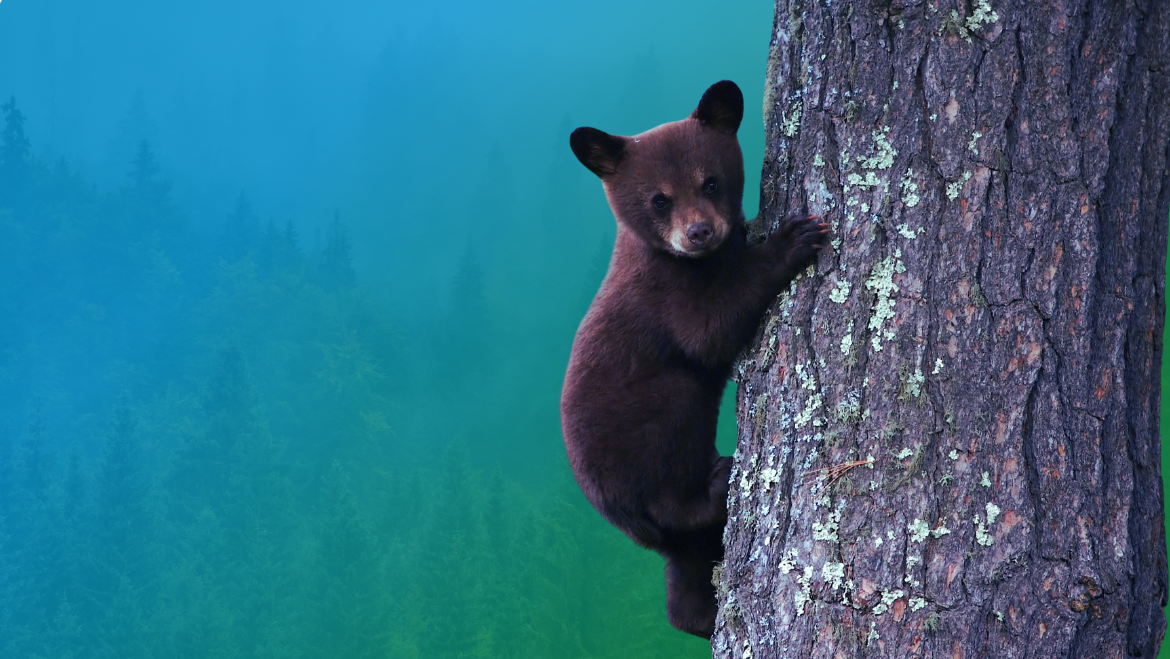
When the bear arrives on a journey, the first thing people notice is not the size. It is the indifference. The bear does not perform for you. It does not circle, it does not test you, it does not particularly care that you came. It carries on doing what it was doing — turning over a stone, walking a line only it can see — and the effect on the person watching is almost always the same: they stop trying to make something happen.
If you are here for habitat ranges and diet, you are in the wrong place. This is about the bear spiritual meaning — what it means when this animal keeps arriving in your dreams, in your journeys, or in that stubborn way an image returns when it wants something from you.
In my practice, the bear does not come to people who need to be stronger. It comes to people who are already carrying far too much and have decided that the answer is to carry it harder. Bear medicine is almost never about adding power. It is about stopping. And it is the only animal I know that makes stopping look like an act of authority rather than a defeat.
The Bridge: What the Real Animal Teaches About Bear Spirit Animal Meaning
Every claim about this animal’s medicine should be traceable to something the animal actually does. With the bear, the biology is more extraordinary than any symbolism anyone has invented for it.
- It gives birth while asleep, in the dark, in the dead of winter. This is the fact that changes everything. A female bear does not den down and simply wait out the cold — she bears her cubs in the den, in near-total darkness, in the deepest part of her dormancy, and nurses them there for months before anyone sees daylight. The most important thing the bear ever does, she does in the season when it looks like nothing is happening. If you have been told that your fallow period is wasted time, this animal is the correction.
- It does not waste itself in the dormancy. Through months without eating or drinking, a hibernating bear recycles its own waste products back into protein and emerges having lost fat but kept its muscle. It is not decaying in there. It is being maintained by something it does not have to think about. That is a precise description of what a real retreat does — and of what mere collapse does not.
- It eats enormously first — and that is a phase, not a personality. In autumn the bear enters hyperphagia, consuming vast quantities with a single purpose: to fund the dark months. Consumption is in service of the retreat. When it becomes the whole life, it is no longer bear medicine. It is the shadow of it.
- It stands up to understand, not to attack. The upright bear — the image every culture has made terrifying — is usually a bear gathering information: lifting its nose, which is one of the most sensitive in the animal world, into the wind. It rises in order to perceive. Standing at full height is a form of listening. Most people get this exactly backwards.
- It walks flat-footed, like us. A bear is plantigrade; its footprint in mud is disturbingly human. Every culture that lived alongside bears noticed this, and it is why the bear is so often not treated as an animal at all, but as a person of the forest.
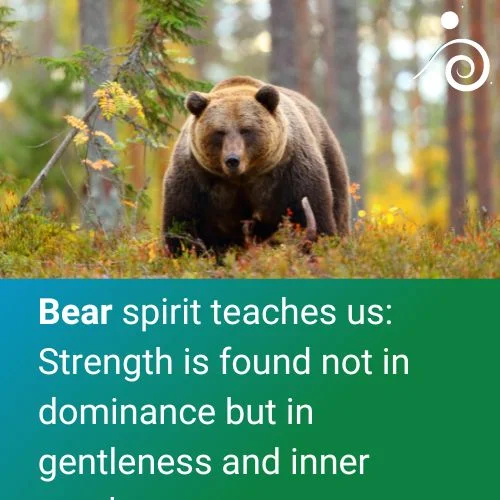
Bear Symbolism Across Traditions
Almost everywhere bears and humans have shared a landscape, the bear has been treated less as prey and more as a relative — and, frequently, as a being whose name it was unwise to say out loud.
Sámi and Finnish: the one you do not name
Across the north, bear ceremonialism was among the most elaborate ritual complexes in Europe. In Sámi and Finnish tradition the bear was hedged about with careful, respectful circumlocutions — the honey-eater, the old man of the forest, the broad-brow — because the direct name carried too much power to be used casually, and because the bear was understood to be listening. In the Finnish material the bear (Otso) is spoken of as having descended from the sky and being returned there after death, with rites of apology and honour. The teaching embedded in that etiquette is simple: some powers cannot be addressed casually. If the bear has come to you and you feel you should approach it carefully, you are not being timid. You are being correct.
Celtic and Germanic: the bear in the name
The Gaulish bear goddess Artio is known from a bronze from Muri, in Switzerland, where a seated woman faces a bear across a basket of fruit — not a hunt, a meeting. The Welsh word for bear, arth, sits inside the name Arthur, and the same root gives us the constellation of the Great Bear turning permanently around the pole. In the Germanic world, the berserkr — literally “bear-shirt” — was a warrior who fought in the animal’s fury. Note the split that runs through all of this: the bear is either the seated one who feeds you, or the one who loses himself entirely in rage. There is no version in which the bear is casual.
Greek: Artemis and the little bears
At Brauron, girls on the threshold of adolescence served Artemis as arktoi — “little bears” — before re-entering ordinary society. The bear here is the animal of the transition: the wild, unsocialised interval you must pass through in order to be changed. And in the myth of Callisto, the nymph turned into a bear and set among the stars, the bear is what a woman becomes when she is exiled from the human world. Bear medicine has always lived at the edge of the community, and it has always had something to do with going away and coming back different.
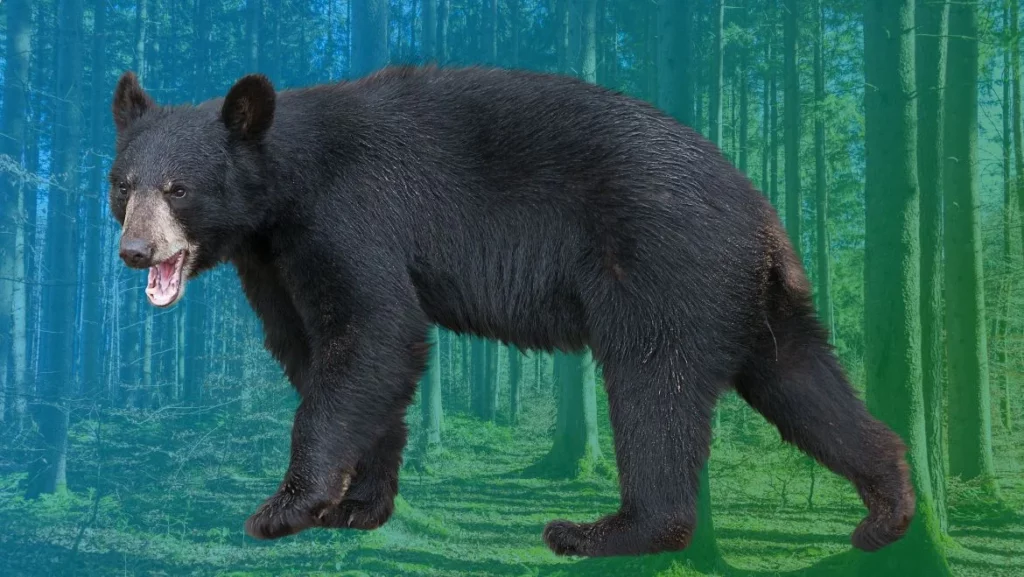
The Shadow: When the Cave Becomes a Hiding Place
The bear’s shadow is not the roar. Everyone expects the roar. Its shadow is quieter, and it is the one I see most often in people who love this animal.
- The den that has no exit. Withdrawal is bear medicine — until it isn’t. A retreat has a door and a season; depression has neither. The distinction I use is this: a real den is entered on purpose and is generative. If nothing is being born in there, you are not hibernating. You are hiding. This is a hard sentence and I mean it kindly.
- Rage standing in for a boundary. The most common distortion I encounter: someone who cannot say no at normal volume, and therefore says nothing for months and then says it enormously. The bear does not do this. A bear that has to charge has already been ignored several times. If your boundaries only exist at maximum force, you do not have boundaries. You have an eruption schedule.
- The mother who cannot let go. The protective bear is magnificent and it is also, in its shadow, the parent, manager or partner who has confused protection with control — who defends the cubs long past the point where the cubs need defending, because the defending has become the identity.
- Hyperphagia without hibernation. Consuming to fill something — food, work, purchases, information — with no dark season on the other side of it to make the consumption mean anything. The autumn feed only makes sense because winter follows. Endless autumn is just hunger.
A bear that appears threatening or charging in a recurring dream is rarely a hostile figure. In my experience it is the dreamer’s own suppressed force, arriving in the only volume it has left. A bear blocking the entrance to a cave points to something being kept from the person’s own interior — they want to go in, and something in them will not permit it. And a bear that appears emaciated or unable to sleep is one of the clearest body-level warnings this animal gives. Take it seriously and take it literally.

How to Journey to the Bear
Shamanic work is not a substitute for medical or psychological care, and if what you are facing is clinical exhaustion or depression, please treat that first. If you are new to journeying, start with the beginner’s guide to shamanic journeying. Allow thirty undisturbed minutes.
- Set an intention the bear can answer. Not “give me strength.” Rather: “Show me what I am refusing to put down.”
- Enter through the ground. A cave mouth, a hollow beneath roots, an opening in a hillside. Descend until the light changes and the air gets colder and older.
- Wait at the entrance. Do not walk in. The den belongs to the bear. People who march in usually meet nothing, and the meeting-nothing is itself the teaching about how they enter other people’s territory.
- Notice its season. Is the bear feeding, or settling, or already asleep? A feeding bear and a denning bear are giving completely different instructions, and this is the single detail people most often fail to register.
- If it lies down, lie down. This is the instruction people skip. Stay there and do nothing until your body actually settles. Notice how long you can tolerate it — that number is your diagnosis.
- Ask one question on the way out: “What is being born in me while I am not looking?”
The Integration Ritual: Making a Real Den
Bear medicine is useless as an idea and transformative as a practice. Within a week:
- Choose the den and defend it. One block of time — an afternoon is enough to begin — that is not available to anyone. Put it in the calendar as a commitment, not a gap.
- Take nothing productive in with you. No podcast, no book that is secretly work, no plan for what you will get out of it. A den with a KPI is not a den.
- Say the boundary once, at normal volume. Pick the one you have been storing up. Say it plainly, without the accumulated charge of six months. This is the bear standing, not the bear charging.
- Put your hands in the ground. Soil, sand, a garden bed. The bear is plantigrade for a reason — its whole weight rests on the earth. Grounding is not a metaphor for this animal; it is anatomy.
- Name what is gestating. Write one sentence about the thing forming in you that nobody has seen yet. Then do not show it to anyone for a month. Cubs are born blind, in the dark, and they survive precisely because no one is watching.
If the bear’s solitude is what draws you, it is worth reading it against the wolf spirit animal, whose power runs entirely through the pack — the two animals are the clearest possible study in opposite strategies for the same problem.
Bear Spirit Animal: Questions People Actually Ask
What does it mean when a bear appears in your life?
It usually means a boundary is overdue or a rest is overdue — and in my practice it is very often both, because the two are the same problem. The bear arrives for people who are being consumed by demands they have not refused. It does not ask you to fight harder. It asks you to take up the space you actually occupy, and then to go in.
Is the bear a good or bad omen?
Traditionally it is among the most protective and honoured of all animals — but it is never a comfortable one. The bear is an omen of seriousness. Whatever it has come about is not a small matter, and it will not be resolved by being pleasant about it. Whether that turns out well depends entirely on whether you go into the cave voluntarily or get dragged in.
What does a bear in a dream mean?
Read the distance and the season. A distant bear that ignores you speaks to power you have not yet claimed as yours. A charging bear is almost always your own force, arriving at the only volume left to it. A sleeping bear you are afraid to disturb points to something in you that is resting properly — and to a part of you that does not believe rest is permitted.
What is the difference between the brown, black and grizzly bear as spirit animals?
The distinctions are real but modest. The black bear is the most introspective — the forest-dweller, the guide of the interior and the dream. The brown bear holds the balance of tenderness and force, the parent who is gentle with the cubs and immovable with everyone else. The grizzly is sovereignty without apology: the one that does not negotiate its territory. If you are unsure which came to you, ask what it was doing — not what colour it was.
Can the bear be my totem if I have never seen one?
Yes. Spirit animals are not allocated by postcode. What matters is persistence — whether the image returns without your invitation. If you want a structured way to test the connection instead of guessing, work through the A–Z spirit animal guide, or sit with the Path of the Paws oracle deck and let the animal find you.
Is the Bear Your Spirit Animal?
Check the boxes that resonate with your spirit and current life journey.
The bear does not arrive to make you formidable. It arrives to tell you that the winter you are dreading is the room where the thing you are waiting for is already being born.