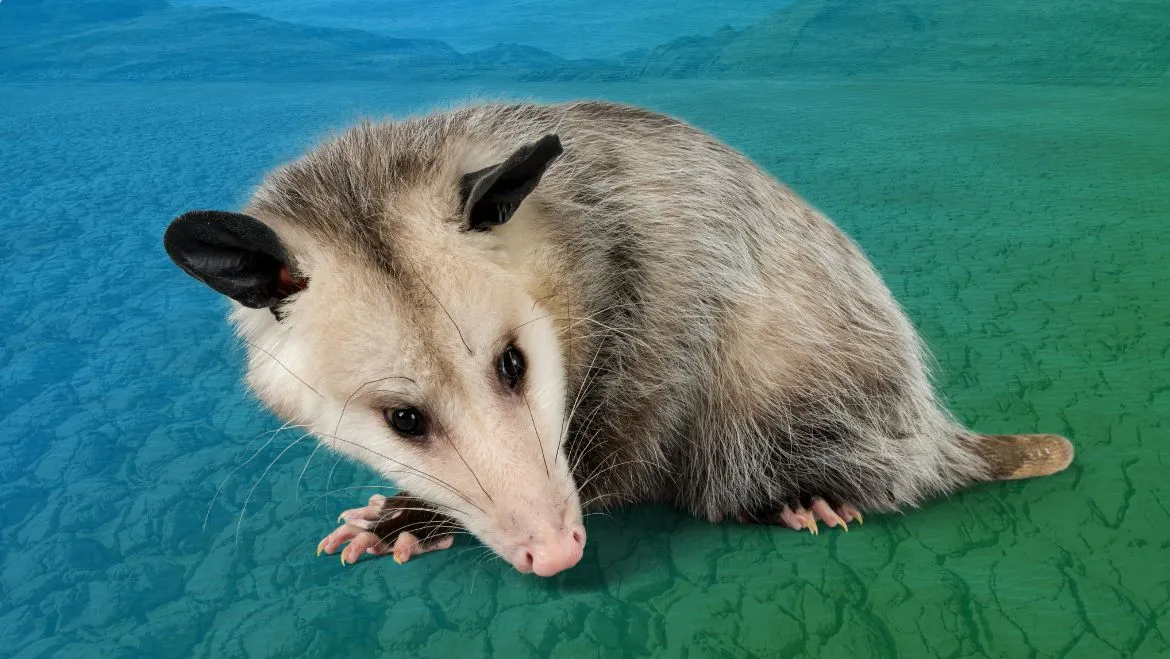
The opossum rarely arrives with any drama, and that is the first clue to what it is. On a journey it tends to appear at the edge of the light, unbothered, watching, and then — if the moment calls for it — it simply drops, goes limp, and waits. People often laugh the first time they see it, and then something in them goes very quiet, because they recognise the move. The opossum does not fight what is coming. It outlasts it by refusing to play.
This is about the opossum spiritual meaning — or the possum spiritual meaning, since people search both — what it means when this creature keeps turning up in your dreams, your journeys, or at the edge of your porch light. In my practice the opossum comes for people who have been exhausting themselves fighting battles that were never worth the energy. It is not a glamorous guide, and it knows it. Its medicine is strategy disguised as surrender, and survival disguised as weakness.
The Bridge: What Opossum Biology Actually Teaches
The opossum is one of the most underestimated animals alive, and every piece of its medicine is written into its strange, ancient body.
- It plays dead — involuntarily, and brilliantly. Thanatosis, the famous “playing possum,” is not a decision the animal makes; under extreme threat its body shuts down, goes limp, and even emits a smell of decay. A predator loses interest in prey it did not kill. The medicine is uncomfortable and precise: sometimes the winning move is total non-engagement — to stop being a target by stopping the fight entirely.
- It is almost immune to venom. The opossum carries a protein that neutralises many snake venoms and rarely carries rabies, its low body temperature making it an inhospitable host. Read as medicine, this is emotional immunity: the capacity to move through toxic environments without absorbing their poison.
- It survives anywhere. Forest, city, suburb, roadside — the opossum, North America’s only marsupial and a lineage older than most of the mammals around it, thrives on adaptability and opportunism rather than strength. Where specialists die when the world changes, the opossum simply eats something else and moves on.
- It carries its young, then lets them ride. The mother opossum carries her babies in a pouch and then on her back. Its medicine includes a fierce, mobile kind of care — protection that keeps moving rather than digging in.
Opossum Symbolism Across Traditions
Indigenous America: the trickster and the strategist
The opossum appears in the stories of many Indigenous peoples of the Americas — traditions that belong to those communities and are referenced here with respect, not ownership. In a number of these stories the opossum is a clever, sometimes comic figure who wins not by force but by wit and misdirection; in some Mesoamerican material the opossum is even credited with stealing fire for humanity. The through-line is consistent: the small, underestimated animal that outsmarts the powerful.
The oldest survivor
The opossum’s deepest symbolism is written in its evolutionary age. Opossums belong to a marsupial lineage that has persisted, largely unchanged, for tens of millions of years, outlasting countless flashier creatures. It is, quite literally, a living survivor. Where cultures across the world revered the mighty predator, the opossum offers a quieter authority: the authority of the thing that is simply still here.
The modern misreading
Much of Western culture reads the opossum as ugly, dim, or vermin — and that misreading is itself part of the medicine. The opossum is routinely underestimated, and it uses that. Anyone who has been dismissed, overlooked, or written off will recognise the strategic advantage of being the creature no one takes seriously.
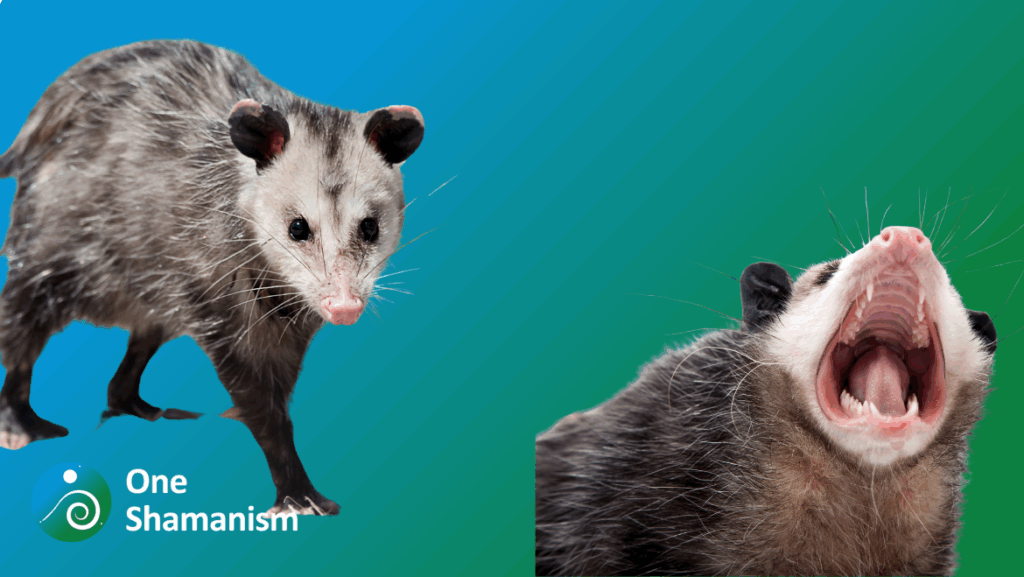
The Shadow: When Playing Dead Becomes a Way of Life
The opossum’s gifts have exact and unflattering distortions, and it shows them when it appears frozen, numb, or endlessly playing dead.
- Chronic avoidance. Thanatosis is a survival tool for genuine threats, not a way to run a life. The opossum’s shadow is the person who plays dead at every conflict — who goes numb, disappears, or withdraws from anything difficult, and calls it wisdom. There is a difference between strategic non-engagement and never showing up for your own life.
- Numbness mistaken for peace. The opossum can shut its whole system down. In people this looks like emotional flatlining dressed up as being “unbothered” — a deadness that avoids pain by avoiding feeling altogether. Immunity to poison is a gift; immunity to everything is a wound.
- Playing small as a permanent strategy. Being underestimated is useful in a fight. Made into an identity, it becomes a cage: hiding your capacities so consistently that even you forget them.
- The opossum in the nightmare. When the animal appears dead-but-not-dead, or repeatedly playing dead in a recurring dream, the reading in my practice is usually that a part of the dreamer has gone into long-term shutdown — a survival freeze that made sense once and has quietly become the nervous system’s default.
How to Journey to the Opossum
Shamanic work is not a substitute for medical or psychological care — and if the “shutdown” described above sounds familiar and persistent, please treat it as a reason to seek support, not only a symbol. If you are new to journeying, start with the beginner’s guide to shamanic journeying.
- Set an opossum-shaped intention. Not “make me stronger” but: show me which fight I need to walk away from, and which numbness I need to come back from.
- Enter through the ordinary. The opossum lives at the edges — a hedge, a woodpile, the boundary of a garden at night. Do not journey to a grand landscape; go to a modest, in-between place.
- Do not corner it. The opossum’s whole medicine is about not being trapped. Approach with ease, and let it decide whether to watch, to amble, or to drop.
- Ask which it is doing — strategy or shutdown. If it plays dead, ask whether it is showing you a battle to disengage from, or a place you have already gone numb. This distinction is the entire journey.
- Ask what you have been carrying. The opossum is a carrier; ask what you are hauling on your back that could ride more lightly, or be set down.
- Ask one question on the way out: where am I fighting a battle that is not worth my life?
- Return, and choose one move this week — one conflict to strategically decline, or one numb place to gently re-enter.
Affirmations for Opossum Medicine
- “Not every fight is mine to have; walking away can be the strongest move.”
- “I move through toxic places without taking their poison into my body.”
- “Being underestimated is not an insult. It is sometimes an advantage.”
Is the Opossum Your Spirit Animal?
Check the boxes that resonate with your spirit and current life journey.
Opossum Spirit Animal: Questions People Actually Ask
What does the opossum spirit animal mean?
The opossum spirit animal represents strategy, adaptability, and the wisdom of knowing which battles to fight. Its signature gift — “playing dead” — is really about strategic non-engagement: the power to step back, conserve your energy, and let a threat pass rather than meeting every provocation head-on. It arrives for people who are exhausting themselves in conflicts that were never worth the cost, and it teaches survival through cleverness rather than force.
What does it mean when an opossum crosses your path?
An opossum crossing your path is usually a prompt to think strategically about a current struggle. In practice it tends to show up when someone is locked in a draining fight or trying to force a confrontation. The opossum’s counsel is to ask whether the battle is worth your energy at all — and, often, to try the unexpected move of stepping back, detaching, and letting the situation resolve without you.
Is the opossum a good or bad omen?
It is a good omen wearing an unglamorous costume. The opossum is dismissed as ugly or lowly, but as a sign it is strongly positive: it points to resilience, cleverness, and the ability to survive and adapt through hard times. If it unsettles you, that is part of the message — it often appears precisely for people who have been underestimated, to remind them that survival is its own kind of victory.
What does a possum in a dream mean?
Read whether it is active or playing dead. An alert, ambling opossum points to adaptability and resourcefulness — you have more options than you think. An opossum playing dead asks a sharper question: are you strategically disengaging from something not worth your energy, or have you gone numb and shut down where you actually need to be present? The dream is usually about the difference between the two.
The opossum will never be anyone’s favourite guide, and it does not care. It has outlasted animals far grander than itself by knowing exactly one thing: you do not have to win every fight — you only have to still be here when it is over. For a defensive cousin with related medicine, see the badger spirit animal, and to find the guide that is walking with you now, explore the A–Z spirit animal guide or sit with the Path of the Paws oracle deck.