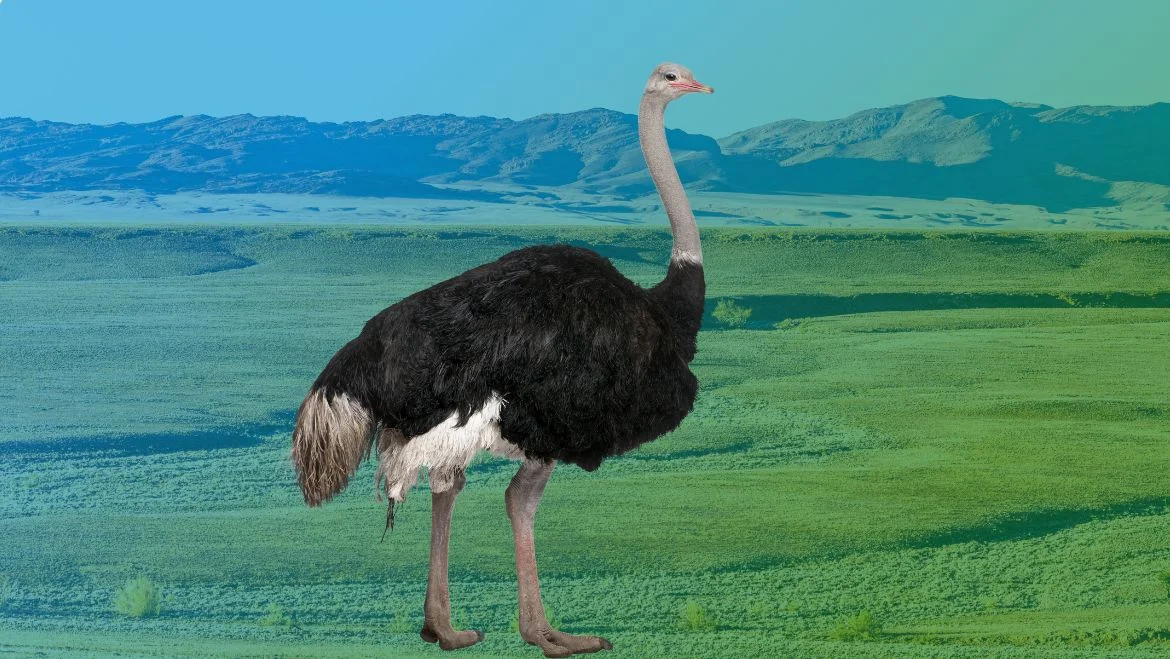
The ostrich does not arrive in a journey the way other birds do. There is no descent, no wingbeat, no shadow crossing the ground. It is simply standing there when you turn around — two and a half metres of it, eye level with your head, watching you with an eye the size of a plum. And it does not move. People consistently report the same reaction: not awe, not fear, but a strange embarrassment. As though they had been caught reaching for something.
If you have come here for wingspan measurements and farming facts, this is the wrong page. This is about the ostrich spirit animal — what it means when the largest bird on earth, the one that gave up flight entirely, starts turning up in your dreams and your journeys.
In my practice, the ostrich tends to arrive for people who are treating their actual life as a rough draft of the one they meant to have. It does not come to console them. It comes to stand there, enormous and unashamed, and let the comparison do the work.
The Bridge: What the Real Bird Teaches About Ostrich Spiritual Meaning
The ostrich’s medicine is not poetry. It is anatomy.
- It did not fail to fly. It stopped. Ostriches descend from flying ancestors. Flight was not withheld from this bird — it was surrendered, over evolutionary time, in exchange for size, speed and power on the ground. This is the whole teaching: the ostrich is what you get when a creature commits completely to one element instead of hedging between two.
- It runs on two toes. The only bird in the world that does. Everything else — balance, grip, the option of perching — was traded away for the one thing it does at seventy kilometres an hour with strides of nearly five metres. Mastery costs you your alternatives.
- It has the largest eye of any land animal. Around five centimetres across — bigger than its brain. On open savanna, an ostrich sees a threat while it is still a smudge on the horizon. Grounded does not mean short-sighted. The bird that renounced height sees further than almost anything walking.
- Its kick goes forward, and it is lethal. A cornered ostrich strikes with a clawed foot that can open a lion. Not a defensive flap — a strike. An animal with no exit route upward has to be genuinely dangerous, and it is.
Put these together and the ostrich stops being a comic bird. It is a creature that gave up the sky, and got the earth in return — completely.
The Sand Myth, and What the Ostrich Is Actually Doing
Everyone knows the ostrich buries its head in the sand. It does not, and never has. The behaviour behind the myth is this: the ostrich’s nest is a shallow scrape in the ground, and the bird regularly lowers its head into it to turn the eggs. From a distance, on a shimmering plain, that looks like a bird burying its head.
So the most famous image of avoidance in the animal kingdom is, in fact, an image of tending. The bird is not hiding from the world. It has its head down at ground level, attending to the most vulnerable thing it owns — and it looks ridiculous while doing it, and it does it anyway.
Sit with that before you go further. Almost every person who is genuinely tending something — a child, an illness, a marriage, a piece of unglamorous work — looks, from a distance, like they have their head in the sand.
Ostrich Symbolism Across Traditions
Egypt: the feather that weighs the heart
In ancient Egypt the ostrich feather was the emblem of Ma’at — truth, balance, cosmic order. In the judgment scene of the Book of the Dead, the heart of the deceased is placed on one pan of the scales and Ma’at’s ostrich feather on the other. A heart heavier than the feather was devoured.
The choice of feather is not arbitrary, and this is the detail almost everyone misses. A flight feather is asymmetrical — the vane is wider on one side than the other, because it has to bite the air. An ostrich feather, having no aerodynamic job to do, is almost perfectly symmetrical. The Egyptians chose as the symbol of cosmic balance the feather of the bird that does not fly. Truth was measured against the plume of the creature that gave up the sky.
Southern Africa: the eggshell that carried life
Among San communities of the Kalahari, ostrich eggshells were used as water flasks — sealed, buried at known points across the desert, and returned to. Fragments worked into beads are among the oldest ornaments ever excavated in Africa. This is not symbolic decoration; it is a survival relationship tens of thousands of years deep. The ostrich’s gift here is storage against drought — what you put away now for the version of yourself who will be desperate later.
The nest: shared work, and a hard arithmetic
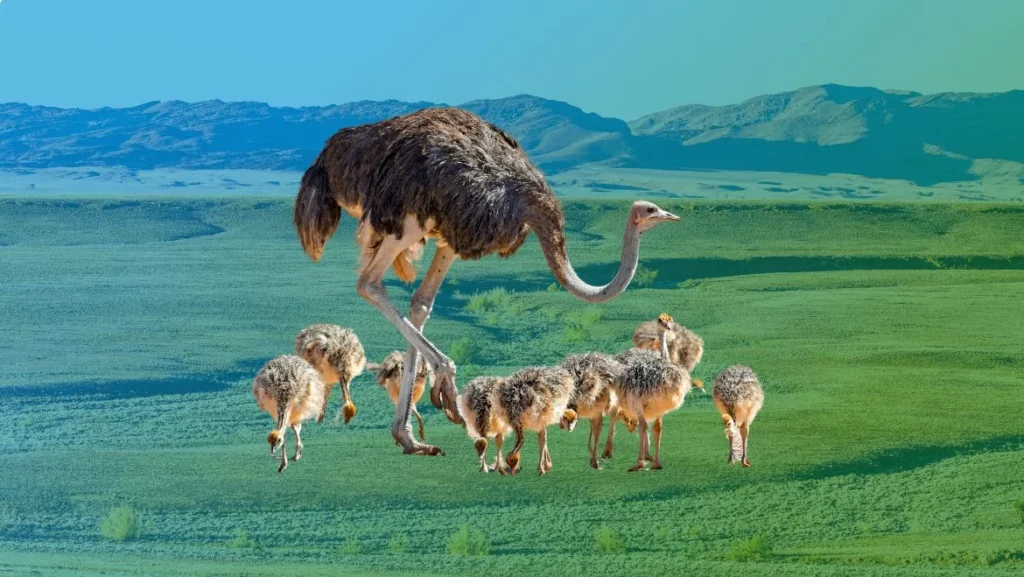
Ostriches incubate in shifts — the dark-plumaged male at night, the grey-brown female by day. Each is camouflaged for the hours it sits. It is one of the cleanest images of shared labour in nature, and it belongs in any honest account of this bird. But there is a second half, and it is not comfortable: several females lay into one nest, and the dominant hen rolls the eggs she recognises into the warm centre and pushes the others to the cold edge, where they are less likely to hatch and more likely to be taken. We will come back to that.
The Shadow: When Grounded Becomes Stuck
Every gift of this bird has a precise failure mode, and the ostrich’s are among the least discussed of any animal I work with.
- Grounded as a story about staying. “I am practical. I am realistic. I am not one of those people with their head in the clouds.” The ostrich chose the ground and became magnificent on it. Choosing the ground and becoming merely stationary is not the same act, and the second one likes to borrow the language of the first.
- Running as a default. The ostrich’s first answer to almost everything is to run — fast, efficiently, in a straight line, for a long time. Some people carrying this medicine are astonishingly good at outrunning: outworking, outmoving, outproducing. They are never still long enough for anything to catch them, including the thing they need.
- The kick. An animal with no escape upward defends with lethal force. Human beings with no perceived way out do the same thing, and they usually strike at whoever is closest. If the ostrich has arrived while you are lashing out at the people who live with you, the question is not who provoked you. It is: where do I believe I have no exit?
- The eggs at the edge of the nest. The hardest one. The dominant hen keeps her own in the warm centre and lets the others chill on the rim — and calls it a shared nest. The human version is precise and common: the person who appears to be holding everything together for everyone, while quietly ensuring that only their own is truly kept warm. If you sit with this and feel nothing, sit longer.
An ostrich that appears threatening in a recurring dream — charging, kicking, blocking a road — is very rarely hostile in my experience. It usually stands between the dreamer and an escape they have been planning, and it is asking them to stay in the field. An ostrich appearing dead, penned or flightless-and-grieving points somewhere else entirely: to a life that was not chosen but accepted, and has quietly been mourned ever since.
How to Journey to the Ostrich
Shamanic work is not a substitute for medical or psychological care. If you are new to this, begin with the beginner’s guide to shamanic journeying before attempting the practice below.
- Stand up before you start. Feet flat, weight even, shoes off if you can. This is the only journey I would ask you to enter through the soles of your feet rather than through the breath. The ostrich reads the world through the ground.
- Journey to open ground with a horizon. Plain, savanna, wide field, dry riverbed. No forest, no cave, no water. The ostrich will not come to anywhere enclosed.
- State the intention as a position, not a wish: “This is the ground I am actually standing on.” Then name it — the job, the body, the marriage, the town, the year you are in. Plainly. No editing.
- Do not chase it, and do not look up. The reflex to scan the sky is the exact habit this bird has come to interrupt. Keep your gaze at eye level and let it approach.
- Let it look at you. That eye is bigger than its brain and it does not blink much. Ostrich journeys are usually not conversations. They are inspections. Let it finish.
- Ask to be shown the nest. Then look at where the eggs are lying. What is in the warm centre of your life, and what have you rolled to the cold edge and are still calling cared-for? This is the question the ostrich is actually good for.
- Ask one question on the way out: “What would I do differently if this life were not a compromise?”
If ground and endurance are the territory you are working in, the elk carries a related medicine of sustained weight-bearing, and the full A–Z spirit animal guide will show you which neighbours of the ostrich are already circling. The Path of the Paws oracle deck is the gentler way in if you would rather be found than search.
Affirmations for Ostrich Medicine
- “I stop apologising for the element I actually live in.”
- “I put my head down to tend what matters, and I do not care how it looks.”
- “Let my heart be no heavier than a feather that never had to fly.”
Ostrich Spirit Animal: Questions People Actually Ask
What does it mean when an ostrich appears to you?
It is a message about where you are standing, not where you are going. The ostrich turns up when a person is living one life and privately grading it against another. It does not tell you the life is right. It tells you that the reaching is costing you the ground — and that nothing grows in a life you are only half in.
Do ostriches really bury their heads in the sand?
No. They lower their heads into a ground nest to turn their eggs, which at a distance looks like burying. Spiritually, the myth is worth more than the fact: the world’s most famous symbol of avoidance is actually a bird tending the most vulnerable thing it has. Ask yourself which one you are doing.
Is the ostrich a good or bad omen?
Neither, and it is not a comfortable one. In Egyptian terms it is the animal of Ma’at — of weighing. Its arrival tends to coincide with an honest accounting: what have you accumulated by living out of step with what you already know? That is not a curse. It is an invoice, and it is survivable.
What does an ostrich in a dream mean?
Read the legs, the eye and the nest. A running ostrich asks what you are outpacing. A still ostrich staring at you is a weighing, and the dream will usually be uncomfortable in a way you cannot explain afterwards. An ostrich at its nest, head down, points to something close to the ground of your life that needs undefended attention now, not later.
What is the ostrich feather’s spiritual meaning?
Balance and truth. Unlike a flight feather, it is symmetrical — which is exactly why Egypt made it the counterweight to the human heart. Working with an ostrich feather is not a charm for good fortune. It is an instrument of self-honesty, and it is best used on days you would rather not be honest.
The ostrich is not a bird that failed to fly. It is a bird that stopped negotiating with the sky — and became the fastest thing on two legs the moment it did.