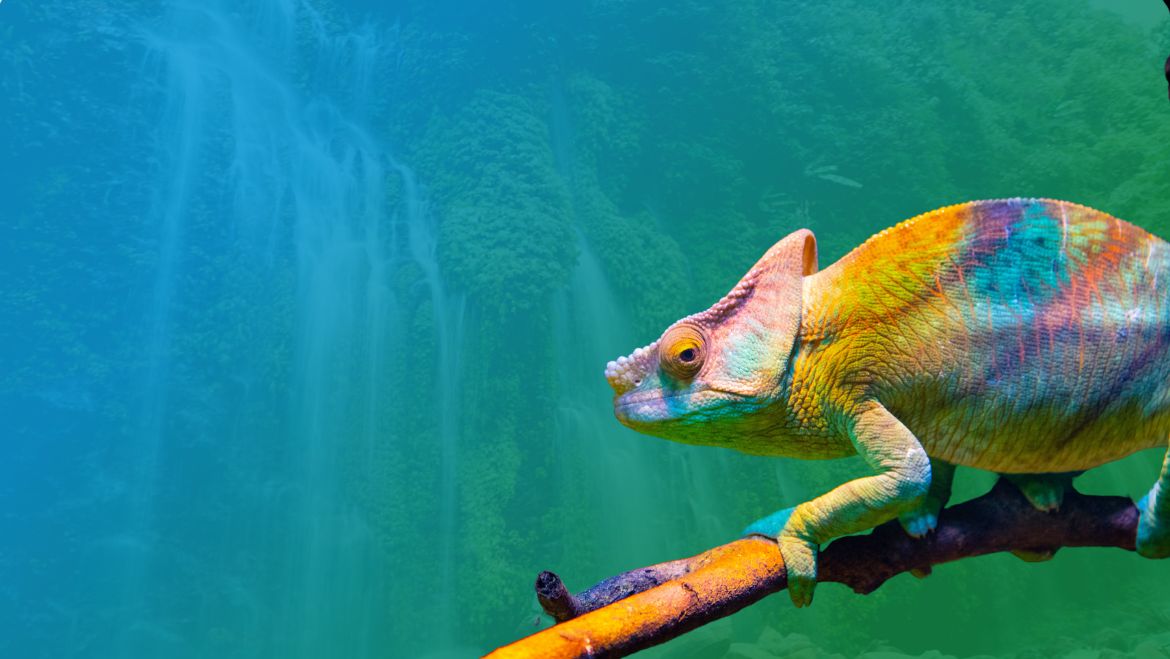
The first time the chameleon came through in a journey, I expected it to hide. It did the opposite. It sat in full view on a branch, turning slowly from grey to gold, and I understood — in the body, before the mind caught up — that the colour was not camouflage. It was a reply. The chameleon was answering the light, the temperature, the mood of the moment, and it was doing so without apology and without hurry.
That is the signature of the chameleon spirit animal. It does not arrive for people who need to become someone else. It arrives for people who have been shape-shifting so long to survive that they have forgotten which colour is actually theirs. In my practice, this guide tends to appear at thresholds — a move, a new role, the end of a version of yourself — when the old ways of adapting have started to cost more than they return. If the chameleon is circling you, the question it carries is not how do I fit in? It is what am I responding to, and is it worth the change?
Chameleon Spiritual Meaning: The Bridge From Biology to Message
Every symbol worth trusting grows out of the real animal. The chameleon is not a metaphor a human invented — it is a creature whose body already tells the truth about adaptation.
- Its colour change is communication, not disguise. Contrary to the popular myth, most chameleons shift colour mainly to regulate temperature and to signal mood, dominance and readiness to mate. The lesson is precise: the chameleon shows you its inner state rather than hiding it. Its adaptability is honest, not deceptive.
- Its eyes move independently. A chameleon can watch two directions at once, holding a full field of awareness. In spiritual terms this is the capacity to hold two truths — the situation as it is and the situation as it is becoming — without collapsing one into the other.
- It moves slowly, then strikes fast. The deliberate, rocking gait is not timidity. When the tongue fires, it is one of the fastest movements in the animal kingdom. Patience is the setup; the strike is the payoff.
- It grips before it steps. Fused, pincer-like toes and a prehensile tail mean the chameleon never lets go of one branch until it has hold of the next. That is the whole instruction for a threshold season: keep your footing while you change.
Put together, the biology gives us a far sharper message than “be flexible”. The chameleon teaches responsive integrity: change your colour to meet the moment, but never lose your grip on where you actually stand.
Symbolism and Cultural Context
The chameleon carries very different weight across traditions, and it is worth naming them precisely rather than flattening them into one “ancient wisdom”.
In several West and Southern African traditions, the chameleon appears in creation and origin narratives as a messenger — famously as the bearer of a message about life and death whose slow pace changed the fate of humankind. In these stories the chameleon is associated with the threshold between states of being, and its unhurried movement is treated as significant rather than incidental. These stories belong to the peoples who carry them; I reference them with respect and without any claim to their ceremony.
In Malagasy culture, home to roughly half the world’s chameleon species, the animal is woven into proverbs about caution and foresight — the eye that looks forward and the eye that looks back at the same time, a reminder to consider consequence before movement. In the broader ancient Mediterranean world, writers such as Pliny and Aristotle catalogued the chameleon with a mix of fascination and suspicion, and the word later entered European languages as a term for the changeable or the inconstant. That double reputation — visionary adaptability on one side, untrustworthy shifting on the other — is exactly the tension the spirit animal asks you to resolve.
As a totem, then, the chameleon sits at a crossroads that most cultures recognised in their own way: the being who can move between worlds and states, and who must be trusted to do so with integrity. When you work with your own spirit animal, the chameleon’s cross-cultural thread is consistent — it is the guardian of honest transition.
The Shadow of the Chameleon: When Adaptation Becomes Disappearance
This is where a real reading separates from a fortune-cookie one. The chameleon’s gift and its wound are the same skill, and its shadow is one of the most common I meet.
- Camouflage that never comes off. When adaptability hardens into a survival identity, you become so good at matching every room that you no longer know your own colour in an empty one. The most common misunderstanding I encounter is that this is humility. It is not — it is self-erasure with good manners.
- Reading everyone, felt by no one. The independent eyes that track every mood in the room can leave you exquisitely attuned to others and completely unmet yourself. People with strong chameleon medicine often report that they can sense what everyone needs and cannot say what they need.
- Waiting that curdles into avoidance. Patience is the chameleon’s virtue until the strike never comes. If you have been “timing it right” for years, the shadow is asking whether you are waiting or hiding.
- The chameleon that will not change in a dream. When the chameleon appears stuck on one colour, or frantically flickering through many, the reading I use in practice is this: a part of you is either frozen in one performance, or exhausting itself trying to be all things at once. Both are a signal to stop adapting outward and ask what you are matching yourself to.
The medicine is not to stop adapting — you cannot, and you should not. It is to choose your colour on purpose instead of letting the room choose it for you. That is the difference between the chameleon as guide and the chameleon as trap. If this shadow resonates, the deeper work often overlaps with the shedding taught by the snake spirit animal.
A Shamanic Practice: The Chameleon Journey and the True-Colour Ritual
The chameleon is a gentle guide to journey with because its medicine is about perception rather than force. This is the practice I offer people standing at a threshold.
- Set a colour-shaped intention. Not “help me adapt” but: “Show me where I am wearing a colour that is not mine.”
- Prepare. Sit or lie somewhere warm, cover your eyes, and use fifteen to twenty minutes of steady drumming. The chameleon responds to warmth; do not journey to it cold and rushed.
- Enter through the canopy. Picture a branch in dappled light. Let the chameleon find you rather than searching for it — it will already be watching you with one eye.
- Watch it change, and notice your own body. As it shifts colour, ask it to show you the colour you turn when you walk into the room you dread most. This is often the most honest moment of the journey.
- Ask for your resting colour — the shade you are when no one is watching and nothing is required. Let the chameleon show it to you directly.
- Return slowly, keeping one hand on your sternum, and write down both colours before you speak to anyone.
The True-Colour Ritual
- Name the room. Write down the one situation where you most reliably lose your own colour — a person, a role, a family table.
- Choose one true thing you will keep visible in that room next time: an opinion, a limit, a preference. One only. The chameleon changes gradually, not all at once.
- Grip before you step. Before you enter, place both feet on the floor and name where you actually stand on the matter. Only then walk in.
- Record what happened afterwards without judging it. Responsive integrity is a practice, not a personality change.
If the chameleon is not the guide who ultimately comes for you, that is useful information too — you can explore the wider list of spirit animals and their meanings, or work with the Path of the Paws oracle deck to let the right one arrive.
Frequently Asked Questions
What does it mean when a chameleon appears in your life?
When the chameleon keeps appearing — in the physical world, in journeys or in dreams — it usually marks a threshold that asks for conscious adaptation. It is a call to change how you meet a situation while keeping hold of who you are, rather than either forcing your way through or disappearing into the background.
Is the chameleon spirit animal a good or bad omen?
Neither. The chameleon is a mirror, not a verdict. It reflects your relationship with change: a gift when you adapt with integrity, a warning when you have been shape-shifting to please others until your own colour is lost.
What does a chameleon mean in a dream?
A chameleon in a dream often points to a transition you are navigating. A chameleon changing colour freely suggests healthy adaptability; one frozen on a single colour, or flickering frantically, suggests you are either stuck in one performance or exhausting yourself trying to be everything to everyone.
Who has the chameleon as a spirit animal?
In my experience the chameleon tends to walk with highly perceptive, emotionally attuned people — those who read a room instantly and adapt easily. Its medicine is most needed by exactly these people, because their strength is also where they are most likely to vanish.