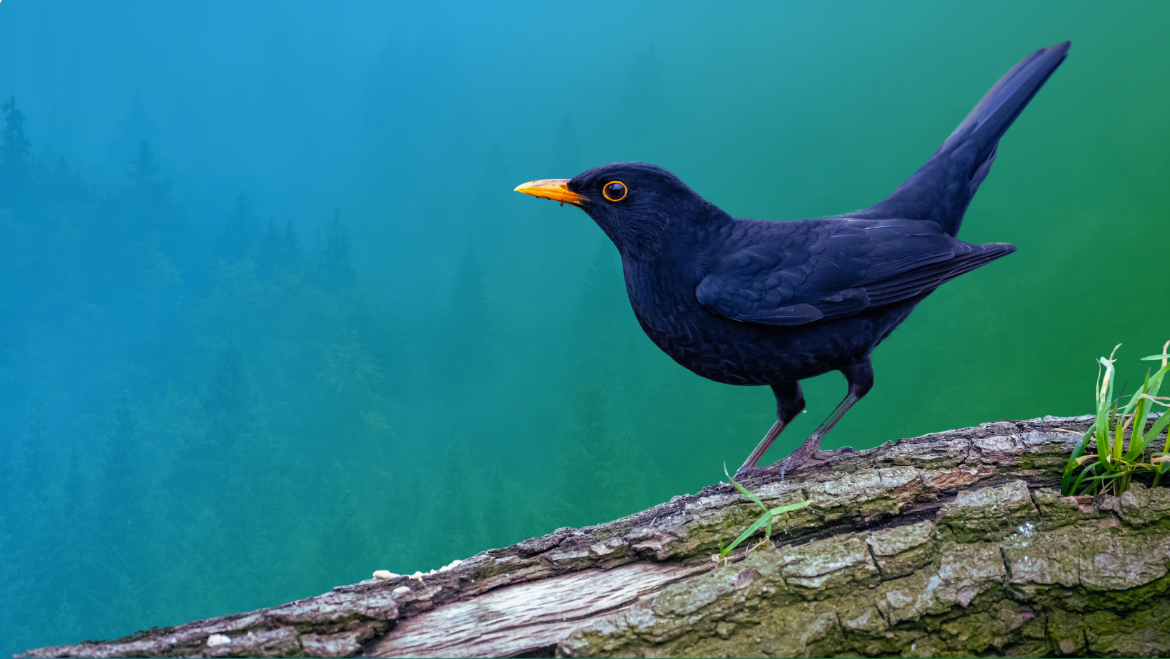
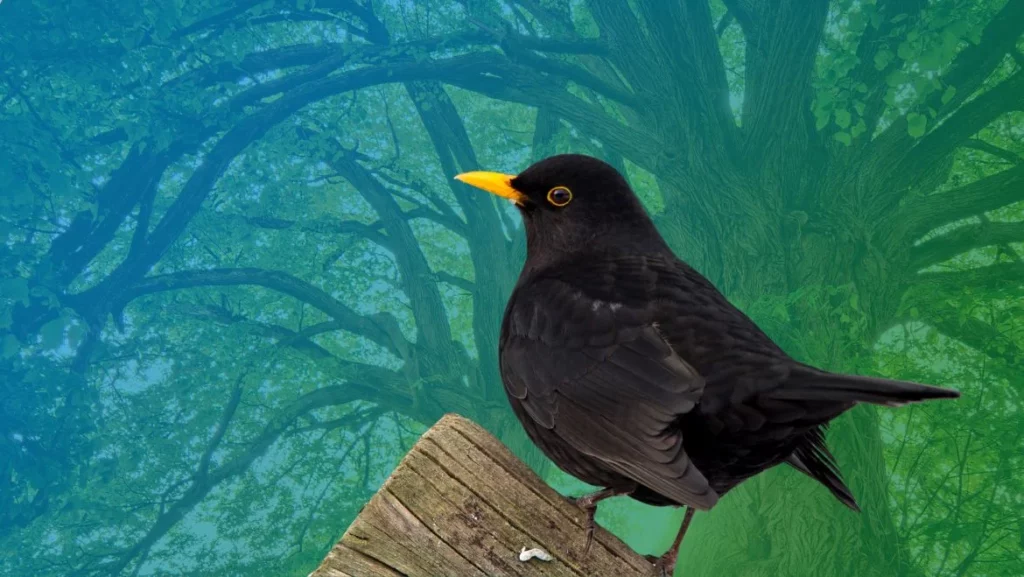
You almost never see the blackbird first. You hear it. A fluted, unhurried phrase from the top of a hedge in the half-light, repeated and then varied, as though the bird were thinking aloud. And when you finally locate it — a small black shape against a grey sky, beak the colour of a struck match — it is not hiding. It is simply refusing to compete with its own voice.
This is a page about what the blackbird spirit animal means, not about garden birds. If you have come here because a blackbird keeps appearing — on the fence every morning, in a dream you cannot shake, or during a journey where it would not stop singing — then you are in the right place. In my practice, the blackbird arrives for people who have something to say and have been saying it to themselves. It is the guide of the unspoken. And it does not arrive quietly.
The Bird Behind the Symbol: Why the Blackbird Sings When It Does
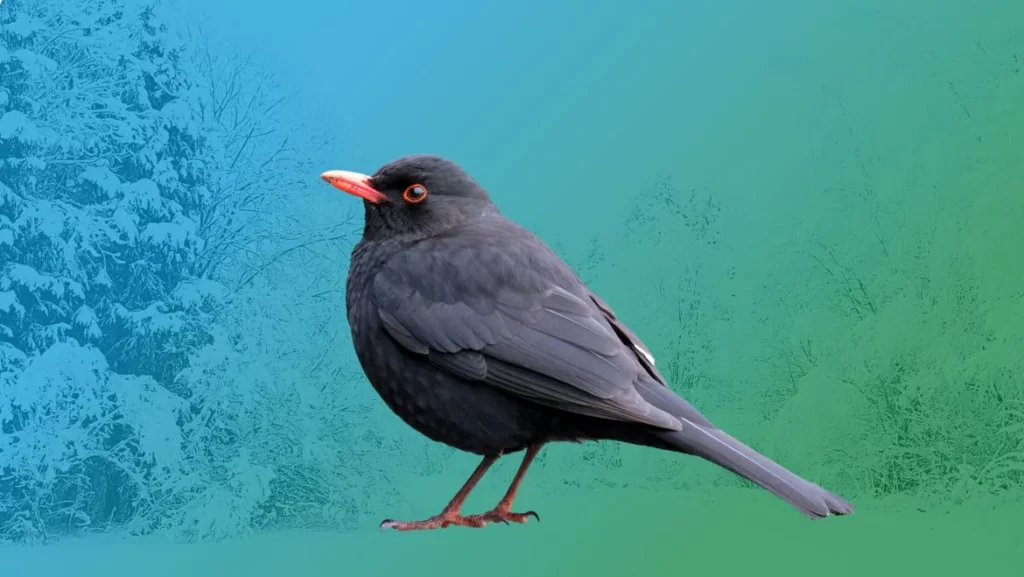
Everything the blackbird means comes out of one fact: it sings at the thresholds. Male blackbirds are among the very first birds into the dawn chorus and among the last voices at dusk, singing in light too dim for most birds to feed in. Ornithologists have a straightforward explanation — low light makes foraging inefficient, sound carries further in the still, cool air, and a bird that sings at the edges of the day is heard across a much wider territory. Practical. Precise. And spiritually, almost unbearably apt.
The blackbird has chosen the two hours when the world is neither day nor night — the liminal hours — as the moment to declare where it stands. It does not wait for good conditions. It uses the ambiguity itself as the medium that carries its voice.
The second fact worth holding: a blackbird’s song is improvised. It does not have one fixed call. Each male develops a repertoire of phrases and recombines them, borrowing motifs from other birds, from ambient sound, sometimes from a mobile phone ringtone. This is a bird whose voice is made, not inherited. That is the bridge to its meaning, and it is why the blackbird is so consistently connected with creativity: it is one of the few creatures whose central act of self-declaration is something it composes itself.
And a third: the female is not black at all. She is brown, streaked, easily overlooked — and she does not sing. The blackbird archetype therefore contains both, the one who declares and the one who watches from cover, and in my experience people who work with this guide are usually standing somewhere uncomfortable between the two.
Blackbird Symbolism Across Traditions
Ireland and Wales: the birds that make time stop
The richest material comes from the Celtic-speaking world, and it is specific enough to be worth quoting properly. In the Welsh tale Culhwch and Olwen, the Blackbird of Cilgwri is one of the Oldest Animals — a creature so ancient it has worn away an anvil merely by wiping its beak on it, and yet it says it has never heard of the man being sought. It is the keeper of memory that reaches past the edge of human recall.
In Irish tradition, the birds of Rhiannon — often understood as blackbirds — sing a music that wakes the dead and lulls the living into a sleep outside of time. And there is a strand of early Irish monastic poetry in which the blackbird’s song interrupts the writing of a psalm and is treated not as a distraction but as the more sacred of the two sounds. The consistent thread is this: the blackbird’s song opens a door between worlds. It is not a symbol of the Otherworld. It is the thing that lets you hear it.
Christian Europe: the bird as temptation
In medieval Christian symbolism the blackbird was read the other way — its dark plumage and its beautiful voice made it, in some monastic writing, an emblem of temptation, the sweetness that leads the soul astray. It is easy to dismiss this as superstition, but I think it is worth keeping. It preserves something true: a voice that beautiful is a power, and power is never neutral. The tradition that feared the blackbird understood exactly what it was dealing with.
The Norse ravens — and why the blackbird is not one of them
People frequently collapse the blackbird into the raven or the crow, and it is a mistake worth correcting. The raven is a scavenger of battlefields, an eater of the dead, an intelligence that circles. The blackbird is a ground-feeder, a singer, a defender of a small territory it knows by heart. Its darkness is not the darkness of carrion. It is the darkness of fertile soil — the bird digs in it, lives from it, and sings from a hedge above it. If a black bird has come to you and it sang, you are dealing with the blackbird, and the message is about voice, not about death.
The Path of the Paws
42 hand-illustrated oracle cards, one for each animal guide — drawn from the same practice these articles come from. A way to sit with an animal instead of only reading about it.
Order your deck →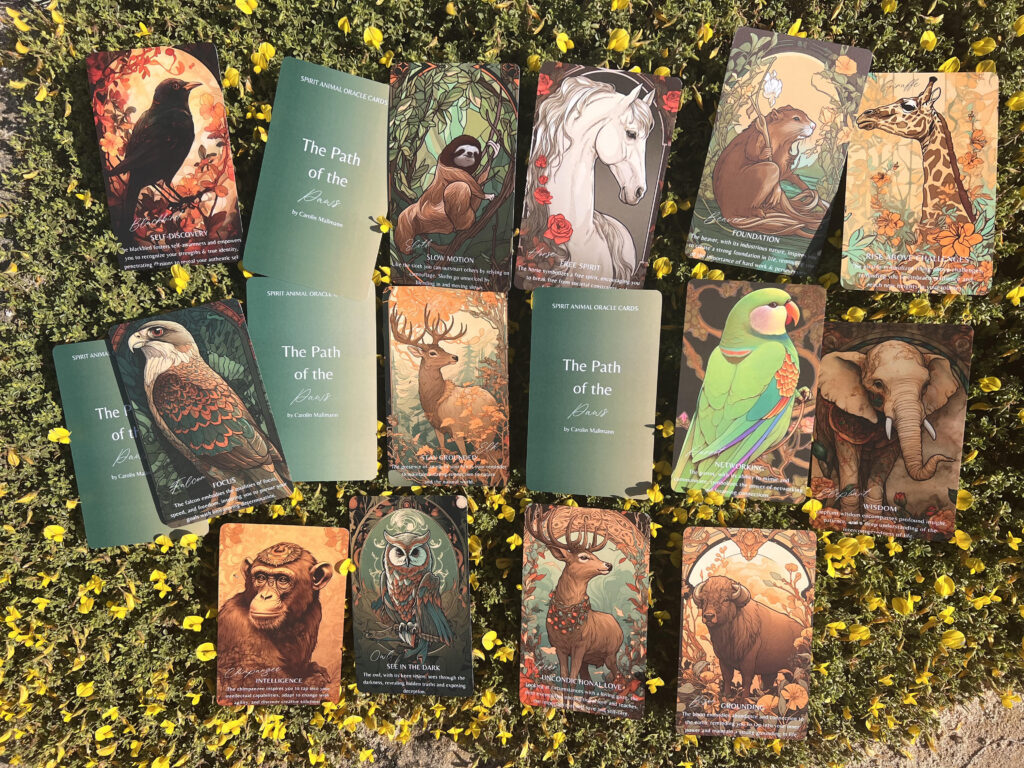
The Blackbird’s Spiritual Meaning: What It Is Actually Asking
- Voice. Not confidence, not volume — voice. The specific thing that only you would say, said out loud, in conditions that are not ideal.
- Intuition at the edges. The blackbird operates in low light. It teaches perception in situations that are not yet clear — the ability to act on what you sense before the evidence arrives.
- Improvisation. Your song is not handed to you. It is assembled from what you have heard, borrowed, and altered. Originality here is a practice, not a birthright.
- Territory. The blackbird sings to say this is where I am. Boundary-setting through declaration rather than through defence.
The Shadow of the Blackbird
A guide this closely tied to the voice has a shadow that lives, precisely, in the throat.
The bird that will not sing. This is the most common form I meet. A person carries the blackbird’s gift — they see clearly, they have something genuinely their own to say — and they have decided that the conditions are not right yet. Not this room. Not these people. Not this year. The blackbird’s shadow is not silence imposed from outside. It is silence chosen and then rationalised, until the sentence “I’ll say something when it matters” has quietly consumed a decade.
The bird that sings only to be admired. The opposite distortion, and it is subtler. The voice becomes performance; the song is tuned to the response it gets. This is the medieval fear of the blackbird made real — beauty in service of nothing but its own reception. If you have stopped being able to tell whether you believe what you are saying, this is where you are.
The alarm call that never stops. Anyone who has startled a blackbird knows its other sound: a hard, metallic, panicked chatter that goes on long after the danger has passed. Some people live there. The gift of perceiving threat early becomes a nervous system that cannot stand down, and vigilance is mistaken for intuition. Intuition is quiet. Hypervigilance is loud. Learning the difference is often the real work.
When it appears menacing. A blackbird that attacks in a dream, or a dream in which a blackbird is dead, mute, or in a cage, is worth taking seriously and reading carefully. In my experience the dead or caged blackbird is almost never about death; it is about a truth that has been swallowed so long it has stopped struggling. The attacking blackbird is usually the same truth, arriving with force because the polite route has been closed for years.
A Practice: Journeying to the Blackbird at the Threshold
This practice is deliberately tied to the hours the bird itself uses. Do it at dawn or at dusk — not at midday, and not in the middle of the night. Allow twenty minutes.
- Go outside first, if you can. Stand in the half-light for two minutes before you begin. Let your eyes adjust to seeing imperfectly. This is the blackbird’s working condition, and the body needs to recognise it.
- Set the intention as a confession, not a request. Say aloud: “There is something I have not said. Show me what it is.”
- Enter through a hedge or a garden wall at twilight. Not a cave, not a tree — this is a middle-world journey, and the blackbird lives at the boundary of the cultivated and the wild.
- Listen before you look. Do not search the branches. Wait until you hear the song, and only then find the bird. Reversing this order matters more than it sounds.
- Ask it to sing your sentence. Ask the blackbird to sing the thing you have not been able to say. Do not translate it while it is singing. Let it be sound first.
- Ask what it costs. Then ask the harder question: “What happens if I say it?” The blackbird does not promise safety. It only tells you that the hour is right.
- Return and write it down — in your own words, unedited.
The integration: within seven days, say one true sentence out loud to one person. Not the whole truth — one sentence. The blackbird does not sing a symphony; it sings a phrase, then waits, then sings another. That is the method. If you have been waiting for the courage to say everything, you have misunderstood the bird.
If you are still identifying the guide that is working with you, the A–Z guide to spirit animals is the place to keep looking, and the Path of the Paws oracle deck was made for this kind of listening. If the shadow material above landed hard, the shadow spirit animals page goes further into it.
Affirmations for Working with Blackbird Medicine
- “I do not wait for perfect conditions to use my voice.”
- “My song is composed, not inherited. It is allowed to change.”
- “I can see clearly in low light. I do not need certainty to act.”
- “I say one true sentence at a time.”
- “I know the difference between intuition and fear. One is quiet.”
Is the Blackbird Your Spirit Animal?
Check the boxes that resonate with your spirit and current life journey.
Blackbird Spirit Animal: Questions People Ask
What does it mean when a blackbird keeps appearing?
In my practice, a repeatedly appearing blackbird almost always points to something unsaid — a truth, a boundary, a piece of creative work you have been postponing. The bird sings at the thresholds of the day, and it tends to arrive when you are standing at a threshold yourself and refusing to announce where you stand.
Is the blackbird a good or bad omen?
Both traditions exist, and both are useful. Celtic material treats the blackbird as a sacred singer that opens the door to the Otherworld; medieval Christian symbolism treated it as a temptation. Neither is a prediction. The blackbird is not telling you what will happen — it is telling you that your voice carries further right now than you think it does.
What does a blackbird in a dream mean?
A singing blackbird in a dream generally points to something in you that is ready to be expressed. A silent, caged, or dead blackbird points the other way — a truth that has been held down so long it has stopped fighting. A blackbird that attacks is usually that same truth arriving with force because it has been ignored.
What is the difference between a blackbird and a crow or raven as a spirit animal?
They are frequently confused and they are not the same. The raven and crow are scavengers and strategists, associated with death, prophecy and intelligence. The blackbird is a singer and a ground-feeder with a small, defended territory. If the black bird that came to you sang, the message concerns your voice — not death, and not omens.
The blackbird does not wait for full light. It sings into the ambiguity, from a hedge, at the hour when nothing is settled — and it is heard across the whole field. That is the entire instruction, and it has never been about the bird.