The parts of your body that ache are rarely confused. They’re only waiting for the right animal to translate them.
Your nervous system doesn’t always speak in words — it speaks through animals. In shamanic practice, an animal that keeps showing up, in dreams or at the edge of your vision, is often mirroring the exact physiological state your body is already in: hypervigilance, freeze, fawn, or collapse. Working consciously with that animal’s medicine — its posture, its pace, its particular way of meeting threat — gives your body something to practice, not just a symbol to admire.
You’ve read the books on nervous system regulation. You know the words — vagal tone, window of tolerance, co-regulation. And on a Tuesday afternoon your jaw is still clenched, your breath still shallow, and none of the words are doing anything.
In shamanic work, animals have never been decoration for a dysregulated body. They’re treated as the most direct language the body has left when words stop working. An animal that returns again and again is rarely random — it’s usually describing exactly the state you’re in, and exactly what would move you through it. That’s what a spirit animal actually is, underneath the aesthetic.
So instead of asking which spirit animal you have — permanently, like a tattoo — ask a smaller, more useful question: which animal is your nervous system calling in, right now?
1. Your shoulders live somewhere near your ears, and you don’t remember when that started.
This one is easy to miss because it’s become furniture. You notice it in a photo, or when someone touches your shoulder and you flinch slightly before you soften. It isn’t posture. It’s a body that has been listening for a threat for so long it forgot listening was optional.
This is the exact state the deer lives in — and knows how to live in without breaking. A deer’s stillness in a clearing isn’t relaxation, and it isn’t panic either; it’s a third thing, an alert readiness that can hold for a long time without collapsing into exhaustion. What the deer teaches isn’t “stop being vigilant.” It’s how to let one part of the body stay alert while another part, quietly, unclenches. Start with the jaw. Let the eyes soften into the wide, unfocused gaze a deer uses to watch a whole field at once instead of one single point of danger.
There’s a second kind of dysregulation that looks nothing like a clenched jaw — it looks like being fine, on a loop.
2. You keep circling back to the same worry like a path you can’t stop walking.
Three sentences, replayed at 3am. The same unfinished conversation, rehearsed for the tenth time with no new lines. Rumination doesn’t feel like danger — it feels like responsibility, like if you just think about it hard enough you’ll finally arrive somewhere safe. You won’t. Thinking harder is not the same as resolving.
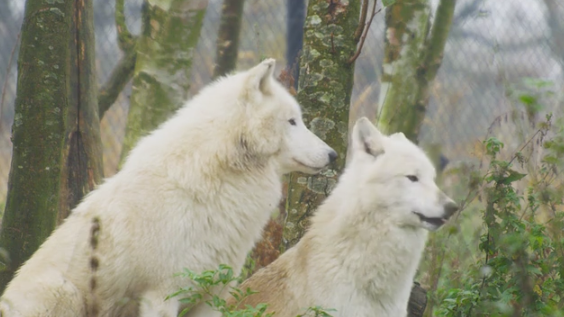
The wolf doesn’t solve problems alone in a den at 3am — it regulates through the pack, sensing and responding to the nervous systems around it rather than looping in isolation. That’s the practical hint hiding in wolf medicine: co-regulation, not more analysis. Call someone. Say the loop out loud to another body. Wolves also trust the first read of a situation over the fifth rehearsal of it — intuition arrives once; anxiety is what happens when you make it arrive nine more times.
Somewhere underneath the looping is a different problem: not too much thought, but too little rest.
3. You crave silence, and then panic the moment you get it.
This is the cruelest version of dysregulation because it punishes you for finally stopping. The weekend clears. The house goes quiet. And instead of relief, there’s a low static of guilt, an itch for a task, a body that doesn’t know what to do with permission.
The bear is the animal most associated with this exact threshold — not because hibernation is passive collapse, but because it’s a deliberate, resourced withdrawal. A bear doesn’t fall into winter sleep by accident; it prepares for it. That’s the practical difference between bear-rest and collapse: build a small ritual around the rest itself. Close the door on purpose. Dim the light on purpose. Let the body register that this stillness was chosen, not that it snuck up on you.
But before you can rest, most people have to get past a much older habit: saying yes before they’ve even felt the no.
4. You say yes before you’ve felt what you actually wanted to say.
The agreement is out of your mouth before your body has finished registering the question. It’s not generosity — it’s a fawn response, a nervous system that learned somewhere along the way that disagreement costs more than it’s worth. The resentment shows up later, quietly, usually aimed at the wrong person.
I remember standing in the kitchen in Portugal with the window open, cicadas going, someone on the phone asking for something I already knew I didn’t have room for. I said yes anyway, out of pure reflex, and only noticed the knot in my stomach after I’d hung up. It took me a full minute of standing there, hand still on the counter, to figure out what I actually wanted to say — which was no.
There’s an animal that has made an entire evolutionary strategy out of the opposite move: the hedgehog, who neither fights nor flees, but curls, and waits you out. The practical version of that for a human body is almost embarrassingly simple — pause before you answer. One breath, curled inward, before the word leaves your mouth. That single breath is often the only thing standing between your habitual answer and your actual one.
The last sign is the strangest of the five, because it doesn’t feel like too much feeling. It feels like none at all.
5. You can be in a room full of people who love you and still feel like you’re watching through glass.
This is dissociation wearing an ordinary face. You’re present enough to nod, to laugh at the right moment, to answer when your name is said — and absent enough that none of it quite lands. It’s not sadness. It’s distance, and it’s the nervous system’s way of protecting you from something it decided was too much to feel in real time.
The owl doesn’t flee the dark — it turns its whole head toward it and somehow sees more, not less. That reversal is the practical hint: instead of trying to think your way back into the room, widen your senses first. Name five things you can actually see. Feel the chair under you. The return usually comes through the body, the same door the dissociation left through.
What does it mean when the same animal keeps appearing to you?
It usually means your nervous system has found a pattern it recognizes in that animal’s behavior — the way it moves through fear, rest, or vigilance. Pay attention to when the animal shows up; the timing often says more than the animal itself.
Can spirit animal work actually calm your nervous system, or is that just a metaphor?
Both. The animal is a metaphor your body already understands, and mimicking its physical qualities — posture, breath, pace — creates a real, trackable shift in how your body meets stress. Metaphor and physiology aren’t separate here.
How do I find out which animal is with me right now?
Start with the body, not a quiz. Notice which of the five signs above feels most familiar today, then read that as a place to begin — spirit animals tend to shift with what you’re moving through rather than staying fixed forever.
Is this the same as choosing a totem animal?
Not quite. A totem is often tied to a lineage or community and stays constant, while a spirit or power animal can shift with your circumstances and is usually called on more personally, session by session.
Now it’s your turn to notice.
Which of these five is the one you recognized fastest? And what has that animal already been trying to teach you, before you had a name for it?
Leave a comment below — the animal you least expected is usually the most accurate one. And if this kind of body-based, animal-guided work is calling you deeper, Elements of Shamanism Training is where we go beyond single signs into full practice.