Shamanic healing and Reiki are both energy-based practices — but they come from entirely different worlds. Shamanic healing is the work of a practitioner who journeys in an altered state of consciousness to ask helping spirits what a person is carrying, and then acts on what they are shown. Reiki is a Japanese hands-on method in which a practitioner channels universal life force energy through the body of the person receiving it. Both can be deeply restorative. They are not, however, the same thing, and they are not interchangeable.
If you are standing in front of two doors and cannot tell which one leads where, this article is for you. Below you will find what each practice actually is, where the two genuinely overlap, what a session feels like from the inside, and an honest guide to choosing — including the cases where I would send someone to a Reiki practitioner rather than take them on myself.
What is shamanic healing?
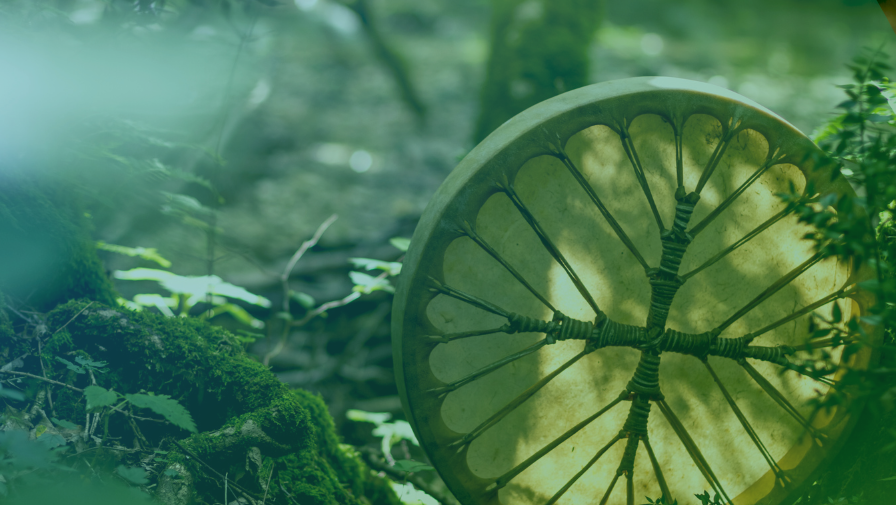
Shamanic healing is a spiritual healing practice in which the practitioner enters a trance state — usually induced by a drum or rattle — travels into what shamans call non-ordinary reality, and works together with helping spirits to restore what has been lost, remove what does not belong, and return power to the person.
It is not one technique but a family of them. The classic interventions are soul retrieval (bringing back a fragment of life force that left during something overwhelming), extraction (removing intrusive energy that has settled where it should not be), power animal retrieval (restoring spiritual protection and vitality), and psychopomp work (helping the dead move on). Which one you receive is not decided in advance — it is decided in the journey, by what the spirits show.
The practice is genuinely ancient. Archaeological evidence for shamanic burial sites reaches back tens of thousands of years, and Mircea Eliade’s classic survey Shamanism: Archaic Techniques of Ecstasy (1951) documented the pattern across Siberia, the Americas, Asia and Australia. The form most Westerners encounter today is core shamanism, the cross-cultural distillation that anthropologist Michael Harner set out in The Way of the Shaman and taught through the Foundation for Shamanic Studies from the 1980s onwards.
The defining feature is this: the shaman does not heal you. The shaman goes and asks. The practitioner is a negotiator and a courier, not a source.
What is Reiki?
Reiki is a Japanese energy healing method in which the practitioner places their hands on or just above the body and allows universal life force energy to flow through them into the person receiving it. The word itself carries the definition: rei (universal, spiritual) and ki (life force energy) — the same ki as the Chinese qi.
Reiki was developed by Mikao Usui in Japan in the 1920s, following a period of fasting and meditation on Mount Kurama. It spread to the West through Hawayo Takata in the mid-twentieth century and has since become one of the most widely practised complementary therapies in the world — offered in a number of hospitals alongside conventional care, usually as comfort and relaxation support rather than treatment.
Reiki training does not happen through years of apprenticeship. It happens through attunements — ceremonies in which a Reiki Master opens the student’s energetic channel. There are traditionally three levels, and a motivated student can reach Master level in a couple of years or, in some lineages, considerably faster.
The defining feature here is equally clear: the Reiki practitioner does not diagnose and does not direct. The energy is understood to go where it is needed. The practitioner is a conduit, and deliberately gets out of the way.
Shamanic healing vs. Reiki: the key differences at a glance
The short version: shamanism asks a question and acts on the answer; Reiki opens a channel and lets it flow. Everything else follows from that one distinction.
| Shamanic healing | Reiki | |
|---|---|---|
| Origin | Indigenous practices worldwide; tens of thousands of years old. Core shamanism systematised by Michael Harner from the 1960s–80s. | Japan, 1920s. Developed by Mikao Usui, brought West by Hawayo Takata. |
| Worldview | The world is alive and populated by spirits. Illness has a spiritual cause that can be identified. | A universal life force energy flows through everything. Illness is blocked or depleted flow. |
| Source of help | Helping spirits, power animals, teachers in non-ordinary reality. | Universal life force energy (ki) itself. |
| Practitioner’s role | Journeys, asks, negotiates, brings something back. Actively intervenes. | Channels. Does not direct where the energy goes. |
| Diagnosis | Yes — through divination and journeying. The spirits are asked what happened. | Generally none. The energy is trusted to find what needs it. |
| Training | Apprenticeship, ongoing journeying practice, a living relationship with spirits. Years. | Attunements from a Reiki Master, three levels. Months to a few years. |
| Typical session | Drum or rattle, practitioner in trance, often 60–90 minutes, followed by a spoken account of what was seen. | Quiet, hands on or above the body, 60–90 minutes, often little or no narrative afterwards. |
| Your part | Receive during the session, then integrate actively for weeks. | Receive. Rest, drink water, carry on. |
| How it feels | Can be vivid, emotional and story-rich. Sometimes confronting. | Usually warm, calm and subtle. Rarely dramatic. |
| Best suited to | Long-standing patterns, grief, a sense of something missing, repeated life themes. | Stress, overwhelm, recovery, general depletion, gentle ongoing support. |
Where do shamanic healing and Reiki overlap?
They overlap more than the purists on either side like to admit. Both work with an energy body that conventional medicine does not measure. Both assume that a person is more than their biology. Both rely on a practitioner who has trained their attention, and both are relational — something passes between two people in a quiet room.
Both also sit in the same evidential position. The U.S. National Center for Complementary and Integrative Health notes that research on Reiki and comparable energy practices remains limited and that studies have not established clear effects beyond relaxation and wellbeing. That is an honest place to stand, and it applies just as much to shamanic work. What we can say with confidence is that people frequently report feeling calmer, lighter and more themselves. What we cannot say is that either practice treats disease.
If you want the wider map that both of these sit inside, I have written about it in what energy healing actually is from a shamanic perspective and in this overview of spiritual healing, its types and its limits.
What does a session actually feel like in each?
The clearest difference is not philosophical. It is what happens in the room.
A Reiki session
You lie down fully clothed. The practitioner works through a sequence of hand positions, resting their hands lightly on or just above your body. It is quiet. People commonly report warmth, tingling, a heaviness in the limbs, and a drifting state somewhere between waking and sleep. Many fall asleep. Afterwards there is usually a short exchange, a glass of water, and a gentle return to the day. The tone is soft from beginning to end.
A shamanic healing session
You lie down too — but the practitioner does not stay in the room in the ordinary sense. There is a drum or a rattle, sometimes for twenty minutes, sometimes longer. The practitioner journeys. You may feel very little while it happens, or you may feel a great deal. Afterwards comes the part that has no Reiki equivalent: the practitioner tells you what they saw. A place. An age. An animal. A sentence.
That account is often the most active ingredient. It is also why shamanic sessions can land harder. Being told, gently and accurately, what you set down when you were eleven is not always comfortable. It is frequently the moment something shifts. If you are considering booking, this is worth knowing in advance — I have written a practical guide to preparing for a first shamanic healing session.
Reiki tends to soothe the system so it can find its own way back. Shamanic work tends to go and fetch what is missing. Both are valid. They are simply doing different jobs.
Which one is right for you?
Choose by what you are actually carrying, not by which tradition sounds more compelling.
Reiki may be the better fit if…
- You are exhausted, stretched thin, or recovering from illness or surgery and want something genuinely gentle.
- You are new to energy work and would like a low-intensity first experience.
- You want regular, ongoing support rather than a one-off intervention.
- You are in the middle of medical treatment and want comfort alongside it, not a parallel story about what is wrong.
- You would rather not receive an interpretation of your life right now.
Shamanic healing may be the better fit if…
- Something feels missing — a spark, a part of you, a version of yourself you remember being.
- The same pattern keeps returning no matter how much you understand it intellectually.
- You are carrying grief, or an ending you never fully came back from.
- You feel drained in specific company, or as though something is sitting where it should not be.
- You want to know what happened, not only to feel better about it.
And a third answer that gets overlooked: sometimes the honest recommendation is neither. If you are in acute crisis, if you are not sleeping, if you cannot function — a therapist, a doctor, or a crisis service comes first. Spiritual work sits alongside that care. It does not replace it, and any practitioner who tells you otherwise is one to walk away from.
What I have noticed in my own practice
I trained in shamanism, I practise shamanism, and I still send people to Reiki practitioners several times a year.
There was a woman who came to me after a long illness. She wanted a soul retrieval. Everything in her story fitted — the exhaustion, the flatness, the sense of having left part of herself in a hospital corridor. But when I sat with her, what I felt was not absence. It was rawness. Her system had nothing left to spare, and a soul retrieval is not a small event to receive. So I asked her to have six weeks of Reiki first, and to come back afterwards.
She did. And when she returned, the journey went somewhere completely different from where it would have gone that first day — because there was finally enough of her present to receive what came back. Months later she told me the Reiki had been the part that let her sleep, and the retrieval had been the part that let her want things again.
That is roughly how I hold the two now. Reiki often makes room. Shamanic work often fills it. Sequence matters more than superiority.
Can you combine shamanic healing and Reiki?
Yes — with one condition: not on the same day, and ideally not in the same week. Both practices ask something of the nervous system, and stacking them makes it impossible to tell what did what.
A sequence that works well in practice:
- Begin with whatever steadies you. For most people who arrive depleted, that is Reiki, or simply rest.
- Bring in shamanic work once there is enough ground under you to receive it.
- Protect the days after a shamanic session. Integration is the work, not the aftermath of the work.
- Return to gentler support during the integration weeks if you want ongoing tending.
If you are curious about what a shamanic session with me involves, you can read about the different kinds of work on the shamanic healing sessions page — soul retrieval, extraction and ancestral healing, in person in Portugal or as distance healing anywhere in the world.
Frequently asked questions
Is shamanic healing stronger than Reiki?
Not stronger — more targeted. Shamanic healing identifies something specific and intervenes directly, which is why sessions can feel more intense. Reiki works broadly and gently. Intensity is not the same as effectiveness, and the right practice is the one that matches your capacity right now.
Do I have to believe in spirits for shamanic healing to work?
No. Belief is not a prerequisite, and healthy scepticism is welcome. What does matter is willingness — being open to what comes back, even if you privately file it as metaphor rather than literal spirit contact. Many people arrive as sceptics and stay sceptics while still finding something changes.
Can Reiki and shamanic healing be dangerous?
Both are physically non-invasive and generally considered safe. The real risks are practitioner-related: someone who discourages medical care, who makes diagnostic claims they are not qualified to make, or who creates dependency. If you are managing a mental health condition, particularly one involving psychosis or dissociation, speak with your treating professional before undertaking trance-based work.
How many sessions do I need?
Reiki is often received as an ongoing practice — weekly or monthly, for as long as it serves you. Shamanic healing tends to work in small numbers: one to three sessions on a particular theme, with real time between them for integration. A practitioner who prescribes a long package before meeting you is worth questioning.
Which is better for anxiety?
For everyday anxiety and overwhelm, Reiki is usually the gentler and more sustainable starting point. Shamanic work can be valuable where anxiety is rooted in a specific event or loss — but it should come alongside proper mental health support, never instead of it.
Can shamanic healing be done at a distance?
Yes. Because the practitioner journeys rather than working on the physical body, distance healing is a long-established part of the tradition and many practitioners, myself included, work with people all over the world this way. Reiki is also commonly offered at a distance, though hands-on sessions remain the more traditional form.
The short answer
Reiki channels universal life force energy through gentle hands-on contact, asking no questions and making no diagnosis. Shamanic healing sends a practitioner into an altered state to ask the spirits what happened, and to bring back what was lost. One soothes the system. One goes looking.
If you are depleted, start gently. If something is missing, go looking. And if you are not sure which describes you — that uncertainty is itself worth bringing to a conversation rather than solving alone.
Which of the two are you drawn to, and what made you start looking? I read every comment.
A note on scope: Shamanic healing and Reiki are complementary practices. They support wellbeing but do not diagnose, treat or cure illness, and they are not a substitute for medical or psychological care. If you are unwell, please work with a qualified healthcare professional.
About the author. Carolin Mallmann is a shamanic practitioner, coach and teacher based in Portugal. She trained in core shamanism and NLP, leads the One Shamanism online school and community, and works with people worldwide through healing sessions, trainings and retreats.