Sámi shamanism (also spelled Sami or Saami shamanism) is the indigenous spiritual practice of the Sámi people of Arctic Norway, Sweden, Finland and Russia’s Kola Peninsula, centred on the noaidi, a ritual specialist who used a painted drum, trance and song to travel between worlds, divine the future and heal the sick. Unlike several other European traditions covered on this site, this is not a modern reconstruction built from fragments. The Sámi are a living indigenous people today, and Sámi spiritual practice, though badly damaged by centuries of persecution, has an unbroken thread back to the people who actually lived it.
I want to be careful with that distinction, because it matters more here than almost anywhere else on this site. What follows is written from outside the culture, as information, not as an invitation to help yourself to Sámi ceremony. The Sámi have their own living voice on what is theirs to share and what is not, and that voice outranks mine.
| Term | What it means |
|---|---|
| Noaidi | The Sámi ritual specialist: healer, diviner and the one who travels between worlds |
| Goavddis | The sacred drum, painted with symbols and used mainly for divination |
| Joik | The traditional Sámi chant or vocal style, still widely practised today |
| Seita | Sacred stones and sites in the landscape, given offerings |
| Sáivo | The underworld of ancestors and helping spirits in Sámi cosmology |
Who was the noaidi, and what did they actually do?
The noaidi was the person in a Sámi community who could enter trance deliberately and act on what they found there. The role was practical rather than purely mystical: a noaidi was consulted to find missing reindeer, to diagnose and treat illness, to foresee the outcome of a hunt or journey, and to deal with a death that felt unsettled. Both men and women could hold the role, and it was usually recognised rather than chosen, often running in certain families.
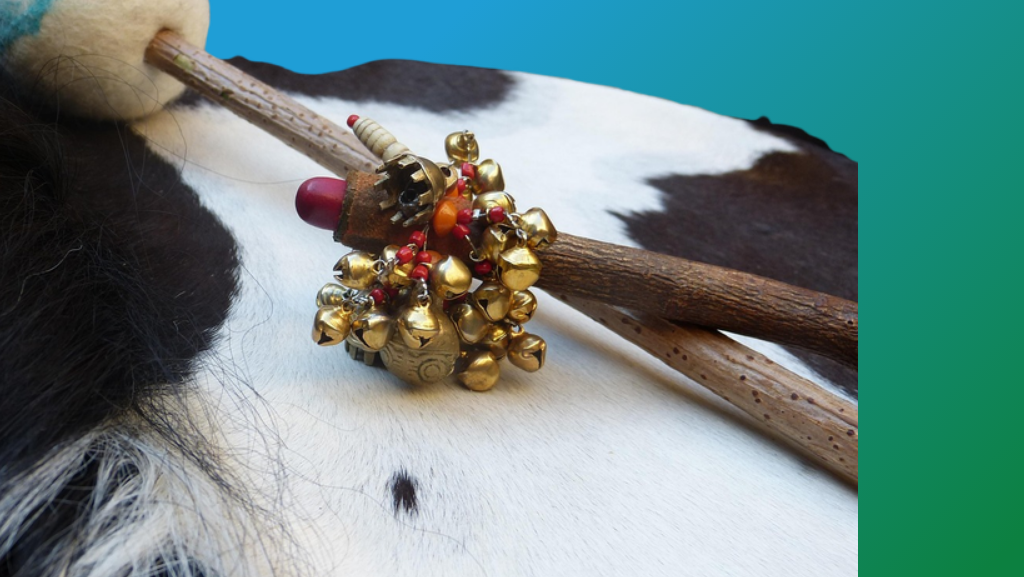
What set the noaidi apart technically from many drum-journeying traditions elsewhere is how central the drum was to divination specifically, not only to trance. A small indicator, often a ring or a piece of bone or antler, was placed on the drumskin, which was then struck. How the indicator moved and where it landed against the painted symbols gave the answer. The drumming that carried the noaidi into trance and the drum that was read like a map could be the same instrument used two different ways in the same sitting.
What was painted on the goavddis, the sacred drum?
The goavddis was painted with red alder-bark dye in a personal cosmology: the sun, reindeer, boats, the layers of the Sámi universe, helping spirits, sometimes figures specific to the noaidi who owned it. No two surviving drums are painted identically, because each one mapped one practitioner’s own relationships with the unseen, not a fixed universal chart. This is one reason the drums that survived persecution (a small number, scattered now across museums in Scandinavia and beyond) are read by scholars with real caution: a symbol’s meaning on one drum does not automatically transfer to another.
What is joik, and how does it relate to the shamanic work?
Joik is the traditional Sámi vocal style, a chant without fixed lyrics that can be composed for a person, an animal, a place or a feeling, and carried for that subject for life. It predates Christianity in the Sámi world and survived its suppression far more visibly than the drum did, partly because a song in someone’s memory is harder to confiscate and burn than an object.
Joik is not simply a shamanic technique in the way drumming is. Much of it is social and everyday, a way of holding someone or something in mind through sound. But it sits close to the tradition’s spiritual core, and some noaidi used joik alongside the drum to call in a trance state or to address a specific spirit by its own song. Today joik is a living, visible part of Sámi culture and music, performed far beyond any ritual context, and that ordinary, everyday survival is itself part of the story.
What do seita stones and reindeer cosmology have to do with it?
Sámi spiritual life was never only about the noaidi’s dramatic trance work. Seita, sacred stones and natural sites in the landscape, were and in places still are given offerings of fat, blood or small gifts, in exchange for luck in hunting and herding. The underworld in Sámi cosmology, sáivo, held ancestors and helping spirits and was understood as mirroring the world above, sometimes upside down.
Reindeer herding is not incidental background here. It is the economic and spiritual centre of much traditional Sámi life, and the cosmology reflects that directly: luck with the herd, safe calving, successful hunts and good weather were the practical concerns the whole system of noaidi, seita and ritual existed to serve. This is a tradition built around a specific relationship with a specific land and a specific animal, not an abstract spiritual technology.
How was Sámi religion suppressed, and by whom?
From the 1600s onward, Scandinavian crowns and the Lutheran church ran a sustained campaign against Sámi religion that is difficult to soften. Missionaries and colonial officials confiscated and burned sacred drums by the hundreds, so that only a small number survive worldwide today. Noaidi were arrested, tried and in documented cases executed for practising their role; the trial of the noaidi Anders Poulsen in Norway in 1692, which ended in his death in custody, is one of the better recorded examples. Joik, the drum and the Sámi language itself were banned or heavily restricted at different points over the following three centuries, extending into forced assimilation policies in Norway, Sweden and Finland well into the twentieth century, including the removal of Sámi children into residential schools designed to erase their language and culture.
The pattern runs disturbingly close to what happened to shamanic practice under Soviet rule in Siberia at roughly the same historical distance from us, different empires, the same underlying logic: a state deciding that an indigenous spiritual practice was an obstacle to control and setting out to erase it.
What does the modern Sámi revival look like?
Sámi political and cultural revival accelerated from the mid-twentieth century onward, gaining real momentum after the Alta controversy in Norway in the late 1970s and early 1980s, a dam project that galvanised Sámi rights activism and led to greater recognition, including the establishment of Sámi parliaments in Norway, Sweden and Finland. Joik moved from suppressed practice to celebrated art form, performed on national and international stages. Interest in the drum, in seita and in noaidi history has grown alongside this, carried mostly by Sámi people themselves reclaiming what colonial policy tried to take.
This is also exactly where outside enthusiasm needs to slow down. A living indigenous people recovering from genuine religious persecution is not the same situation as a European reconstructing a broken lineage from old texts, which is the subject of the related articles on Nordic and Celtic shamanism on this site. If Sámi practice draws you, the respectful path is to learn its history, support Sámi-led cultural and political institutions, and ask before assuming any of it is yours to use. There is more on where that line sits in shamanism and cultural appropriation.
How does Sámi shamanism compare with the tradition I teach?
What I recognise straightaway is the drum, the trance and the layered cosmology, the same bones shared across the wider northern family of practice this site covers, from Siberia to Mongolia. What is specific to the Sámi, and genuinely striking, is how much of their tradition is read rather than entered: the drum as a divination instrument with a physical indicator and a personal painted map is a different emphasis from the pure journeying I teach through Elements of Shamanism, where the drum carries you rather than answers you directly. For the fuller picture of how all these traditions relate to each other, I have mapped it in Shamanism Was Never One Thing, and the difference between learning universal technique and taking a specific culture’s closed practice is covered in core shamanism versus traditional shamanism.
Frequently asked questions about Sámi shamanism
No. They are historically neighbouring but distinct traditions. Sámi shamanism belongs to the Sámi, an indigenous people with their own language and cosmology, while Norse practices such as seidr belong to the Germanic-speaking Norse world. Some Norse sources even describe seidr as learned from the Sámi, but the two are separate traditions, not variants of one another.
The role as it existed historically was deliberately suppressed almost to extinction, and there is no continuous, publicly visible lineage of noaidi in the old sense. There is, however, real and growing Sámi-led interest in reclaiming this history, alongside the open, thriving survival of joik and seita offerings in parts of Sápmi today.
This is contested territory and not mine to settle from outside. Joik performed respectfully and with attribution is increasingly shared internationally by Sámi artists themselves. Using the sacred drum or claiming the noaidi role without Sámi guidance or invitation is widely considered appropriation of a living people’s closed spiritual practice.
From the 1600s onward, Scandinavian church and state authorities treated the sacred drum as the central tool of a religion they wanted to eliminate, confiscating and burning drums by the hundreds as part of a wider campaign that also banned joik and prosecuted noaidi. Only a small number of original drums survive today, mostly in museum collections.
Most shamanic drums worldwide are used primarily to carry the practitioner into trance through rhythm. The Sámi goavddis did that too, but it was also read directly as a divination tool: a ring or indicator was placed on the painted skin, the drum was struck, and the answer was found in how the indicator moved across the symbols.
About the author. Carolin Mallmann is a shamanic practitioner and teacher and the founder of One Shamanism. She trained in Mongolian and Siberian lineages and in Core Shamanism with the Foundation for Shamanic Studies, and teaches practitioners internationally.
Shamanic work supports, but does not replace, medical or psychological treatment.