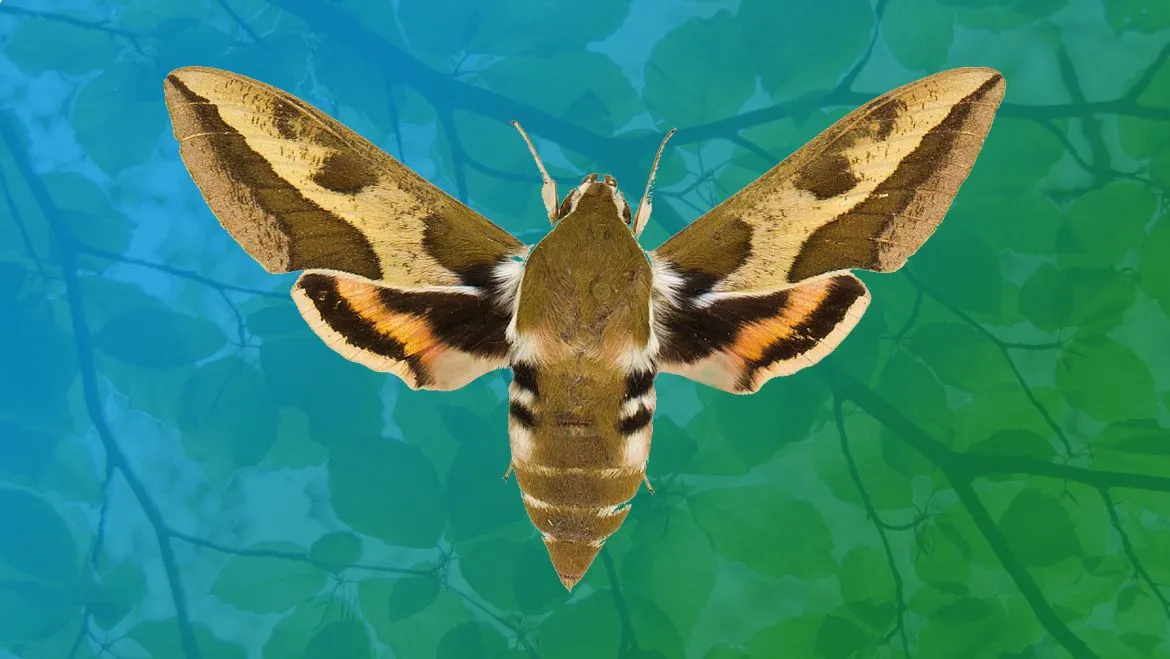
The moth spirit animal is the ally of people who are changing in the dark, where nobody is watching and nothing yet proves it is working. Where Butterfly gets the applause, Moth does the same work in a plain brown cocoon and comes out at night. In shamanic practice, Moth arrives in two situations. Something in you is changing and none of it shows yet. Or you have been following a light that is slowly burning you.
Moth is not a lesser butterfly. There are vastly more moths than butterflies, they were here first, and the medicine is harder and more useful than it looks.
What does the moth spirit animal mean?
The moth spirit animal means changing where nobody can see it, steering by very little light, and being honest about which light you are steering by. Moth represents the part of you that is being remade quietly, the pull toward something bright, and the question of whether that brightness is the moon or a bulb.
In shamanism, a power animal is a helping spirit in animal form. It carries one particular medicine and lends you that quality once you are in relationship with it. Moth’s medicine is faithful change without an audience. Where Butterfly teaches you to dissolve and emerge into daylight, Moth teaches you to keep going through the part nobody sees, and to be honest about what you are flying toward.
The biology says the same thing. About 160,000 moth species have been described, against some 18,000 butterflies, so for every kind of butterfly there are about nine kinds of moth you never notice. Most of them fly at night and steer by the light of the open sky. A butterfly forms a smooth chrysalis; a moth often spins itself a cocoon out of silk, rough and dull and often buried in leaf litter. And the large silk moths, the Luna and the Atlas among them, emerge with no working mouth at all. They cannot eat. They live about a week on what the caterpillar stored, and they spend that week doing one thing only.
Then there is the light. For a long time we said moths are attracted to flame. Research published in Nature Communications in 2024 found a more precise explanation, and a bleaker one. Flying insects tilt their backs toward the brightest light in the sky, which keeps them upright under an open sky and traps them circling helplessly around a lamp (Fabian et al., 2024). The moth is not in love with the bulb. It is using an instinct that worked for millions of years, in a world we changed. If you have ever done the same thing, the same way, with the same loyalty, and watched it slowly cost you, you already know this animal.
Mircea Eliade, in Shamanism: Archaic Techniques of Ecstasy, documented how often the soul is pictured as something winged that leaves the body and returns. Michael Harner, whose The Way of the Shaman brought core shamanic journeying to a Western audience, insisted that power animals are met directly rather than chosen from a list. Moth tends to come to people who are mid-change and quietly ashamed of how little there is to show.
What is moth symbolism across cultures?
Moth symbolism gathers around three things almost everywhere: the souls of the dead, the night, and a message you did not ask for. Because moths are everywhere and mostly fly at night, the lore is far older and far more varied than the modern idea of the moth as a failed butterfly.
| Tradition / region | What Moth carries |
|---|---|
| Mexico and Central America | The black witch moth, mariposa de la muerte, widely read as a visitor connected to death or to news from the dead |
| European folk belief | A moth in the house as a soul passing through; the death’s-head hawkmoth as an omen, because of the skull marking on its back |
| China and Japan | The silk moth, Bombyx mori, domesticated for thousands of years; moths and butterflies alike understood as souls of the departed |
| Australia | Bogong moths, which migrate to the high country in their millions, were a major seasonal food and the reason for large ceremonial gatherings |
| Modern Celtic revival practice | Night creatures at the window read as a sign that the boundary between worlds is thin, strongest around Samhain |
| Modern Western imagery | The moth as a symbol of obsession and of quiet, unglamorous devotion |
One honest caution. Many living traditions, including a number of Indigenous ones, hold their animal teachings as closed knowledge, and a short entry in a table is not the teaching. If a tradition is not yours, read it as someone else’s and work with the animal as it comes to you. There is more on this in animal spirit guides across cultures.
What messages does Moth bring when it appears?
When Moth shows up, in a journey, a dream, or on the inside of your window at two in the morning, it is usually pointing at one of six things. Read them slowly. One of them will be uncomfortable, and that is the one.
- Check which light you are flying toward. Something has your whole attention. Moth does not ask you to stop wanting it. It asks you whether it is the moon or a bulb.
- The change is already happening. You think nothing is moving because nothing is visible. Inside a cocoon, a caterpillar is largely liquid for a while. That stage has no progress to report.
- You are allowed to do this unseen. Not everything needs to be announced, posted or explained to your family. Some work only survives if it is kept quiet.
- Your senses are sharper than you think. A male silk moth can find a female by scent alone across a remarkable distance. If you keep picking something up that nobody else notices, you are not imagining it.
- You are burning fuel you cannot replace. The silk moths come out of the cocoon with no mouth. One week, nothing to eat, one purpose. Beautiful in a moth. In a human being running on reserves for a year, it is a warning.
- Something is being delivered. In many places the moth at the window is a message, often from the dead. You do not have to take that literally to take it seriously. Ask what you were thinking about when it arrived.
A distinction worth making: a moth that settles quietly near you and stays tends to carry an invitation. A moth that batters itself against a lamp while you watch tends to be showing you something about your own fixation. The two feel completely different in the body, and the body is the better instrument here.
Is Moth your power animal? Signs to look for
Moth is likely one of your power animals if it keeps returning across unrelated situations and its presence steadies you rather than unsettling you. What tells you is that it keeps coming back and that you feel different afterwards, not how striking the encounter was.
- Moth turns up in more than one journey without being called
- You are in the middle of a change that you cannot yet describe to anyone
- You do your real work at night, or your mind only comes properly alive after dark
- You notice things other people miss, and you have been told you are too sensitive
- You have a history of giving everything to one thing, and it has cost you before
- Being unseen is a relief to you rather than a wound, and you have been told that is a problem
If you are not sure whether an animal is genuinely yours, the honest answer is to journey and ask rather than to decide. You can browse the full A to Z spirit animal guide to compare, or read how to find your spirit animal for the whole process. And if you want to be told which animal walks with you, that is what the Power Animal Finder does.
How do you work with the moth spirit animal?
You work with Moth the way a moth works: at night, by small steps, with one honest question about the light. Here is a sequence you can start this week.
- Journey to meet it. Use a steady drumbeat, travel to somewhere dark and open, and ask directly: Are you my power animal? What am I changing into, and what light am I following? If journeying is new to you, the Path of the Paws spirit animal course walks you through a first journey.
- Name your lamp. Write down the one thing that currently has most of your attention. A person, a job, an approval you are waiting for. Then write what it has cost you in the last year. Read both out loud.
- Find your moon. Next to it, write what you would orient by if that lamp went out tomorrow. This is the harder half, and most people cannot answer it on the first attempt. Leave it open for a few days.
- Keep one thing unannounced. Choose something you are working on and tell nobody for a month. Notice what happens to it when it is not being watched.
- Go out after dark. Give it twenty minutes somewhere you know is safe, and put the torch away once your eyes have adjusted. Night vision takes roughly that long to arrive, and most people turn back before it does.
- Eat properly. Moth’s shadow is running on nothing. Pick the part of your week where you have been going without and put something back into it.
- Give something back. Leave a window dark for the moths, plant something that flowers at night, or just sit with the animal and ask for nothing. A relationship you only take from does not last. There is more on this in how to honor your spirit animal.
Moth’s shadow side
Every power animal has an edge where its own medicine turns on you. Moth’s edge is the most literal of any animal I work with, because the image is already in the language: flying into the flame.
Moth shadow is devotion pointed at the wrong thing. Staying loyal to a person, a job, a version of yourself that has been consuming you for years, and calling it commitment. It is the fixation that feels like purpose, right up to the point where there is nothing left to burn. It also shows up as the opposite, in people who have made themselves so unremarkable that nobody can see them at all. A moth’s camouflage is beautiful, and it is also a life spent pressed flat against bark, hoping not to be noticed.
The correction is not to stop being devoted. Moth is not built for half-measures. The correction is to look hard at what you are circling, and to let yourself be seen by at least one person who is safe.
What I have seen with Moth in practice
Moth rarely comes to people who are at the start of something. It comes in the middle, in the part with no view.
I journeyed once for a man in his fifties who had left a career he had built over twenty years and had nothing to show for the eighteen months since. No new title, no story he could tell at a dinner table. He kept apologising to me for wasting my time. What came was a moth in a cocoon under a pile of wet leaves, and the clear sense that it was absolutely not finished and absolutely not failing.
He asked what he was supposed to do with that. I told him: nothing. That was the part he was going to hate, and he did hate it. He also stopped explaining himself to his brother every Sunday, which was the real cost he had been paying.
He came out of it eventually, doing work that looks small from the outside and fits him properly. What he said afterwards has stayed with me. The hardest part was never the not knowing. It was how much of his energy had gone into looking like someone who knew. That is Moth. It does not shorten the dark part. What it takes away is the obligation to perform your way through it.
Moth compared with other winged allies
| Animal | Kind of medicine | Arrives when |
|---|---|---|
| Moth | Unseen change, night senses, the question of the light | You are mid-transformation with nothing to show for it |
| Butterfly | Transformation that becomes visible, emergence into daylight | An old form of you is finally ending |
| Hummingbird | Joy, vitality, endurance through sweetness | You are functioning well and feeling almost nothing |
| Raven | Truth-telling, prophecy, crossing between worlds | Something needs to be said that nobody will say |
| Owl | Night sight, seeing what is hidden, the uncomfortable truth | You already know the answer and are avoiding it |
| Snake | Release, shedding a finished identity | You have outgrown a skin and are still wearing it |
Frequently asked questions about the moth spirit animal
What does it mean when a moth visits you?
A moth visit is traditionally read as a message arriving, often connected to the dead or to something you have been avoiding looking at. Shamanically it marks a thin moment rather than a fixed omen. The useful question is not what moths mean in general, but what you were thinking about in the ten seconds before it appeared. That thought is usually the message.
What is the difference between moth and butterfly medicine?
Butterfly is transformation that ends in daylight, where people can see it. Moth does the same work in the dark, in a rough silk cocoon, and nobody applauds. Others notice what Butterfly changes in your life. What Moth changes, only you can verify, and that is much harder to hold on to.
Is a moth a bad omen or a sign of death?
Not in itself. The association is real and very old, and in parts of Mexico and Central America the black witch moth is read as a visitor linked to death. But in shamanic terms, death usually means an ending rather than a funeral: a role, a relationship, a phase that is finishing. A moth at the window points to an ending in your own life far more often than to anyone’s death.
What does it mean to dream of moths?
Dream moths usually point to what you are drawn to and what it is doing to you. Moths circling a lamp tend to mark a fixation that is costing you. A moth resting quietly, or one in a cocoon, tends to mark a change that is underway and not yet ready. Note which it was, then look for where in your waking life that picture already fits. There is more in dreaming of animals.
Can Moth be a power animal if I am drawn to light and colour?
Yes, and that is often exactly why it comes. Power animals frequently bring the quality you are missing rather than the one you already have. Moths themselves are not drab: the Luna moth is pale green, the Atlas moth is one of the largest winged insects alive. Moth is not about being dull. It is about not needing to be seen in order to continue.
How do I know Moth has actually accepted the relationship?
Something shifts in ordinary life. You stop explaining yourself to people who were never going to understand, the waiting stops feeling like failure, and you find you can tell the difference between the thing you love and the thing you are circling. Power animals are known by their effects, not by how vivid the vision was.
About the author. Carolin Mallmann is a shamanic practitioner and teacher and the founder of One Shamanism. She has been journeying with the drum for over a decade, trains practitioners internationally, and created the Path of the Paws spirit animal deck. She works with clients across Europe and teaches online.
Shamanic work supports, but does not replace, medical or psychological treatment.