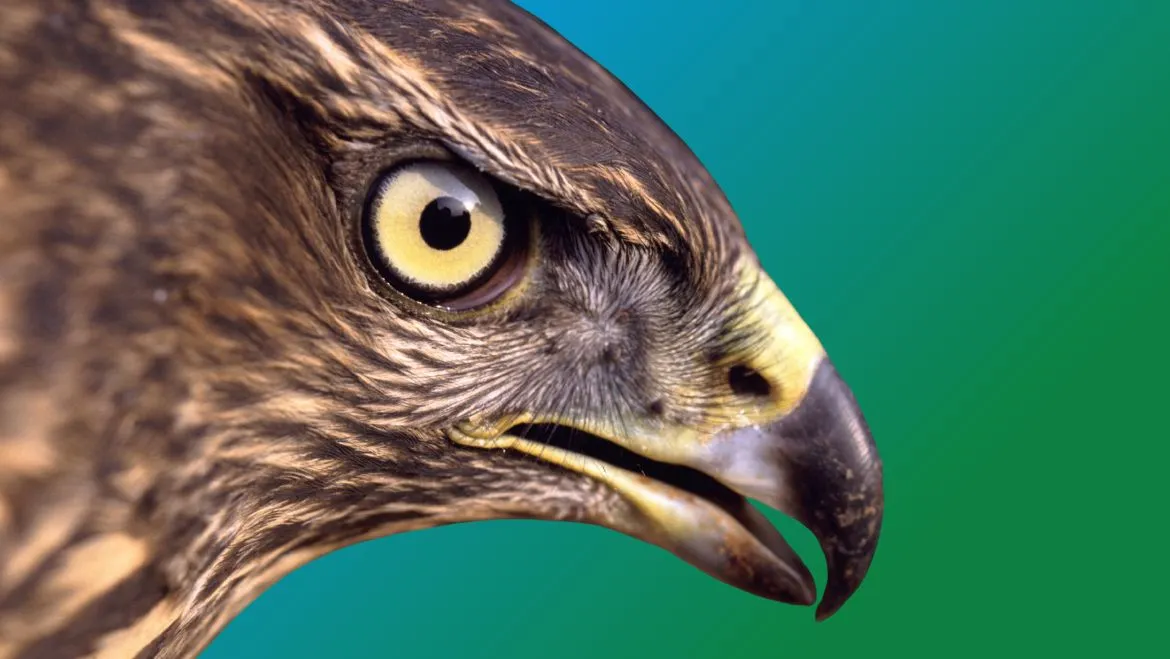
The hawk spirit animal is a symbol of altitude, precise sight and the willingness to see a situation as it actually is. In shamanic practice, Hawk is the ally who arrives when you have been standing so close to your own life that you can no longer read it. Hawk does not solve the problem. Hawk lifts you high enough to finally see its shape.
Hawk also has a reputation for being uncomfortable. People ask for clarity, and then clarity comes. It shows them the conversation they have been avoiding, the job they outgrew two years ago, the relationship that has been over for a while. That is Hawk medicine working exactly as it should.
What does the hawk spirit animal mean?
The hawk spirit animal means clear-sighted perspective. Hawk represents the ability to rise above confusion, to see detail and whole picture at the same time, to recognise the moment for action, and to tell yourself the truth about what you are looking at.
A power animal, in shamanism, is a helping spirit in animal form that carries a particular medicine, a quality it lends you once you enter into relationship with it. Hawk’s medicine is vision that leads to decision. Where Owl sees in the dark and works with what is hidden, Hawk works in full daylight. Nothing is concealed. The difficulty is not that you cannot see. The difficulty is that you have not been willing to look.
A red-tailed hawk can pick out a mouse in a field from a hundred metres up. Its eyes resolve detail several times more sharply than ours, and it holds that detail without losing the landscape around it. That is the exact quality Hawk offers a person: you keep the small facts and the large context in one field of view, at the same time. Most of our stuck places come from losing one or the other.
Mircea Eliade, in Shamanism: Archaic Techniques of Ecstasy, described birds of prey across Siberian and Central Asian traditions as the classic carriers of the shaman’s soul in flight, the animals whose feathers were sewn into the costume so the practitioner could rise. Michael Harner, whose The Way of the Shaman brought core shamanic journeying to a Western audience, was clear that power animals are met directly in non-ordinary reality rather than chosen from a list. Hawk tends to arrive for people who already know something and have been working hard not to know it.
What is hawk symbolism across cultures?
Hawk symbolism centres on vision, messengership and the link between the human world and the sky world. Almost everywhere hawks are found, they are read as the animal that carries word between the two.
| Tradition / region | What Hawk carries |
|---|---|
| Siberian and Central Asian shamanism | The bird of prey that lifts the shaman’s soul; feathers worn to make flight possible |
| Ancient Egypt | Horus, the falcon-hawk whose eyes are sun and moon, sovereignty joined with sight |
| Many North American nations | Messenger and guardian, the one who watches the road ahead and warns |
| Celtic tradition | The hawk of Achill, one of the oldest animals, keeper of long memory |
| Polynesian traditions | The hawk as an ancestral spirit and omen-bearer, appearing before change |
| Norse and northern European lore | The hawk seated between the eyes of the eagle in the world tree, watchfulness itself |
The thread through all of them: Hawk does not fight what it sees. Hawk names it. The power lies in accurate perception, and in the fact that once something has been truly seen, it cannot easily be unseen again.
What messages does Hawk bring when it appears?
When Hawk shows up, in a journey, a dream, or circling above the road on your drive to work, it is usually pointing at one of six things. Read them slowly and notice which one you would rather skip.
- Get higher. You are too close. Step back from the detail you have been chewing on and look at the whole pattern instead.
- You already know. Hawk rarely brings new information. It brings permission to admit what you have quietly understood for months.
- Something is approaching. Hawk is a watcher on the road ahead. Pay attention to the thing you keep half-noticing at the edge of your life.
- Focus, then commit. A hawk hovers, then drops. Endless circling is not discernment after a certain point, it is avoidance.
- Speak the message. Hawk is a messenger bird. There is something you are meant to say out loud, probably to one specific person.
- Trust the sharp thought. The clear, unsentimental read you had and then immediately talked yourself out of was correct.
One distinction worth making: a hawk that circles calmly overhead is usually offering perspective and time. A hawk that stoops, screams, or appears suddenly at close range is urgency. It marks something that has waited long enough. The two feel very different in the body, and the body is the better instrument here.
Is Hawk your power animal? Signs to look for
Hawk is likely one of your power animals if it keeps returning across different contexts and its presence makes you feel steadier and more clear-headed rather than exposed. Recurrence plus a sense of things coming into focus is the test.
- Hawk appears in more than one shamanic journey without you calling it
- Thinking of it sharpens you, the way cold air does, rather than unsettling you
- Hawks find you repeatedly in a short window: a fence post, a motorway verge, a feather on the path
- People come to you for a clear read on their situation, and you can usually give one
- You see problems early and have learned to keep quiet about it
- You are in the middle of something you cannot make sense of from where you are standing
If you are unsure whether an animal is truly yours, the honest answer is to journey and ask rather than to decide. You can browse the full A to Z spirit animal guide to compare, read more about finding your spirit animal, and if you want the animal that actually walks with you named for you, that is what the Power Animal Finder is for.
How do you work with the hawk spirit animal?
You work with Hawk the way a hawk works with a landscape: rise, survey, wait for the moment, then act once and cleanly. Here is a simple sequence.
- Journey to meet it. Use a steady drumbeat, ascend to the Upper World or travel to a high place, and ask directly: Are you my power animal? What am I not seeing? If you are new to this, the Path of the Paws spirit animal course walks you through the journey step by step.
- Take the aerial view. Write your situation down, then rewrite it in three sentences as if describing a stranger’s life. What you leave out is usually the noise. What survives is the actual problem.
- Go where you can see far. A hilltop, a rooftop, a long stretch of coast. Twenty minutes of physical distance changes mental distance more reliably than any technique.
- Practise the single sharp look. Once a day, choose one thing you have been softening and describe it to yourself in one plain sentence, without cushioning. Hawk does not editorialise.
- Stop circling. Pick one decision you have been turning over for more than a month and set a date to make it. Hovering has a purpose only if it ends in a dive.
- Carry the message. Say the thing. Hawk medicine turns stale when the seeing never becomes speech.
- Give something back. Sit with the animal without asking for anything. Relationships that only take, thin out.
Hawk’s shadow side
Every power animal has an edge where its medicine turns against you, and Hawk’s is easy to miss because it looks like competence.
Hawk shadow is the person who sees everything and feels nothing about it. Cold accuracy. The habit of hovering permanently above your own life, analysing it beautifully, never landing in it. If you find you can describe your marriage, your grief or your work with perfect clarity while remaining entirely untouched by any of it, that is Hawk gone too high. The correction is not less sight. It is descent. Come down, land, be in the field with the ordinary uncomfortable detail.
What I have seen with Hawk in practice
In my own work, Hawk almost never comes to people who are confused. It comes to people who are pretending to be confused.
I journeyed once for a man who had been going back and forth about leaving his business for nearly three years. He wanted a spirit animal that would help him decide. What came was a hawk on a fence post, doing nothing at all, simply looking at him. He was frustrated. He said he had come for guidance and had been given a bird that just stared.
I asked him what the hawk was looking at. He went quiet for a long time, and then said: the door. Not the business. The door out of it. He had known for three years. What he had actually wanted was for someone else to make the choice so it would not be his fault.
He left five months later. He told me afterwards that the hardest part was never the decision. It was giving up the story that he did not know. That is Hawk, precisely. It does not hand you an answer. It removes the excuse of not having one.
Hawk compared with other birds of prey and sky animals
| Animal | Kind of medicine | Arrives when |
|---|---|---|
| Hawk | Perspective, accurate sight, decisive action | You are lost inside something and need altitude |
| Eagle | Spirit vision, sovereignty, the long view | You need the view of your whole life, not one problem |
| Falcon | Speed, focus, committed strike | The target is already clear and you are hesitating |
| Owl | Intuition, hidden truth, seeing in the dark | What matters is concealed rather than merely unseen |
| Raven | Prophecy, truth-telling, crossing worlds | Something must be named that no one wants named |
| Vulture | Cleansing, rebirth, facing what has died | Something is finished and needs to be let go of |
Frequently asked questions about the hawk spirit animal
What does it mean when a hawk crosses your path?
A hawk crossing your path is traditionally read as a call to pay closer attention to something you have been moving past too quickly. Shamanically, it marks a moment of heightened perception rather than a fixed omen. The useful question is not what hawks mean in general, but what you were thinking about in the ten seconds before you saw it. That thought is usually the message.
What is the difference between a hawk and an eagle spirit animal?
Hawk works at a middle altitude and deals with a specific situation: it shows you the shape of the thing in front of you and asks you to act on it. Eagle works far higher and deals with your whole direction, your purpose and your relationship with spirit. Hawk clarifies a chapter. Eagle clarifies the book.
Is seeing a hawk a good sign or a warning?
It is generally both, and that is not a dodge. Hawk brings clarity, which is protective, and clarity almost always arrives with something you would rather not confront. A calm circling hawk usually signals perspective and time. A hawk that appears abruptly and close tends to mark urgency. Neither is bad news. Both are information.
What does finding a hawk feather mean?
In many traditions a raptor feather marks a message received and a connection acknowledged. Treat it as a reminder to raise your view rather than as a prediction. One practical note: in the United States and several other countries it is illegal to keep the feathers of native birds of prey. Leave it where it is, or note it and photograph it. The relationship does not depend on possession.
Can Hawk be a power animal for someone who is not naturally decisive?
Very often, yes. Power animals frequently bring the quality you lack rather than the one you already have. People who agonise over decisions are exactly who Hawk tends to visit. The medicine is not a personality transplant. It is the growing ability to see clearly enough that the decision stops needing so much force.
How do I know Hawk has actually accepted the relationship?
Something changes in your ordinary life. You get to the point faster, you spend less time in circular thinking, and you notice you can say what you see without rehearsing it first. Power animals are known by their effects, not by how vivid the vision was.
About the author. Carolin Mallmann is a shamanic practitioner and teacher and the founder of One Shamanism. She has been journeying with the drum for over a decade, trains practitioners internationally, and created the Path of the Paws spirit animal deck. She works with clients across Europe and teaches online.
Shamanic work supports, but does not replace, medical or psychological treatment.