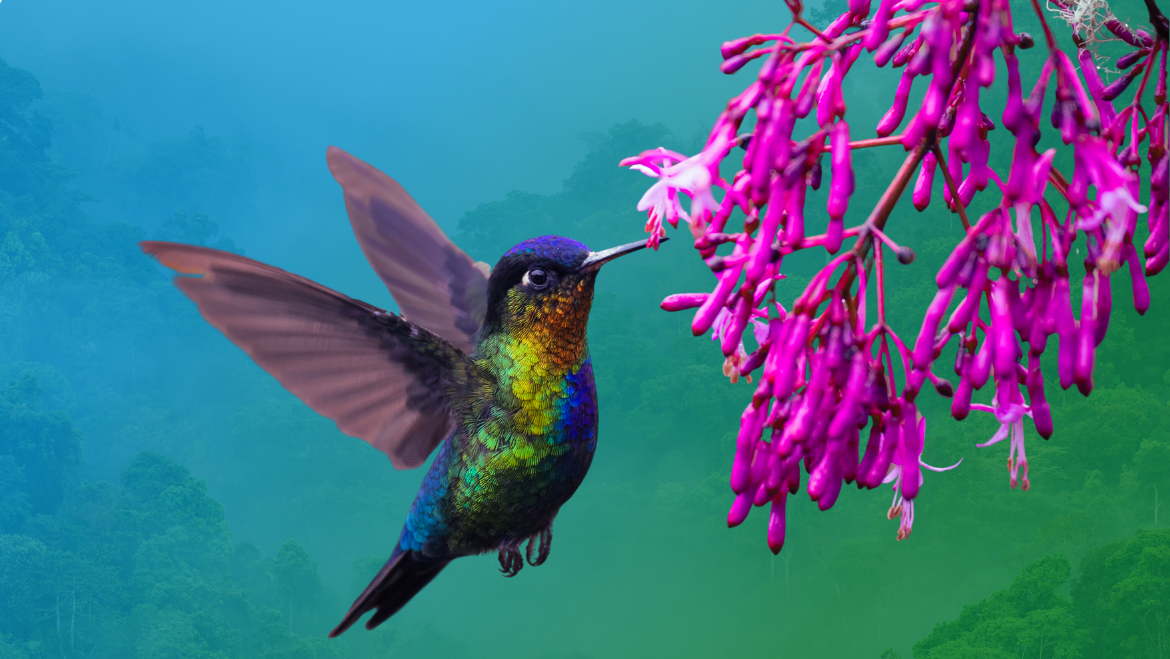
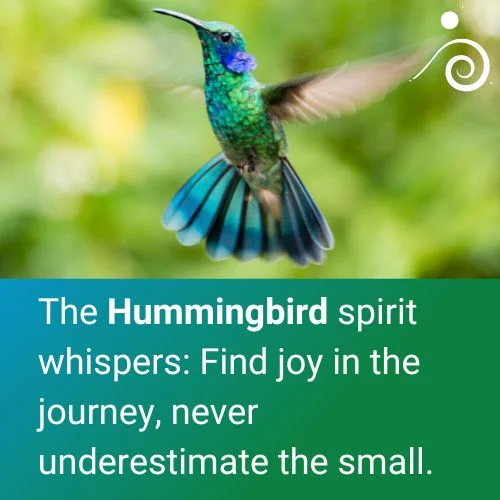
The hummingbird arrives fast. On a journey it does not walk toward you — it is suddenly there, hovering at eye level, impossibly still in the middle of impossibly fast movement, and then gone, and then back. What people report afterwards is the paradox of it: a creature moving faster than the eye can follow, that somehow brings a feeling of complete presence. It should be exhausting to be near. Instead it is the opposite.
This is about the hummingbird spiritual meaning — what it means when this bird keeps appearing in your dreams, your journeys, or your waking life — not about feeders or flight speeds. And it is one of the most sentimentalised guides there is. The greeting-card version says “joy.” The real bird says something far more demanding: that joy is not the absence of hardship, and that the hummingbird earns its lightness through a nightly brush with death most people never hear about.
The Bridge: What the Body Teaches About the Hummingbird Spirit Animal
Everything this bird has to say is written into a body that lives closer to its limits than almost any animal alive.
- It nearly dies every night — on purpose. A hummingbird’s metabolism is so extreme it cannot survive a cold night at full speed, so it drops into torpor: heart rate and body temperature plummet, and it hangs, apparently lifeless, until dawn revives it. The hummingbird’s joy is not naive. It is built on a daily descent into a death-like stillness and a return. The lightness is real because the darkness is real.
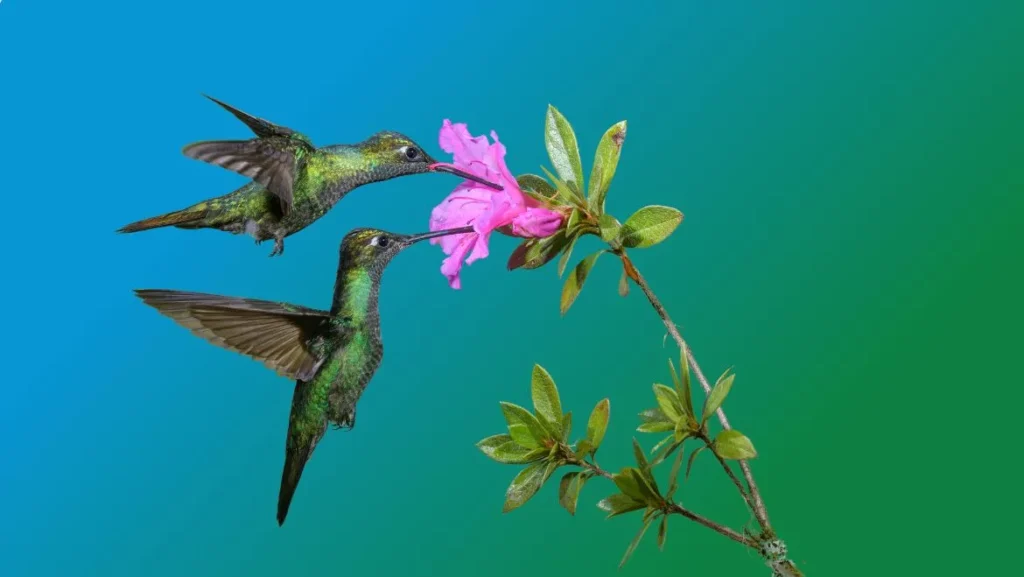
- It is the only bird that can hover and fly backwards. Its wings trace a figure-eight, generating lift on both strokes, which lets it hold a still point in the air and reverse. The medicine is the ability to stop dead in the middle of motion, and to go back — to revisit, to reconsider, without losing your place.
- It must feed almost constantly, and it savours. With a heart that can beat over a thousand times a minute, the hummingbird has to take nectar again and again through the day. For this bird, seeking sweetness is not indulgence — it is survival. Joy is not the reward for finishing the work. It is the fuel that makes the work possible at all.
- It is astonishingly fierce. For all its delicacy, a hummingbird will defend a flower or feeder against birds many times its size, diving and jabbing without hesitation. The sweetness is not weakness. Anyone who mistakes this bird for merely pretty has not watched one defend its territory.
When the hummingbird appears as your guide, the question it carries is usually: where have you been treating joy as a luxury to be earned — and are you brave enough to rest as completely as you fly?
Hummingbird Symbolism Across Traditions
The hummingbird belongs to the Americas, and its deepest symbolic history sits there — not in the pan-global grab-bag it is often assigned to. It is worth being accurate rather than expansive.
Aztec: the warrior reborn
Among the Aztec (Mexica), the hummingbird was anything but delicate. Their supreme deity Huitzilopochtli — whose name is often rendered as “hummingbird of the south” or “left-handed hummingbird” — was a god of the sun and of war, and fallen warriors were believed to return to the world as hummingbirds. Hold that against the greeting-card version: in the tradition closest to this bird’s home, it symbolised courage, resurrection and the fierce spirit of those who had died well. The joy and the ferocity were never separate.
Andean and Nazca: the messenger figure
On the Nazca plain of southern Peru, one of the great geoglyphs — lines carved into the desert on a scale only fully visible from the air — is a hummingbird. Its exact purpose is still debated, but its presence tells us the bird carried enough significance to be drawn across the earth itself. Across a number of Andean traditions the hummingbird is understood as a messenger and a bringer of vitality — a small creature entrusted with large things.
The teaching of the migration
Some hummingbirds make journeys that should be impossible for their size — the ruby-throated hummingbird crosses the Gulf of Mexico in a single non-stop flight of hundreds of miles. There is a genuine teaching in this, and it is the honest version of the “anything is possible” cliché: the impossible crossing is survivable, but only if you have fed properly first and only if you are willing to rest completely at the other end. The hummingbird does not power through on optimism. It fuels, it flies, and it collapses into torpor when the flight is done.
The Path of the Paws
42 hand-illustrated oracle cards, one for each animal guide — drawn from the same practice these articles come from. A way to sit with an animal instead of only reading about it.
Order your deck →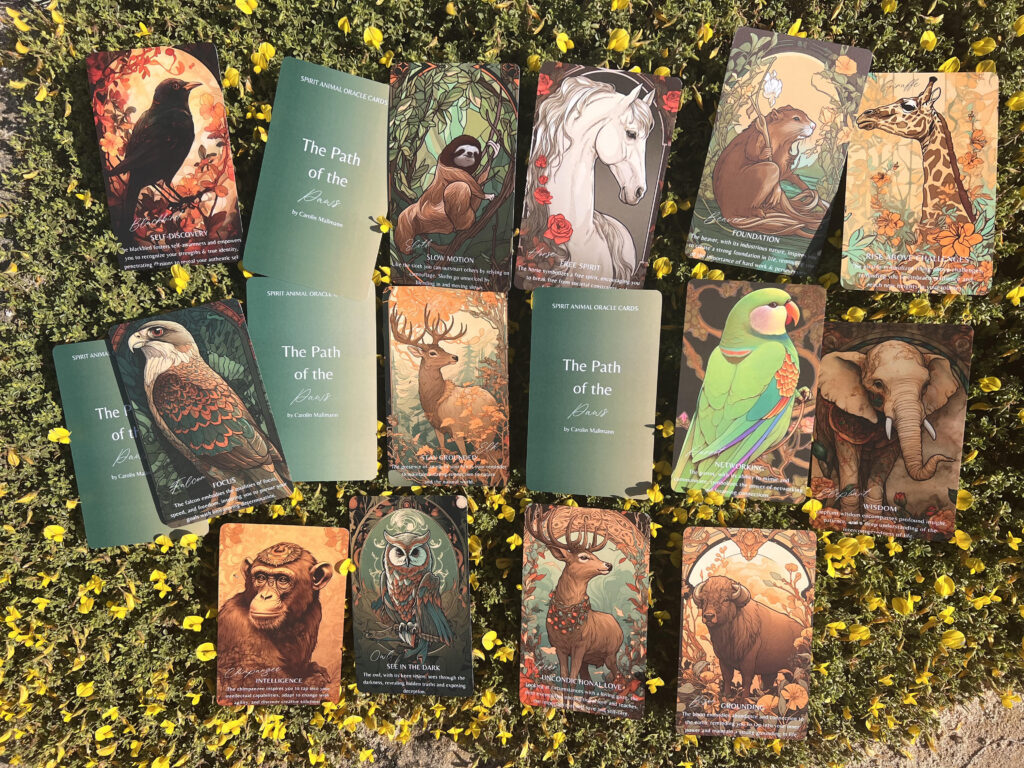
The Shadow: When Lightness Becomes a Refusal to Land
Hummingbird medicine has a shadow that is easy to miss precisely because it looks so pleasant.
- The bright mask. This is the distortion I meet most often. Relentless positivity used as a lid — “everything happens for a reason” said about a genuine loss. The hummingbird’s real joy is built on the nightly torpor, on going all the way down. Forced cheer that never descends is not lightness. It is a way of never grieving, and the pressure underneath it accumulates.
- The refusal to land. A hummingbird can hover indefinitely, and the shadow version of a person never touches down — always moving, always onto the next flower, never staying long enough for anything, or anyone, to hold weight. If you cannot remember the last time you were still, this is your medicine and this is its warning.
- Flitting mistaken for freedom. Darting from project to project, person to person, interest to interest, and calling it a free spirit. The hummingbird’s speed is purposeful. Its shadow is scattered, and it leaves nothing finished.
- Burning the fuel too fast. The extreme metabolism is a gift and a threat. People carrying this medicine badly run hot, give everything, and forget that the bird survives only because it also drops into near-death rest. Without the torpor, the speed kills.
A hummingbird that appears in a dream trapped indoors, beating against glass is one of the clearest images of a bright spirit exhausting itself against a limit it will not name. A hummingbird on the ground, unable to lift speaks to depletion — the fuel run out. And a hummingbird frozen, cold, seemingly dead is not, in my experience, a frightening omen: it is torpor, the necessary descent, and it usually arrives to give someone permission to finally rest.
How to Journey to the Hummingbird
Shamanic work is not a substitute for medical or psychological care. If you are new to this, begin with the beginner’s guide to shamanic journeying before attempting the practice below.
- Set a hummingbird-shaped intention. Not “give me more energy.” Rather: “Show me the joy I have been postponing — and the rest I have been refusing.”
- Journey to a garden in full bloom. Colour, warmth, flowers heavy with nectar. The hummingbird lives where sweetness is abundant, and it will meet you there rather than in the dark.
- Watch it hover, and notice the stillness inside the speed. Do not chase it. The whole teaching is in that held point — total motion and total presence at once. Sit with it for longer than feels comfortable.
- Ask it to show you where you have stopped savouring. The hummingbird takes nectar deliberately, again and again. Ask: “What sweetness in my life have I been rushing past as if it did not count?”
- Follow it into torpor. This is the part people skip and the part that matters most. Let the journey slow, let the bird settle, and stay in that stillness until your own body genuinely lets go. How hard that is to tolerate is your diagnosis.
- Afterwards, schedule one true rest. Not a productive one. Twenty minutes, this week, doing nothing at all. If that feels unbearable, you have found the exact work the hummingbird came for.
Affirmations for Hummingbird Medicine
- “Joy is my fuel, not my reward. I am allowed it now.”
- “I can rest as completely as I fly. The stillness is where I recover.”
- “I savour the sweetness instead of rushing past it.”
Hummingbird Spirit Animal: Questions People Actually Ask
What does it mean when a hummingbird appears in your life?
It is almost always a message about joy and resilience — but the deeper reading is about the relationship between them. The hummingbird tends to arrive for people who have been powering through without savouring anything, and it comes to remind them that joy is not frivolous. It is what makes the crossing survivable.
Is the hummingbird a good omen?
Yes — warm, hopeful and encouraging in nearly every tradition where it appears. But it is an omen that asks something of you: to actually receive the sweetness it points to, and to be brave enough to rest. An omen of joy you do nothing with is just a beautiful bird passing through.
What does a hummingbird in a dream mean?
Look at what it is doing. A hovering hummingbird points to a moment that deserves your full presence. A trapped one — beating against glass — speaks to a bright spirit worn out against a limit. And a still, cold hummingbird is rarely a bad sign; it is usually torpor, an invitation to rest that you have been resisting.
Why do I keep seeing hummingbirds?
Repeated appearances are usually a nudge to lighten your grip and let joy back in — but also, more quietly, to check whether you are running too hot. Ask what sweetness you have been postponing until you have earned it, and whether you have rested properly since the last hard crossing.
How do I know if the hummingbird is my spirit animal?
Persistence, not preference — whether the image keeps returning uninvited. For a structured way to test the connection rather than guess, work through the A–Z spirit animal guide or sit with the Path of the Paws oracle deck and let the animal find you.
Is the Hummingbird Your Spirit Animal?
Check the boxes that resonate with your spirit and current life journey.
Where is the hummingbird calling you to savour the sweetness — and where is it calling you, finally, to rest?