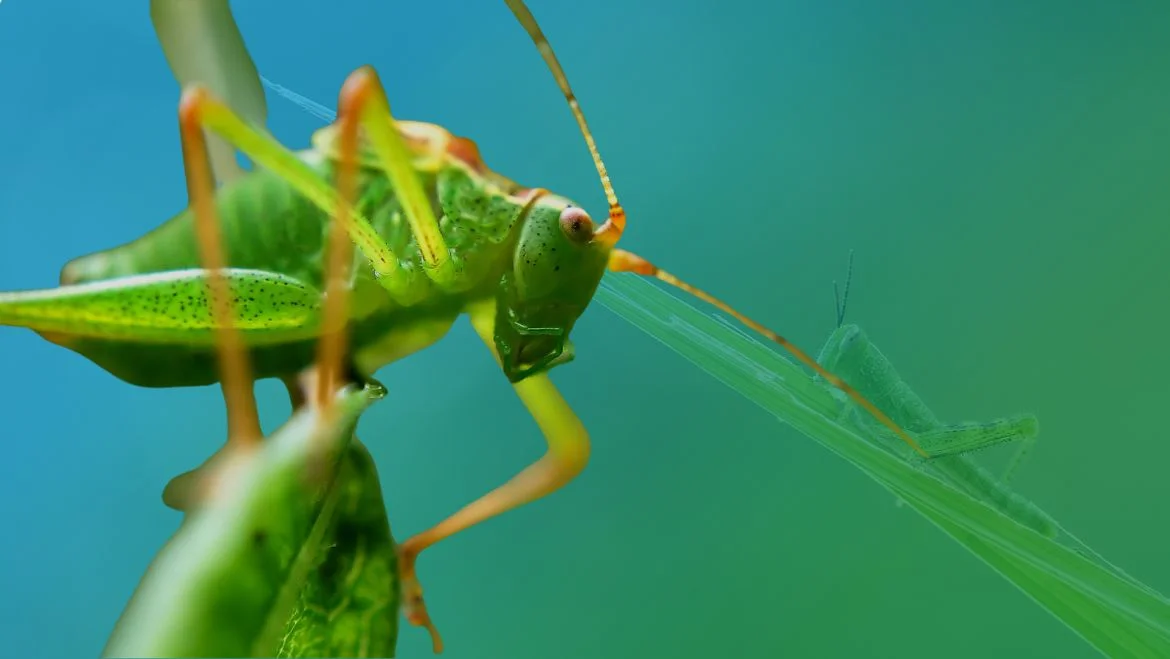
The grasshopper does not arrive slowly. On a shamanic journey it is on a blade of grass one instant and gone the next — no wind-up, no visible decision, just an explosive leap into space it could not possibly have measured first. That is the whole of its medicine, and it is more demanding than its cheerful reputation. In my practice, the grasshopper spirit animal comes for people who have been standing at the edge of a decision for far too long, mapping and re-mapping a jump they already know they need to make. Its message is not “think it through.” It is: the leap is the thinking. You will not see the far side until you are already in the air.
If the grasshopper keeps appearing for you — in dreams, in journeys, landing on you in a summer field — this page is about the grasshopper spiritual meaning, not about its life cycle. It is one of the oldest symbols of the forward leap, and it tends to arrive at exactly the moment you are refusing to take one.
The Bridge: What Grasshopper Biology Teaches About the Grasshopper Spirit Animal
Honest animal medicine grows out of the real creature. Every part of the grasshopper’s meaning is written into how its body actually works.
- It can only jump forward. A grasshopper’s whole leg architecture is built for one thing: a huge forward propulsion, storing energy like a spring and releasing it all at once. It cannot leap backward. Grasshopper medicine is movement that only goes forward — an animal that has no mechanism for retreat, and so teaches the person stuck in reverse how to commit to a direction.
- It leaps blind. The grasshopper cannot survey the landing zone before it jumps; the leap is a fraction of a second and it trusts its body to handle whatever it meets. This is the hard teaching underneath the pretty one: the leap of faith is called faith precisely because you cannot see where you land.
- It sings by friction. The grasshopper’s song is made by rubbing one part of its body against another — stridulation. Its voice is literally produced by resistance, by two surfaces pressing together. There is a teaching there for anyone who believes their creativity requires perfect, frictionless conditions.
- It is a creature of abundance and of warning. Grasshoppers are prolific, tied across cultures to fertility and plenty — and yet under the right conditions they transform into swarming locusts. The same animal is both blessing and plague. Its gift, taken to excess, becomes devouring. Hold both.
The Path of the Paws
42 hand-illustrated oracle cards, one for each animal guide — drawn from the same practice these articles come from. A way to sit with an animal instead of only reading about it.
Order your deck →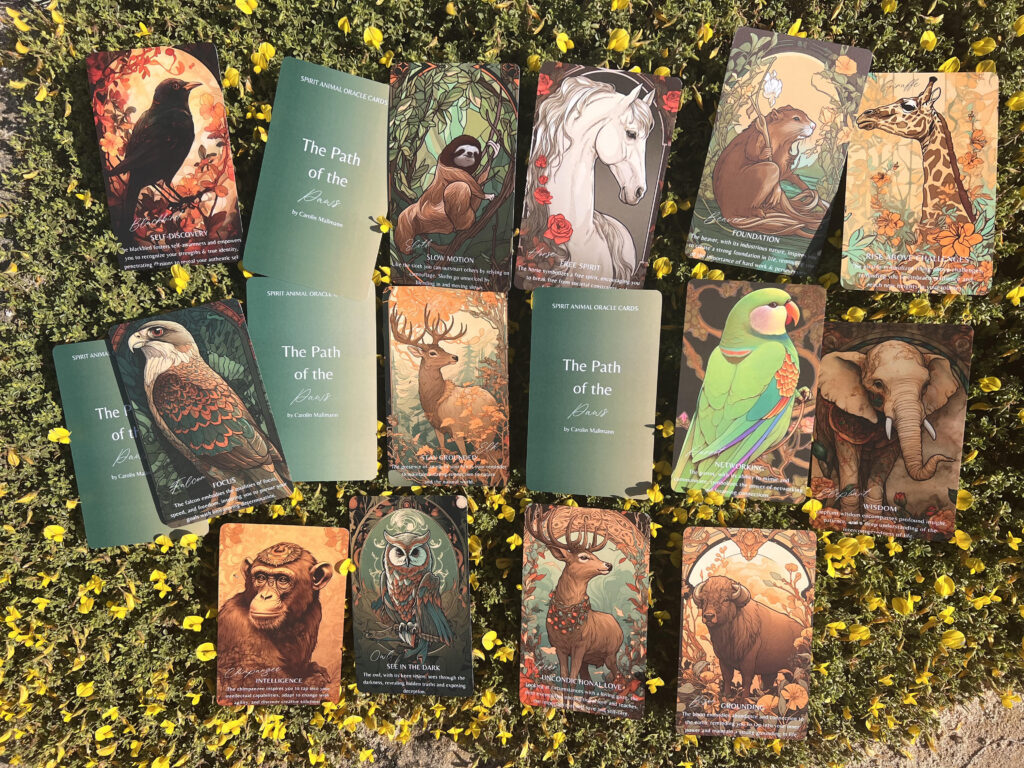
Grasshopper Symbolism Across Traditions
For such a small creature, the grasshopper carries a surprisingly heavy symbolic history, and the traditions converge on two themes: the forward leap, and abundance that must be respected.
Ancient Greece: nobility and the cicada’s cousin
In ancient Athens the grasshopper — closely associated with the singing cicada — was worn as a golden brooch and treated as a symbol of nobility and of being autochthonous, born from the land itself. To be “of the grasshopper” was to be rooted in a place and yet ready to spring. The Greeks also gave us the fable of the ant and the grasshopper, and it is worth reading against the grain: the grasshopper’s fault was never the singing, only the failure to also prepare. The leap and the song are gifts; they simply are not a substitute for the harvest.
East Asia: luck, courage and abundance
In parts of China and Japan the grasshopper and cricket have long been kept and prized — as symbols of good luck, of the coming of good harvests, and of a certain fearless vitality; fighting crickets were admired for their willingness to face a larger opponent without flinching. Read as medicine, this is the grasshopper’s courage: a small creature that does not measure the odds before it commits.
The harbinger and the swarm
Across many cultures the sudden appearance of a grasshopper is read as a message to take a leap or a sign of imminent change — and its darker aspect, the locust, appears in the oldest texts as a symbol of judgement and devastation. This double meaning is not a contradiction; it is the honest whole. The leap taken with trust brings freedom; the same restless hunger, ungoverned, consumes everything in its path.
The Shadow: When the Leap Becomes Flight
The grasshopper’s shadow hides inside its brightest gift. Not every leap is courage, and not all forward motion is progress.
- Leaping to avoid landing. The most common distortion I encounter is the person who is always jumping to the next thing — the next project, city, relationship, plan — and never staying long enough to build anything. It looks like boldness. Underneath, it is a refusal to be still long enough to feel what staying would ask. The grasshopper that never lands is not free. It is fleeing.
- The frozen jumper. The opposite shadow, and the more painful one: the person so afraid of the blind leap that they map forever and never spring. Grasshopper medicine turns sharp here — it points out that endless preparation is its own kind of avoidance, dressed as prudence.
- The swarm. Vitality without limit becomes the locust. When the appetite for more — more experience, more acquisition, more stimulation — stops nourishing and starts consuming, the grasshopper has tipped into its shadow. Ask whether your forward motion is feeding you or eating the ground bare behind you.
A grasshopper appearing unable to jump, or with a damaged leg, in a recurring dream often points to a leap you know you need to make and feel unable to. A swarm of grasshoppers or locusts points somewhere harder: to a hunger in your life that has stopped serving you and begun to strip things bare.
How to Journey to the Grasshopper
Shamanic work is not a substitute for medical or psychological care. If you are new to journeying, begin with the beginner’s guide to shamanic journeying first.
- Set a grasshopper-shaped intention. Not “give me courage” but: “Show me the leap I keep measuring and will not take.”
- Journey into a summer meadow. Tall grass, warm light, the height of a small insect. Let the landscape be vast and green, and get down to the level where a grasshopper lives.
- Ask it to show you the edge. The grasshopper will bring you to the exact place where you are standing still. Look at what is on the far side that you cannot quite see — that blur is the point.
- Leap with it, once. Let the grasshopper take you through a single leap without letting you survey the landing first. Notice what your body does in the air — that reaction is your real relationship with risk.
- Take one real, small leap this week. Not the whole jump — one committed, irreversible step toward it: the message sent, the application filed, the sentence spoken. The grasshopper’s medicine dies in the gap between insight and motion.
Affirmations for Grasshopper Medicine
- “I trust the leap. I do not need to see the landing to jump.”
- “Forward is a direction I am allowed to choose — and then stay in.”
- “My vitality feeds me. I let it move me without letting it consume me.”
Grasshopper Spirit Animal: Questions People Actually Ask
What does it mean when a grasshopper appears in your life?
It is almost always a message about a leap — a decision or change you have been circling and not committing to. The grasshopper does not arrive to make you generally braver. It arrives pointing at one specific forward move you already know you need to make, and it is not subtle about the timing.
Is the grasshopper a good omen?
Overwhelmingly yes — across most traditions it is a sign of good luck, forward progress and abundance. Its one warning face is the locust: vitality that has tipped into excess. For almost everyone who meets it as a guide, though, the grasshopper is an encouraging omen that the time to move has come.
What does a grasshopper in a dream mean?
Read what it is doing. A grasshopper leaping freely usually points to progress and the courage to move forward. A grasshopper that cannot jump points to a leap you feel blocked from taking. A swarm points to a hunger or restlessness that has grown beyond what nourishes you.
How do I know if the grasshopper is my spirit animal?
Persistence rather than preference — whether the image keeps returning uninvited. Grasshopper people are often intuitive, forward-leaning and quick to move, sometimes to the point of never landing. For a structured way to test the connection, work through the A–Z spirit animal guide or sit with the Path of the Paws oracle deck and let the animal find you.
Is the Grasshopper Your Spirit Animal?
Check the boxes that resonate with your spirit and current life journey.
What leap of faith is the grasshopper asking you to take — the one you keep measuring instead of making?