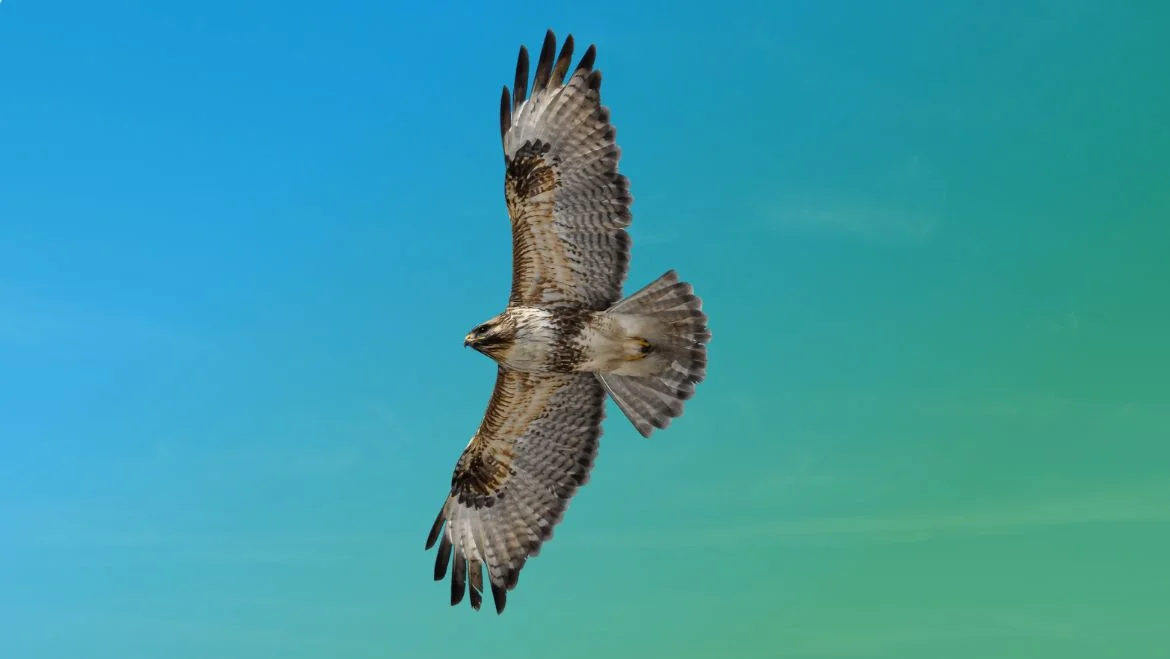
The most beautiful story about the Buzzard as a spirit animal comes from one of my clients. We did a journey together to connect with her ancestors. Since then, her ancestors have appeared to her in the form of buzzards. Sometimes, when she goes outside, she sees them soaring in the sky nearby. They accompany her, they bring messages, and she has developed a wonderful relationship with them. This story shows so beautifully how spirit animals can sometimes appear as channels for our ancestors.
What I want you to notice about that story is the physical quality of it. Buzzard does not come with a voice or a vision. He comes as a lifting — a sensation in the sternum, as though something heavy has been picked up off you and carried away, and a sudden odd calm that makes no sense given what is happening in your life. When Buzzard shows up in a journey, the world does not get clearer. It gets smaller. You rise, and the crisis that filled your entire horizon an hour ago becomes one field among many. That is the whole of his medicine. The Buzzard spirit animal is often misunderstood because he feeds on what is dead. Yet he symbolises cleansing, fresh starts and transformation. With sharp eyes and soaring flight, he teaches us to rise above challenges and to see life from a broader perspective — and he reminds us that new beginnings are always within reach.
The Bridge: What Buzzard Biology Actually Teaches
The buzzard is a master of the skies, with broad wings and a circling flight, and everything spiritual about him grows out of how that flight actually works.
- He rides thermals; he does not fight the air. The buzzard’s circling is not aimless — he is spiralling upward inside a column of rising warm air, gaining hundreds of metres with barely a wingbeat. Buzzard medicine is the medicine of rising by using what is already lifting. He is not asking you to work harder to get above your situation. He is asking you to find the warm current that is already there and stop flapping against it. In my experience this single reframe changes more for exhausted clients than any ritual I can give them.
- His eyesight is extraordinary — and it is used from a distance. Raptor vision is many times sharper than ours, and the buzzard uses it from a height, not up close. Clarity is a function of distance. You cannot see the shape of your own life while standing inside it. This is not avoidance; it is aerodynamics.
- He is a generalist, and unashamed of it. The common buzzard eats carrion, small mammals, worms, whatever the field offers. He is not a specialist and he is not proud. He takes what is actually available rather than what he thinks he deserves — which is precisely why he thrives while more glamorous raptors decline.
- He is loud, and he is often mobbed. That plaintive, mewing cry over an open field — and then the crows arrive and harass him relentlessly. Buzzard is constantly harassed by smaller, noisier birds, and he mostly just keeps circling. If you have ever been picked at by people with a fraction of your range, this is your bird.
As a spirit animal, the buzzard teaches the importance of embracing change, letting go of the old, and finding sustenance in what has ended in order to make way for the new.
Traits and attributes of the power animal Buzzard
- Vision and insight: the ability to see clearly, to look beyond the obvious, and to perceive the deeper truths hidden inside your experiences.
- Renewal and transformation: as a scavenger, he plays a vital role in the cycle of life — purification, renewal, and the transformation that comes from releasing what no longer serves.
- Adaptability and resourcefulness: he thrives in many environments and makes the most of what is available, teaching creative solutions over rigid plans.
- Endurance under harassment: he keeps his altitude while being mobbed. This is a spiritual skill, and it is rarer than it sounds.
Core Symbolism & Historical Context: The Bird Between the Worlds
The buzzard sits inside one of the oldest and most cross-culturally consistent archetypes there is: the carrion bird as messenger between the living and the dead.
Europe: the misjudged farmland raptor
In European folk tradition the buzzard — the common buzzard (Buteo buteo) of hedgerow and pasture — has often been dismissed as the lesser raptor: too common, too willing to eat carrion, insufficiently noble compared to the falcon or the eagle. Falconry hierarchies ranked him low. And there is the linguistic residue: to call someone a “buzzard” in English is not a compliment. This is the same slander the vulture carries, and it points at the same human discomfort: we are suspicious of anything that makes its living from death, because it reminds us that we will need such a creature one day.
North America and the archetype of the psychopomp
In North America “buzzard” is used colloquially for the turkey vulture, and the two birds share the same symbolic function across the traditions that hold them: a being who moves between the realms, a guardian of the mysteries of life and death, and a guide for souls in transition. These stories belong to the peoples who hold them, and I reference them here with respect and without any claim to their ceremonies. What is worth naming plainly is the anthropological pattern: the carrion bird is almost universally a psychopomp. That is not folklore inventing a metaphor. That is a great many cultures independently watching what happens to a body in the open, and drawing a coherent conclusion.
This is exactly why my client’s ancestors reached her through buzzards, and why I did not find it surprising. If you are going to send a message from the other side, you send it by the bird whose job is crossing over. Buzzard’s presence in myth signifies change, the clearing of paths, and the revelation of deeper spiritual insight — and, very often, contact with the ancestral line.
The Shadow Aspect: Buzzard’s Warning Medicine
Perspective is Buzzard’s gift, and perspective has a shadow that almost nobody names.
- Altitude as anaesthetic. “Rising above it” can become a way of never landing in your own life. If every difficulty is met with a zoom-out — in the grand scheme of things this doesn’t matter — you are not transcending. You are dissociating with excellent vocabulary. Buzzard’s shadow is a person who can see everything from a great height and feel nothing at ground level.
- Circling the same field for years. Buzzard’s flight is a spiral, and the shadow version simply goes round. Same grievance, same relationship, same story, higher and higher, never landing, never eating. Ask honestly: how long have I been circling this?
- Feeding on what is dead and calling it nourishment. Some Buzzard people build an entire identity out of an old loss. The ending happened; it was real; and it is now the only thing on the menu. Carrion is legitimate food. It is not a permanent diet.
- Detachment mistaken for wisdom. The bird who is above the fray can grow quietly superior to everyone still in it. If your perspective makes other people’s pain look small, you have lost the plot — the buzzard’s height is for seeing, not for judging.
The Buzzard in dreams — and when he appears blocked
Encountering a buzzard in dreams or meditation usually signifies a period of transition, urging you to release outdated beliefs or situations and to embrace the transformation already unfolding. He asks you to trust the natural flow, to find renewal in endings, and to see the opportunity inside change.
But read his state carefully. A buzzard circling and never landing in a recurring dream is, in my practice, one of the clearest images of avoidance there is: you know what has ended, and you will not go down and look at it. A buzzard grounded, injured, or unable to lift points to a loss of perspective — you have been in the situation so long you can no longer see its edges, and you need outside help to get altitude again. And a buzzard who lands and looks directly at you, in my experience, is very often not a message about your life at all. It is a message from someone in your line. Sit with it, and consider ancestral work rather than problem-solving.
Practical Shamanic Work: The Thermal Journey & Ancestor Ritual
Buzzard is a generous guide and a good one for people in the middle of an ending they did not choose. Shamanic work is not a substitute for medical or psychological care — if grief is acute, please bring it to someone qualified to hold it with you.
- Set a Buzzard-shaped intention. Not “help me get over this.” Rather: “Show me this from high enough that I can see its shape.”
- Prepare. Lie down, cover your eyes, fifteen to twenty minutes of steady drumming. Buzzard is an upper-world guide; let the drum be even and unhurried.
- Find the rising air. Enter through open farmland or a warm slope on a summer afternoon. Do not launch yourself — wait for the lift. The instruction to resist flapping is the entire practice. If you are straining, you have left his medicine.
- Spiral upward and look down at the field of your life. Let the situation you are consumed by become one field among many. Notice how much else is in the frame.
- Ask him one question: “What here has actually ended?” Buzzard is unsentimental and he will show you. Do not argue.
- Then ask the second: “What is still alive that I have stopped feeding while I circled the dead thing?” This is the question that changes people.
- Land before you return. Do not end the journey in the air. Come down, stand on the ground, feel the weight of your body. Buzzard people skip this step constantly, and it is why the insight never becomes a life.
The Ancestor Ritual: if Buzzard came bearing a message
- Go outdoors, to open sky. Buzzard work does not happen well indoors. A field, a hill, a wide horizon.
- Name the one who has died — the person, the line, or the version of your life. Say the name aloud. Naming is the whole ritual; everything else is decoration.
- Say what has not been said. One sentence. Gratitude, anger, apology — whatever is true. Ancestors do not require you to be nice, only honest.
- Leave something and walk away without looking back. A stone, a piece of bread, a strand of hair. The walking away is the part that heals.
- Then eat, and do something ordinary. Ancestral contact needs an anchor in the living world, or it turns into rumination.
Affirmations from the Buzzard animal totem
- “I rise above, seeing life from a higher perspective — and I come back down to live it.”
- “I embrace change, trusting in the process of renewal.”
- “I find strength in letting go, making space for new beginnings.”
- “I navigate life’s challenges with adaptability and insight.”
To embody the buzzard’s spirit is to accept endings as the precondition of beginnings: cultivate perspective, welcome change, release what no longer serves, and trust the cycle. If you are new to this practice, start with the beginner’s guide to shamanic journeying, read about finding your spirit animal if Buzzard is not the one who comes, and see my writing on shamanic healing of our ancestry if he arrives carrying someone else’s message.
About the Author — Carolin Mallmann
I am Carolin Mallmann, founder of One Shamanism and author of The Path of the Paws. For over two decades I have worked with people as a coach, certified NLP practitioner and shamanic practitioner, guiding thousands of one-to-one sessions and training students internationally in shamanic journeying, spirit animal work, ancestral healing and shadow integration. Everything I write here comes from lived practice — my own journeys, my teachers, and the real experiences of the clients I sit with. I do not promise miracles, and shamanic work is not a substitute for medical or psychological treatment. What I can offer is an honest, grounded path through your endings. Read more about my background and practice here.