
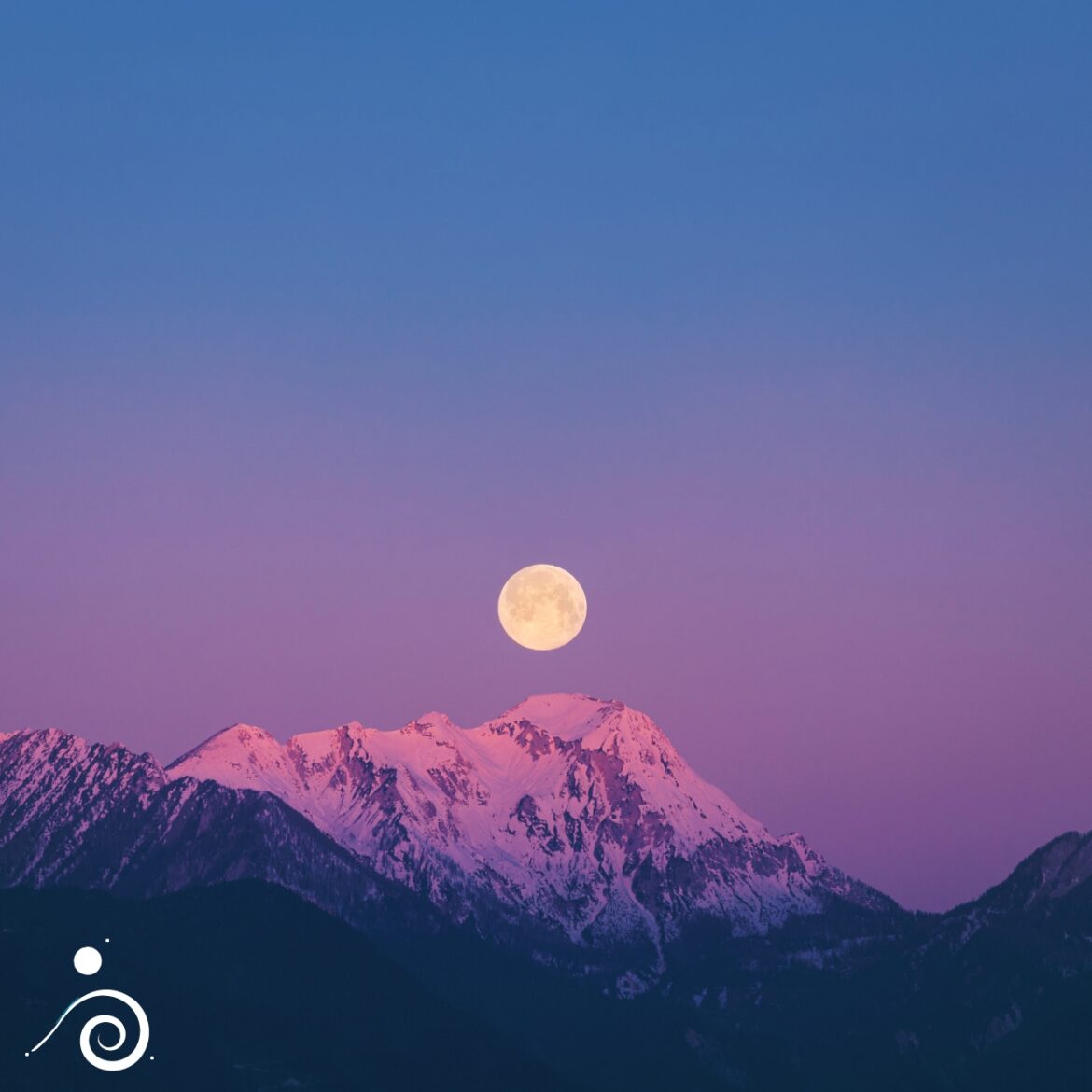
A shamanic full moon ritual is a short, deliberate ceremony held on the night the moon is full, in which you name what has finished in your life, release it with the help of the spirits you work with, and give something back in return. It is not spellwork and it does not require an audience. Most of it is sitting still in a room with a candle and telling the truth out loud.
You do not need a drum, a garden, a special date in an app or any prior training. What follows is a ritual you can do tonight with a candle, a bowl of water and a piece of paper, plus the reasoning behind each step so you understand what you are actually doing rather than copying a script.
What is a shamanic full moon ritual?
A shamanic full moon ritual is a marked period of time, usually twenty to sixty minutes, in which you open a sacred space, state clearly what you are releasing, ask your helping spirits to assist, physically enact the release, make an offering, and close the space again. The full moon is the timing, not the power source. The work is yours.
This differs from most of what is sold as a moon ritual online. There is no manifesting list, no invitation to command the universe, and no promise that the moon will do the difficult part for you. Shamanic practice is built on relationship and reciprocity: you ask, you receive, you give back. A full moon ritual follows the same pattern as any other piece of shamanic work, only with a clearer sense of when to do it.
Cultures across the world have kept lunar ceremonies for as long as we have records. Mircea Eliade, in Shamanism: Archaic Techniques of Ecstasy, documented night ceremonies timed to the moon across Siberian and Central Asian practice. What they share is not a shared theory of what the moon does. It is the practical usefulness of a fixed, visible, recurring signal that tells a whole community when to gather.
Why work with the full moon at all?
You work with the full moon because it gives your practice a reliable rhythm that you did not have to invent. Roughly every twenty-nine and a half days, something in the sky tells you it is time. That is enough of a reason, and it is the reason that holds up over years.
Three things a fixed lunar rhythm gives you in practice.
- It removes the decision. Practices die because you keep deciding whether to do them. A monthly ritual pinned to something visible skips that whole argument.
- It creates a review cycle. Twelve or thirteen times a year you sit down and ask what has finished. That alone catches things you would otherwise carry for another decade.
- It connects you to other people doing the same thing. Circles worldwide gather on the full moon. Practising alone on the same night as thousands of others is not nothing.
There is also a smaller, quieter argument. Sleep researchers led by Christian Cajochen published findings in Current Biology in 2013 suggesting that people took longer to fall asleep and slept less deeply around the full moon, under controlled laboratory conditions with no view of the sky. The finding has been debated since and later studies have gone both ways. I mention it because many practitioners report feeling restless on full moon nights and assume they are imagining it. You are probably not imagining it, and either way, a night when you sleep badly is a good night to be awake on purpose.
When exactly should you do the ritual?
Do the ritual on the evening of the full moon, or within the two days on either side of it. The moon looks full for about three nights, and the exact minute of fullness matters far less than doing the ritual at all. If the exact night is impossible, take the night after rather than the night before, because the moon has already begun to wane and the energy of release is already running.
| Moon phase | Roughly | What it suits | Question to ask |
|---|---|---|---|
| New moon | Day 1 | Setting an intention, beginning something | What am I starting? |
| Waxing moon | Days 2 to 13 | Building, learning, gathering support | What needs feeding? |
| Full moon | Days 14 to 16 | Seeing clearly, releasing, giving thanks | What has finished? |
| Waning moon | Days 17 to 28 | Clearing, cutting ties, resting | What am I still carrying? |
Time of day: after dark, once the moon is up. You do not need to see it. Cloud cover, a north facing flat, a city with too many lights, none of that interferes. The moon is there whether your window cooperates or not.
What do you need for a simple full moon ritual?
You need a candle, a bowl of water, a piece of paper and a pen, and something small to give back. That is the whole list. Everything else is optional and mostly serves to make the ritual feel more serious to you, which is a legitimate function but not a requirement.
- A candle. A tea light is fine. It marks the beginning and the end of the sacred time.
- A bowl of water. Fresh, plain, in a bowl you can carry outside afterwards.
- Paper and a pen. Writing turns a vague feeling into a sentence you can hand over.
- An offering. A little water poured on the earth, a pinch of oats, a strand of your own hair, a song. It has to cost you something small, or it is not an offering.
- Optional: a rattle or drum. If you journey, bring it. If you do not, your voice and your breath work perfectly well.
- Optional: your altar. If you already keep a shamanic altar, do the ritual there. The space is already prepared and your body already knows the signal.
How do you perform a shamanic full moon ritual, step by step?
You perform the ritual in six steps: prepare the space, open it, name what is finished, release it, give an offering, and close. Set aside forty minutes for your first one. Once you know the shape of it, twenty is enough.
1. Prepare the space
Put your phone in another room. Clear the surface you are working on. Wash your hands and face with cold water, which sounds trivial and reliably changes how present you feel. Set out the candle, the water, the paper and the offering. Sit down on the floor or on a low chair, low enough that your body understands this is not an ordinary evening.
2. Open the space
Light the candle. Then speak out loud, in your own words, to the land you live on, to the directions, to your helping spirits and to the moon. Plain speech is better than borrowed formulas. Something like: “I am here tonight under the full moon. I ask the spirits who work with me to be present. I ask for clear sight and a steady heart.” Then sit for a minute and let the room settle. You will feel the shift, or you will not, and either is normal for a first attempt.
3. Name what has finished
Write on the paper, in one or two sentences, what you are ready to release. Be specific. “Negativity” releases nothing. “The version of me who answers work emails at eleven at night to prove she is reliable” releases something. If nothing comes, ask the question out loud and wait. The answer usually arrives within a few minutes, and it is often not the thing you sat down expecting to write.
4. Release it
Read what you wrote out loud, all of it, to the candle. Then release it in one of three ways. Burn the paper, safely, in a metal bowl or over a sink. Or tear it into small pieces and dissolve them in the bowl of water. Or, if you journey, take the written thing with you on a short journey and hand it to your power animal to carry away. Whichever you choose, do the physical act. The body needs to see the thing leave.
If what you are releasing is a tie to a specific person rather than a habit of your own, the release step is different work and deserves its own ceremony. Cord cutting covers that properly, and it is worth doing separately rather than folding it into a first full moon ritual.
5. Give something back
This is the step people skip, and skipping it is what turns a ritual into a wish. Take the offering outside. Pour the water at the base of a tree, scatter the oats, leave the strand of hair under a stone, sing one verse to the dark. Say what it is for out loud: “For the spirits who helped me tonight. Thank you.” Reciprocity is the whole architecture of shamanic practice. Michael Harner made this point repeatedly in The Way of the Shaman: the relationship works because both sides give.
6. Close the space
Come back in. Thank the spirits and the directions by name, in the same plain language you opened with. Blow out the candle. Then eat something and drink a glass of water. Closing properly matters more than opening beautifully, because an unclosed ritual leaves you leaky and vaguely restless for days.
Write down what happened before you go to bed. Even three lines. Six months from now, a shamanic journal full of full moon entries will show you a pattern in what you keep releasing that no single night could ever reveal.
What can you actually release at the full moon?
You can release anything that has genuinely finished and that you are willing to stop feeding. You cannot release something you are still actively choosing, and pretending otherwise is the most common reason a moon ritual feels hollow.
| Works well | Does not work |
|---|---|
| A role you have outgrown but keep performing | A person you are not ready to stop contacting |
| An old identity that no longer fits your life | A decision you have not actually made yet |
| Resentment you have already grieved | Grief that is still fresh and needs time, not ceremony |
| A habit you have already replaced | An addiction, which needs professional support |
| Guilt about something you have made right | A responsibility you are trying to avoid |
One note on health. Shamanic work sits alongside medical and psychological care, never in place of it. If what you are carrying is depression, trauma or an addiction, do the ritual if it helps you feel held, and also see a doctor or therapist. The two are not in competition, and the practitioners I trust most are the ones who say this first rather than last.
What years of doing this badly taught me
For my first two years of practice, my full moon rituals were performances. I would clear an hour, set out far too many objects, write a long list of everything wrong with my life, burn it in a copper bowl, and feel absolutely nothing. Then I would decide the moon had not been strong enough that month.
What changed it was a night in Portugal when I had almost no time. I was tired, the house was full of guests, and I took a candle and a glass of water out to the terrace for ten minutes. I wrote one sentence. It was about my mother, and it was the truest thing I had written all year. I read it out loud to the dark, tore it up into the water, poured the water into the soil under the lemon tree, said thank you, and went back inside.
That ten minute ritual did more than the previous twenty. The difference was not the moon and not the setting. It was that I had stopped listing things and written one sentence I was afraid of. Every full moon ritual since has been shorter and more uncomfortable, and that is the right direction.
If doing this alone feels thin, and for many people it does, practising in company changes it entirely. The Lightkeepers’ Hearth journey circle meets every Monday online, it is free, and we drum, journey and release together. Holding a full moon ritual with other people in the room, even a virtual room, gives the work a witness, and witnessed work goes deeper.
Five mistakes worth avoiding
- Making a long list. One thing, named precisely, beats fifteen things named vaguely. You have another full moon in a month.
- Skipping the offering. Without reciprocity you are making a wish, not doing shamanic work. The offering can be tiny. It cannot be absent.
- Leaving the space open. Thank the spirits and blow the candle out. An unclosed ritual leaves you scattered for days and people rarely connect the two.
- Waiting for the perfect setup. Ten minutes with a candle on a terrace outperforms an elaborate ceremony you keep postponing until you own the right bowl.
- Expecting the moon to do the work. The moon marks the time. The releasing is done by you, and it continues in the ordinary days afterwards.
Frequently asked questions
No. Cloud, rain, city light and a window facing the wrong way make no difference. The moon is full whether you can see it or not, and the ritual is built on your attention and your relationship with the spirits, not on line of sight. If you can step outside for the offering, do. If not, a window or a doorway is enough.
A manifesting ritual asks for something to arrive. A shamanic full moon ritual names something that has finished, releases it, and gives an offering in return. The direction is opposite: one pulls, the other lets go and pays back. You can want things and work towards them, but that belongs to the new moon rather than the full one.
Yes. Nothing in this ritual requires journeying. Steps one to six work entirely in ordinary awareness with a candle, paper and water. Journeying is offered as one option for the release step, and you can simply burn or dissolve the paper instead. Many people do this ritual for a year before they ever pick up a drum.
Twenty to forty minutes for most people. Allow forty the first time, since finding the sentence you actually need to write takes longer than you expect. Once the shape is familiar, ten focused minutes with one honest sentence is worth more than an hour of arranging objects.
Finish it anyway, exactly as planned, and write down that you felt nothing. Feeling is not the measure. Some of the rituals that changed the most for me felt flat while they were happening and only made sense weeks later. If several months pass with nothing at all shifting, the usual cause is that you are releasing things you have not truly decided to let go of.
No, provided you open and close the space and stay within simple release work. Risks in shamanic practice come from unclosed ceremonies, working while very unwell, and attempting healing on other people without training. If you are in a mental health crisis, seek medical support first. Ritual can accompany that care, and it should not replace it.
Where to go from here
Find out when the next full moon falls, put it in your calendar tonight, and set out a candle, a glass of water and a scrap of paper on the surface where you will do it. That is the whole preparation. On the night, write one sentence you are slightly afraid to write, read it out loud, let it go, and give something back.
Do that twelve times and you will have a year of releases behind you, each one recorded, and a practice that no longer depends on how motivated you feel on any given evening.
About the author. Carolin Mallmann is a shamanic practitioner, coach and NLP trainer based in Portugal. She has been practising and teaching core shamanism for over a decade and guides students through journeying, soul retrieval and daily practice at One Shamanism. You can find her trainings and journey circles at shamanism.one.