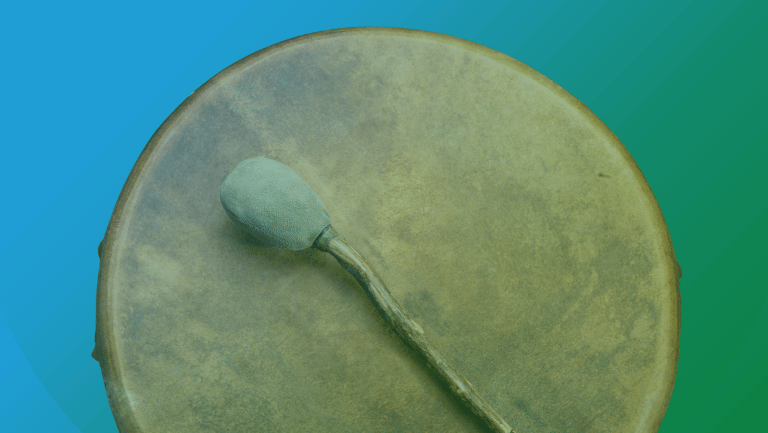
A rattle and a drum do the same job — they carry you into trance — but they do it differently. A shamanic rattle is a gourd, hide or wooden vessel filled with seeds or small stones that produces a fast, high, hissing pulse. A shamanic drum is a single-headed frame drum, usually 14 to 20 inches across, that produces a low, round beat you feel in your chest as much as you hear it. Both work by driving your brainwaves toward the theta range through steady rhythm. Which one belongs in your hands depends less on tradition than on your body, your living situation, and what you are actually trying to do.
I get asked this more than almost anything else. Someone has decided to take practice seriously, they are ready to buy an instrument, and they do not want to spend two hundred euros on the wrong thing. So let us be practical about it.
What is the difference between a shamanic rattle and a shamanic drum?
The difference is frequency, portability and control. The rattle produces a high, dense, fast sound that sharpens attention and is easy to hold for a long time. The drum produces a low, resonant sound with a strong physical component that pulls you downward into a deeper trance more quickly — but it is heavier, louder, more weather-sensitive and far more expensive.
| Rattle | Drum | |
|---|---|---|
| Sound | High, fast, hissing | Low, round, resonant |
| Where you feel it | Head, ears, skin | Chest, belly, bones |
| Typical price | €20–60 | €150–400 |
| Weight & travel | Fits in a bag | Bulky, needs care |
| Volume | Quiet enough for a flat | Neighbours will hear it |
| Humidity sensitivity | Almost none | High — skin slackens |
| Best for | Clearing, precision work, travel, beginners | Deep journeys, groups, ceremony |
| Learning curve | Minutes | Weeks |
Why does rhythm produce trance at all?
Because a steady, monotonous beat between roughly four and seven pulses per second nudges the brain toward theta activity, the same range associated with the drifting state just before sleep. Michael Harner, who did more than anyone to bring shamanic technique into the modern West, called this the sonic driving effect and built his whole method around it. Later work by researchers such as Maxwell and Melinda Maxfield found measurable shifts in EEG patterns in listeners exposed to sustained monotonous drumming.
What matters for your choice is this: the mechanism is the rhythm, not the instrument. A rattle shaken steadily at the right tempo will take you exactly where a drum takes you. Anyone who tells you the drum is the “real” instrument and the rattle is a starter toy has not spent much time with either.
When should you choose the rattle?
Choose the rattle if you live in a flat, travel often, work with your hands close to a person’s body, or are just beginning. It is the more forgiving instrument in almost every practical sense.
- You have neighbours. This is the single most common reason, and it is a perfectly good one. A rattle at journeying tempo is roughly as loud as running water.
- You travel. A rattle survives a suitcase, a rainstorm and an aeroplane hold. A drum does not enjoy any of those.
- You do clearing or extraction work. The rattle’s high frequency is precise. You can move it inch by inch along a body, around a doorframe, into the corners of a room. A drum cannot do detail.
- Your arm tires. Twenty minutes of drumming is real physical work. Twenty minutes of rattling is a wrist movement.
- You are starting out. You will learn the tempo faster on a rattle because there is less to think about — no beater angle, no skin tension, no worrying about waking the house.
When should you choose the drum?
Choose the drum if you journey deeply and often, work with groups, hold ceremony, or find that you need something physical to hold you down when the trance gets loose. The drum’s low frequency travels through the body, and for many people that bodily contact is what makes the state trustworthy rather than merely imagined.
- You want depth over precision. The drum tends to carry people further down, faster — particularly on Lower World journeys.
- You hold space for others. One drum can carry a room of twenty. One rattle cannot.
- You are easily distracted. The physical vibration gives the restless mind something to hold on to.
- You want the instrument to become a relationship. Drums age, change with the weather, need warming and tending. Many practitioners find that the care itself becomes part of the practice.
How do you actually use each one for a journey?
The method is the same for both: a steady tempo of roughly four to seven beats per second for fifteen to twenty minutes, then a clear callback signal to bring you home.
- Set the intention before you make a single sound. One clear sentence.
- Find the tempo. Faster than a heartbeat, slower than a buzz. Count roughly five per second and let your arm settle into it.
- Stop deciding. After a minute or two the rhythm should be running you, not the other way round. If you are still counting at minute five, you are trying too hard.
- Journey for fifteen to twenty minutes. Longer is not better at the start.
- Call back: four sharp accents, a short fast roll, four accents again, then silence. Same on both instruments.
- Write it down immediately. Journeys fade like dreams.
If you are using a recording rather than playing live — which is entirely legitimate, especially at the beginning — the same structure applies. Recorded drumming lets you journey without also being the drummer, which some people find frees them completely and others find leaves them feeling passive. Try both. And if the journey does not come, the instrument is rarely the culprit; more often it is one of the common blocks.
What I actually use, and why
I bought the drum first, because that is what everyone tells you to do. It was beautiful, expensive, and for the first year I barely used it — I was living in a flat with thin walls and a neighbour who worked nights. So I journeyed with a small rattle I had bought almost as an afterthought, sitting on the floor of my bedroom at eleven at night, quietly, and that rattle is where nearly everything I know actually came from.
These days I use both, and I have stopped thinking of it as a choice. Rattle for daily practice, for anything precise, for travelling, for late at night. Drum when I have space and time and want to go a long way down, and always when I am holding a circle. If you can only have one to begin with, I would tell almost anyone: start with the rattle. Buy the drum when you know what you want from it.
What should you look for when buying?
Buy for sound and for ethics, not for decoration. Shake or strike anything you are considering before you pay for it, and ask where the materials came from.
- Rattle: listen for a dense, even hiss rather than a loose clatter. Rawhide and gourd rattles sound warmer than plastic. Check the handle is solidly seated — a rattle that wobbles will distract you every single time.
- Drum: a 15–16 inch frame is the practical sweet spot for one person. Test the tone warm and cold. Ask about the hide’s origin. Buy the beater with the drum, not separately.
- Either: buy from makers who name their materials and their sources. In a practice built on respect for the living world, where the skin came from is not a detail.
Where to go from here
An instrument on its own does not teach you anything. What teaches you is showing up with it, day after day, until the rhythm stops being something you do and becomes something you enter. If you would like structure for that, the 30 Days of Shamanism challenge gives you one small ritual a day — fifteen minutes, thirty days — with the journey to your power animal in week three. It works with a rattle, a drum, or a recording. Whatever you have is enough to start.
Frequently asked questions
Can I journey with a rattle instead of a drum?
Yes. The rattle produces the same steady rhythmic driving effect as the drum and will take you into the same journeying state. Many experienced practitioners use a rattle as their primary instrument, particularly for solo practice, travel and detailed healing work.
Which is better for beginners, a rattle or a drum?
A rattle is usually better for beginners. It costs far less, is quiet enough to use in a flat, needs almost no technique and no maintenance, and lets you focus on the journey rather than on playing an instrument.
How fast should I rattle or drum for a shamanic journey?
Aim for roughly four to seven beats per second — noticeably faster than a resting heartbeat. The tempo should feel monotonous and slightly urgent. Once it is steady, stop counting and let your arm hold it on its own.
Is a recording as good as playing the instrument yourself?
For journeying, a good recording works well and frees your attention completely. Playing live gives you more control and a stronger physical connection, and is essential when you are holding space for someone else. Most practitioners eventually use both.
Do I need both a rattle and a drum eventually?
Not necessarily, but most people who practise regularly end up with both because they do different things well. Start with one, use it until you can feel its limits, and let the second instrument answer a need you have actually noticed.
Can rhythmic journeying replace therapy or medical treatment?
No. Shamanic practice is a complement to medical and psychological care, never a substitute for it. If you are dealing with trauma, a mental health condition or a physical illness, work with qualified professionals and let shamanic practice sit alongside that care.
About the author. Carolin Mallmann is a shamanic practitioner and teacher, founder of One Shamanism and author of the Path of the Paws spirit animal oracle. She has been journeying with drum and rattle for over a decade and teaches shamanic practice online to students across Europe.