Snow Leopard does not arrive. She is already there, and at some point you notice. That is the phenomenology of this guide, and it is unlike any other cat I work with. There is no crashing entrance, no roar, no confrontation. In the journey there is simply a long grey slope, thin air that makes your chest work harder than it should, an enormous silence — and then the slow, sickening realisation that something has been watching you for the entire time you have been climbing. Your body knows before your mind does. The hair rises. Nothing is wrong. Nothing is threatening. You are simply being seen, completely, by something that has no intention of explaining itself.
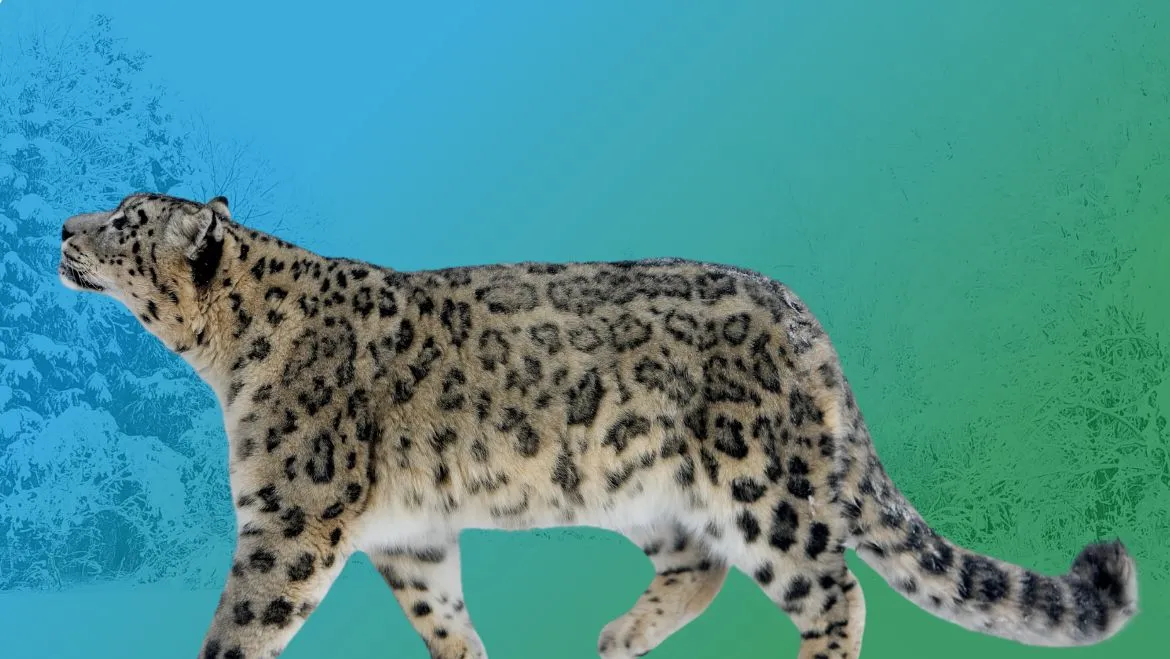
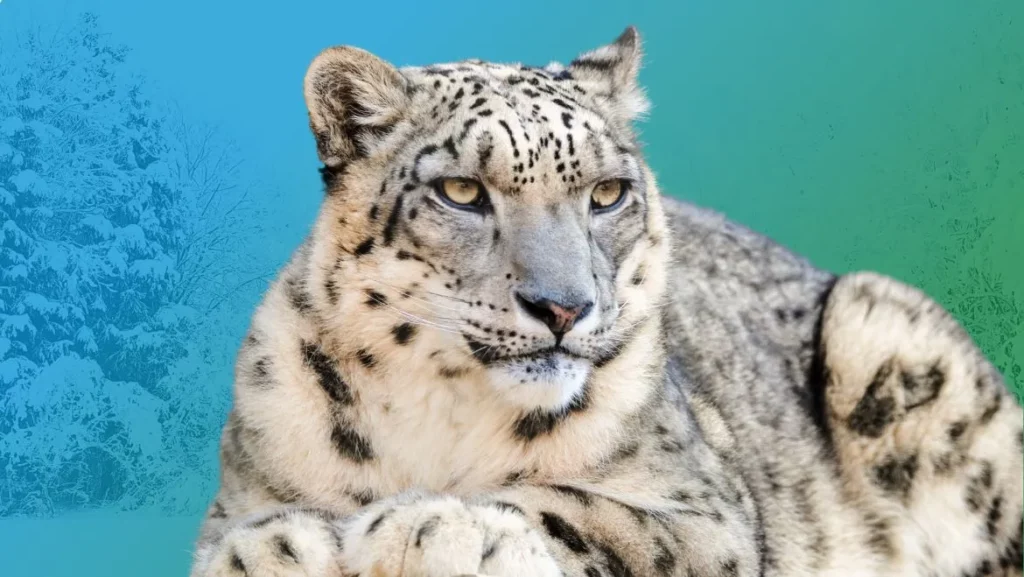
The Snow Leopard (Panthera uncia) reigns over the rugged, snowy highlands of Central Asia — an apex predator and a symbol of the mystical and unseen. Known for her beautiful thick fur adorned with rosettes, she embodies the essence of solitary grace and the silent wisdom of the mountains. In my practice she comes almost exclusively to people who are surrounded by others and profoundly alone in it, and to people who have mistaken their withdrawal for wisdom. She will tell you which one you are. She just will not do it quickly.
The Bridge: What Snow Leopard Biology Actually Teaches
Residing in the mountain ranges of Central Asia, including the Himalayas, the Snow Leopard is perfectly adapted to a harsh, cold, vertical world. Every one of those adaptations is also a teaching.
- Her tail is nearly as long as her body. Roughly a metre of thick, heavy tail — used as a counterbalance on ledges where a mistake is fatal, and wrapped around her face like a scarf when she sleeps. Snow Leopard medicine is the medicine of the counterweight: the thing that lets you walk an impossible edge is not more strength, it is balance. And the same tail that steadies her on the cliff is what keeps her warm at night. What steadies you must also comfort you, or you will not survive the altitude.
- She cannot roar. Unlike lions, tigers and leopards, the snow leopard’s throat structure does not permit a true roar. She chuffs, she mews, she hisses — but she cannot announce herself. Sit with the spiritual weight of that: this is a great cat whose power has nothing to do with being heard. If you have been waiting to be loud enough to be taken seriously, Snow Leopard has come to correct you.
- Her feet are natural snowshoes. Wide, fur-covered paws that spread her weight so she does not sink. She moves over ground that would swallow anything heavier. Tread lightly on terrain that cannot hold weight — in relationships, in grief, in conversations that are more fragile than they look.
- She is a “ghost of the mountains.” Researchers can spend years in her range and never see one. Her camouflage is so total that she is essentially invisible in her own home. Snow Leopard people are often exactly this: fully present, entirely unnoticed — and quietly furious about it, or quietly relieved. Which one is the whole question.
She moves with unmatched stealth and grace, teaching us the power of observation and the value of blending in when necessary. Her ability to tread softly yet powerfully on the earth speaks to the balance between strength and gentleness.
Core Symbolism & Historical Context: Guardian of the High Places
Across the mountain cultures of Central Asia, the snow leopard occupies a position that recurs with striking consistency: she is the guardian of what is too high to be casually reached.
The Himalaya and the Tibetan plateau
In the Himalayan and Tibetan cultural world — whose traditions belong to the peoples who hold them, and which I reference with respect and no claim to their ceremonies — the snow leopard appears widely as a being of the sacred heights, associated with the mountain itself rather than with the valley. She is folded into the broader mountain-guardian complex found across the region: the animal who lives where the gods live, and who therefore knows something the rest of us do not. In the well-known account of the yogi Milarepa, a snow leopard famously features as a form encountered in his mountain solitude — a story that survives precisely because the pairing of ascetic hermit and ghost cat is so intuitively right.
Central Asia and the archetype of the mountain hermit
The snow leopard remains a national symbol across parts of Central Asia — she appears in the heraldry of Kazakhstan and Kyrgyzstan and in Tatar tradition, always in the same register: nobility that does not need an audience.
Anthropologically, the archetype she belongs to is the hermit — and this is where I want to be careful, because the hermit is the most romanticised and most misunderstood figure in modern spirituality. In genuine contemplative traditions, the hermit does not withdraw from people out of contempt. He withdraws toward something, and he almost always comes back. Snow Leopard’s solitude is of that kind: purposeful, temporary, and productive. Solitude that produces nothing and returns to no one is not the hermit’s path. It is just hiding at altitude.
Spiritual Symbolism: What She Actually Offers
The Snow Leopard spirit animal brings several powerful messages to those she chooses to guide:
- Inner wisdom: she encourages introspection and listening to your own inner voice, insisting on self-knowledge over borrowed opinion.
- Balance and harmony: she symbolises the balance between strength and softness — tread lightly, but with total confidence, on your journey.
- Stealth and strategy: she teaches the value of timing, and the power of knowing when to show strength and when to remain in the shadows.
- Endurance at altitude: the capacity to live, sustainably, where the air is thin — in demanding roles, in high-stakes work, in the places most people cannot stay.
The Shadow Aspect: Snow Leopard’s Warning Medicine
This is the section most Snow Leopard articles refuse to write, and it is the reason I take her seriously. Her shadow is the most seductive one in the entire spirit animal canon, because it looks exactly like enlightenment.
- Solitude that has curdled into avoidance. There is a point at which “I need my own space” quietly becomes “I cannot tolerate being known.” Snow Leopard people are exceptionally good at describing their withdrawal in spiritual language. Ask the brutal question: am I on the mountain because it is where my work is — or because nobody can reach me up here?
- Superiority as a defence. The view from altitude makes everyone below look small. The Snow Leopard shadow becomes subtly contemptuous — of people who are messier, louder, more entangled, more ordinary. That contempt is almost always a defence against envy. The people in the valley have something you gave up.
- The cat who cannot roar — and has stopped trying. Snow Leopard cannot announce herself, and her shadow makes a virtue of never asking for anything. If you have needs you have never once voiced, and a private ledger of resentments about people who failed to guess them, that is not stealth. That is silence used as a punishment.
- Endless watching, never striking. Perfect stealth, perfect timing, perfect patience — and no kill. Some Snow Leopard clients have been “waiting for the right moment” for a decade. The right moment was three years ago and you watched it walk past.
When she appears blocked or in a recurring nightmare
If Snow Leopard appears in a recurring dream stalking you and never attacking, I read it in practice as a part of yourself you have exiled to the heights — a capacity, an ambition, a hardness — that is now circling and waiting to be reintegrated. It is not hunting you. It is waiting to be let back in.
If she appears trapped, caged or on flat ground, the reading is almost always about a life that has no altitude in it — no solitude, no silence, no place to think. And if she appears starving, look honestly at how long you have been waiting to act. Snow leopards in the wild are not failing because they lack skill. They are under pressure because their range is shrinking. Ask what has been eroding your range.
Practical Shamanic Work: The Ridge Journey & the Return Ritual
This is the practice I give clients who are depleted by other people, and clients who have been alone so long they have forgotten it was once a choice. Shamanic work is not a substitute for medical or psychological care; if something heavy surfaces, bring it to someone qualified.
- Set a mountain-shaped intention. Not “give me peace.” Rather: “Show me whether my solitude is feeding me or hiding me.” Say it once, out loud, before you begin.
- Prepare. Sit upright, somewhere cool and quiet. Cover your eyes. Fifteen to twenty minutes of steady drumming. Snow Leopard will not compete with noise.
- Climb, and let it cost you something. Enter through a real ascent — a scree slope, a stone stair, a ridge. Do not fly. The effort of the climb is part of the medicine, and people who skip it usually meet nothing.
- Do not look for her. This is the instruction that matters. Sit down on the rock and wait. She reveals herself to stillness, never to searching. If you spend the whole journey hunting her, you have already failed the lesson.
- When she comes, ask one question: “What am I able to see from up here that I could not see down there?” Write the answer down the moment you return — it fades faster than most.
- Then ask the harder one: “What is waiting for me in the valley?” Snow Leopard always has an answer to this, and it is rarely the one people want.
- Descend deliberately. Do not end the journey on the summit. Walk back down. The descent is the integration, and skipping it is how people end up living permanently at altitude with no oxygen.
The Return Ritual: coming down from the mountain
- Name one thing your solitude has genuinely produced — a clarity, a decision, a piece of work. If you cannot name one, that is the finding.
- Name one person you have been unreachable to, and be honest about whether that was protection or punishment.
- Make one contact this week. Small, low-cost, real. A message, a call, an invitation. Snow Leopard does not need you to be gregarious. She needs you to be reachable by someone.
- State one need out loud. A cat who cannot roar must still learn to ask. Say the plain sentence: “I need …” — no justification attached.
- Keep the altitude. Protect one genuinely solitary hour a week and defend it like territory. The medicine only works if the mountain is still there to return to.
If you are new to this, start with the beginner’s guide to shamanic journeying, and read about finding your spirit animal if Snow Leopard is not the one who comes. Her cousin, the Snow Owl, carries a related but distinct medicine of clarity, and the deeper integration work is covered in my writing on shadow work and on bringing practice into daily life.
Affirmations from the Snow Leopard totem
- “I navigate life’s challenges with the grace and stealth of the Snow Leopard, moving through each moment with calm confidence.”
- “Like the Snow Leopard, I embrace the power of solitude, finding strength and wisdom in quiet introspection — and I know when to come down.”
- “I am balanced and poised, drawing on the Snow Leopard’s mastery of harmony between strength and softness.”
- “I approach life with strategic patience and timing, and I act when the moment arrives.”
- “I am resilient and enduring, no matter the terrain, inspired by the Snow Leopard’s ability to thrive in the rugged beauty of the mountains.”
The Snow Leopard, with her silent strength and ethereal beauty, offers a profound and slightly severe teaching. She invites you into the journey of self-discovery, into harmony found in solitude, and into a path walked with a gentle, steadfast heart. She reminds us that even in the harshest of climates there is a grace to be found and a deep, inner wisdom to guide us — and that the mountain is only wisdom if you eventually walk back down and tell someone what you saw.
About the Author — Carolin Mallmann
I am Carolin Mallmann, founder of One Shamanism and author of The Path of the Paws. For over two decades I have worked with people as a coach, certified NLP practitioner and shamanic practitioner, guiding thousands of one-to-one sessions and training students internationally in shamanic journeying, spirit animal work and shadow integration. Everything I write here comes from lived practice — my own journeys, my teachers, and the real experiences of the clients I sit with. I do not promise miracles, and shamanic work is not a substitute for medical or psychological treatment. What I can offer is an honest, grounded path — and the company to walk it. Read more about my background and practice here.