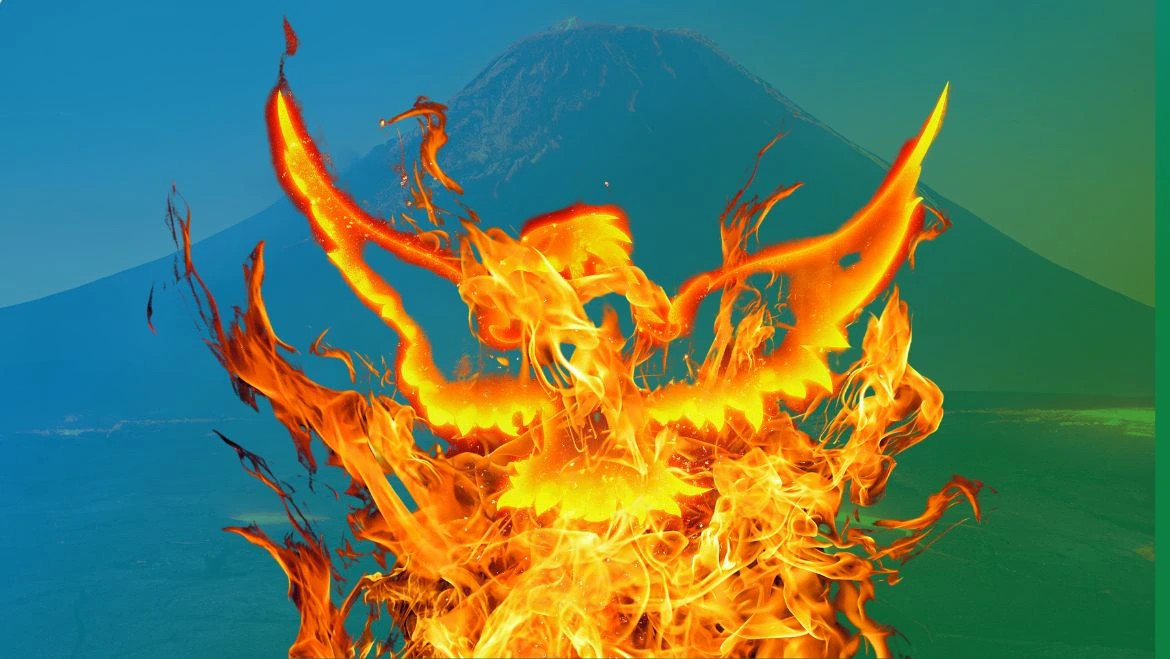
The phoenix is the only guide on this site that has never existed, and it is one of the most common ones people meet. That is not a contradiction — it is the point. When it comes on a journey, it does not arrive as a bird. It arrives as heat. People describe a rising temperature, a pressure behind the sternum, and then, almost always, a moment of pure dread: the recognition that something is going to have to burn, and that they already know what it is.
If you are here for the myth’s plot summary, you are in the wrong place. This is about the phoenix spiritual meaning — what it means when this image keeps arriving in your dreams, in your journeys, in the period after a life has come apart.
And here is the correction I make most often, because the popular version of this animal has done real damage: the phoenix is not a story about rising. It is a story about ash. The rising takes an instant and everyone can picture it. The ash takes months, and nobody wants to talk about that part. In my practice, the people who fail this transition are almost never the ones who could not rise. They are the ones who refused to lie in the ash long enough for anything to be different when they got up.
The Bridge: What Is Real Inside the Phoenix Spirit Animal Myth
A mythical animal still has to be anchored in something, or it is just a mood. The phoenix is anchored in three real things, and each one carries the medicine more precisely than the legend does.
- Some seeds cannot open without fire. This is not a metaphor. Serotinous species — certain pines, many eucalypts, and whole families of plants in fire-adapted landscapes — hold their seed in resin-sealed cones or pods that only release when heat cracks them. Some seeds germinate only after contact with smoke. These plants have not merely survived fire. They have organised their entire reproductive strategy around it. That is the true phoenix, and it is growing in real soil. If you are waiting for conditions to be gentle before you begin, some part of you is a seed that has been waiting for the wrong weather.
- The original phoenix was a heron. The Egyptian Bennu, the earliest form of this bird, appears to have been modelled on a grey heron — a creature that stands motionless in shallow water for hours, waiting, until the moment it does not. The first phoenix was not a creature of flame at all. It was a creature of stillness, connected with the rising of the sun and the flood-waters of the Nile. The bird everyone associates with explosion was originally the bird that knows how to wait.
- Ash is fertile, and it is fertile because something is gone. Wood ash returns potassium and minerals to the soil; burnt ground is famously productive afterwards. But the nutrients in that soil are the tree. The new growth is not a reward for surviving. It is made out of what was lost. This is the single hardest and most honest thing the phoenix has to say, and it is why grief is not an obstacle to rebirth. It is the raw material.
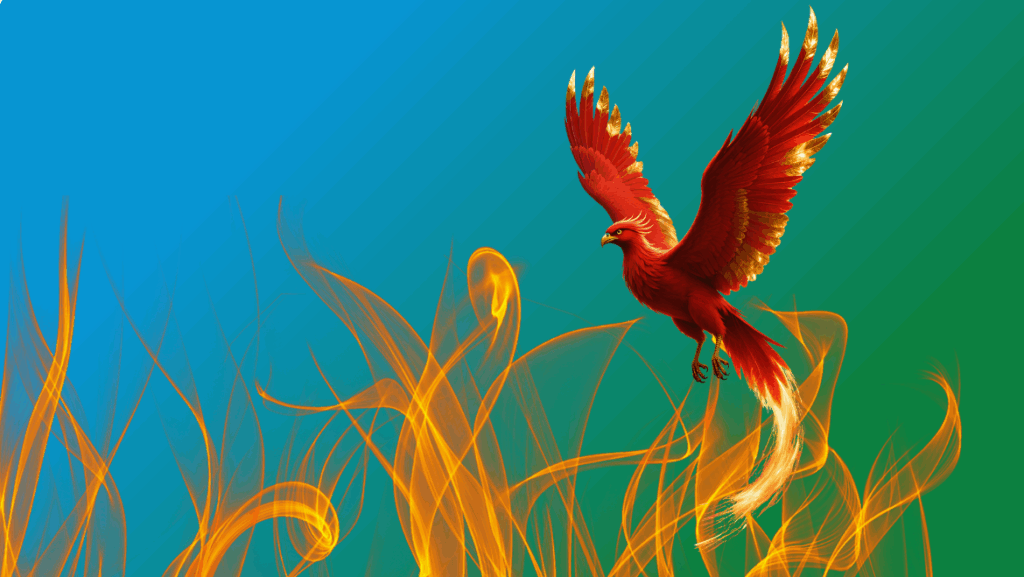
Phoenix Symbolism Across Traditions
The phoenix is the most frequently mistranslated creature in the world, and untangling that is not pedantry — the distinctions change the message entirely.
Egypt: the Bennu and the self-created
The Bennu of Heliopolis is bound to the sun, to the primordial mound rising out of the waters of chaos, and to the idea of a being that brings itself into existence. There is no funeral pyre here and no dramatic immolation — there is the daily, unspectacular fact of the sun going down and coming back. Egyptian rebirth is a rhythm, not an event. That is a much more useful model for anyone actually rebuilding a life.
Greece and Rome: the five-hundred-year bird
The version everyone knows — the bird that builds a nest of spices, burns, and rises from its own remains, carrying the ashes of its predecessor to the temple of the sun — comes to us through Herodotus, Ovid and later Roman writers, and it is the version early Christian authors adopted as an image of resurrection. Note the detail that gets dropped from every motivational poster: the new bird carries the body of the old one, and buries it properly. The rebirth includes a funeral. Skip the funeral and you have not been reborn; you have simply moved.
China: the Fenghuang is not a phoenix
This correction matters. The Fenghuang is routinely translated as “Chinese phoenix,” but it does not burn and it is not reborn. It is a creature of virtue, harmony and auspicious rule, associated with the empress and with the balance of yin and yang, and it appears when the world is well-governed. It does not arrive in your catastrophe. It arrives when things are right. If you are drawn to the Fenghuang, you are probably not being asked to burn anything down — you are being asked to bring something into balance, which is a completely different instruction.
Persia: the Simurgh, and the thirty birds
This is the one I return to most. In the Persian tradition the Simurgh is an immense, ancient bird who nests in the tree of all seeds and whose feathers heal. In Attar’s Conference of the Birds, the birds of the world set out on a terrible journey to find the Simurgh, their king. Most die. Thirty survive to reach the mountain — and find nothing there, until they understand the pun the whole poem was built on: si murgh, in Persian, means “thirty birds.” They are what they were looking for, and there was no way to know that without the journey that nearly killed them. This, and not the funeral pyre, is the most exact description of a real rebirth I have ever found in any tradition.
The Shadow: When Burning Becomes an Addiction
The phoenix has the most seductive shadow of any guide, because our whole culture applauds it. Nobody is ever warned about being too resilient.
- Serial immolation. The most common distortion I encounter with this animal: people who can only feel alive in the fire. The job, the relationship, the city — burned down, dramatically rebuilt, burned down again. Each collapse is narrated as transformation, and nothing is ever actually transformed. If you have risen from the ashes four times, the question is not how you keep rising. It is why you keep lighting the match.
- Rebirth as a way of not grieving. “Everything happens for a reason,” said three weeks after a devastation, is not phoenix medicine. It is a way of leaving the room. The bird that skips the ash produces a beautiful, brittle new self with a corpse inside it.
- Identity welded to the wound. The person whose entire sense of self is “the one who came back from that.” It is a real achievement, and it becomes a cage the moment healing would mean having nothing to say about yourself. I meet this often, and it is one of the loneliest positions there is.
- Waiting for the fire instead of doing the work. The shadow phoenix believes that only a catastrophe can license change — and so it waits, sometimes for years, for permission that ordinary life could have given it at any moment. Not everything has to burn. Some things just have to be finished.
A phoenix that appears burning and screaming in a recurring dream is not, in my experience, a warning of disaster. It is usually a part of the person that is in the fire right now and has not been acknowledged. A phoenix that will not ignite — sitting in the nest, refusing — points to a change the dreamer knows is necessary and has decided not to begin. And a phoenix appearing as cold ash, with nothing rising is the image I take most seriously: it usually arrives for people who are exhausted rather than in crisis, and what it is asking for is not courage. It is asking for rest, and often for real support.
How to Journey to the Phoenix
Shamanic work is not a substitute for medical or psychological care, and this is the one animal I would ask you to be careful with: if you are in the middle of a genuine collapse, please get real-world support first, and journey afterwards. If you are new to this, begin with the beginner’s guide to shamanic journeying.
- Set an intention the phoenix can answer. Not “help me transform.” Rather: “Show me what is already ash, and what I am still pretending is alive.”
- Enter through heat and high ground. Desert, sun, dry stone, a mountain at noon. The phoenix is an Upper World, solar animal, and it does not appear in caves.
- Look for the nest, not the bird. This is the instruction people ignore, and it decides the journey. Ask to be shown the nest — and then look at what it is made of. Every phoenix builds its pyre out of its own life, and the materials are the message.
- Do not light it yourself. If the fire is not ready, forcing it produces a dramatic journey and no change. The phoenix does not need your encouragement. If nothing is burning, that is your answer for today.
- Stay for the ash. Almost everyone leaves at the moment of the fire, because the fire feels like the climax. It is not. Stay in the journey until the fire is out, and sit in what is left. This is where the actual work of this animal happens, and it is the step that is nearly always skipped.
- Ask one question before you return: “What am I obliged to carry out of here — and what am I finally allowed to leave?”
The Integration Ritual: Burying the Old Bird
In the Roman version, the new phoenix carries the remains of the old one and buries them at the temple of the sun. Do the equivalent. Within a week:
- Name what actually died. Not “a difficult chapter.” The specific thing: the marriage, the version of your career, the person you thought you would become. Say it in one plain sentence.
- Hold a funeral for it, however small. Write it on paper and burn it safely, or bury the paper. The ritual is not decorative — grief that has never been given a container tends to leak into everything else you build.
- Then say what it gave you. One sentence. Ash is fertile because it was the tree. This step turns loss into material, and it does not work if you take it before the funeral.
- Plant one thing that is not dramatic. A small, boring, unglamorous new practice — daily, unremarkable, invisible to everyone. Rebirth in the Egyptian sense is a rhythm, not an explosion, and this is the step that decides whether anything is actually different in a year.
- Refuse one fire this month. Some crisis will offer itself. Decline it. For anyone with phoenix medicine, this is far harder — and far more transformative — than rising ever was.
If the phoenix’s fire feels too total, the snake spirit animal teaches the same lesson at a survivable temperature: the snake sheds, and nothing has to burn.
Phoenix Spirit Animal: Questions People Actually Ask
What does it mean when the phoenix appears to you?
It means an ending is either underway or overdue — and, crucially, that it is survivable. In my practice the phoenix rarely arrives before a catastrophe. It arrives during or after one, usually to people who suspect they will not recover. It is not a prediction of disaster. It is a statement about your capacity, made at the exact moment you have stopped believing in it.
Is the phoenix a good or bad omen?
It is an omen of cost. The phoenix promises renewal and it is entirely honest about the price: something has to be genuinely over. Whether that reads as good or bad depends on one thing — whether the thing that must end is something you have already, privately, admitted is finished.
What does a phoenix in a dream mean?
Read the stage of the cycle. A bird in flame: something is burning right now, whether or not you have acknowledged it. A bird refusing to burn: a change you know is necessary and have declined to start. A bird rising: less common than people imagine, and usually confirmation rather than prophecy — it tends to come after the person has already done the hard part.
Can a mythical creature really be a spirit animal?
Yes — and I would go further: the mythical guides are often the most precise, because they were built by human beings over centuries specifically to carry a meaning that no living animal could hold. The phoenix does not exist in a forest. It exists in every tradition that has had to explain to someone how to keep going. That is not a lesser reality. In the A–Z spirit animal guide you will find both kinds, and the mythical ones arrive just as insistently.
How long does the ash last?
Longer than you have been told, and longer than the people around you will find comfortable. The most common pattern I see is someone declaring themselves reborn far too early, because the ash is boring, undignified and impossible to post about. There is no fixed timeline. But you will know you are out of it when you stop needing to describe yourself as rising. If you want a gentle way to work with the passage, sit with the Path of the Paws oracle deck and let it be slow.
The phoenix does not arrive to promise you that it will be worth it. It arrives to tell you that what you are lying in is not the end of the story — and that it is, in fact, the soil.