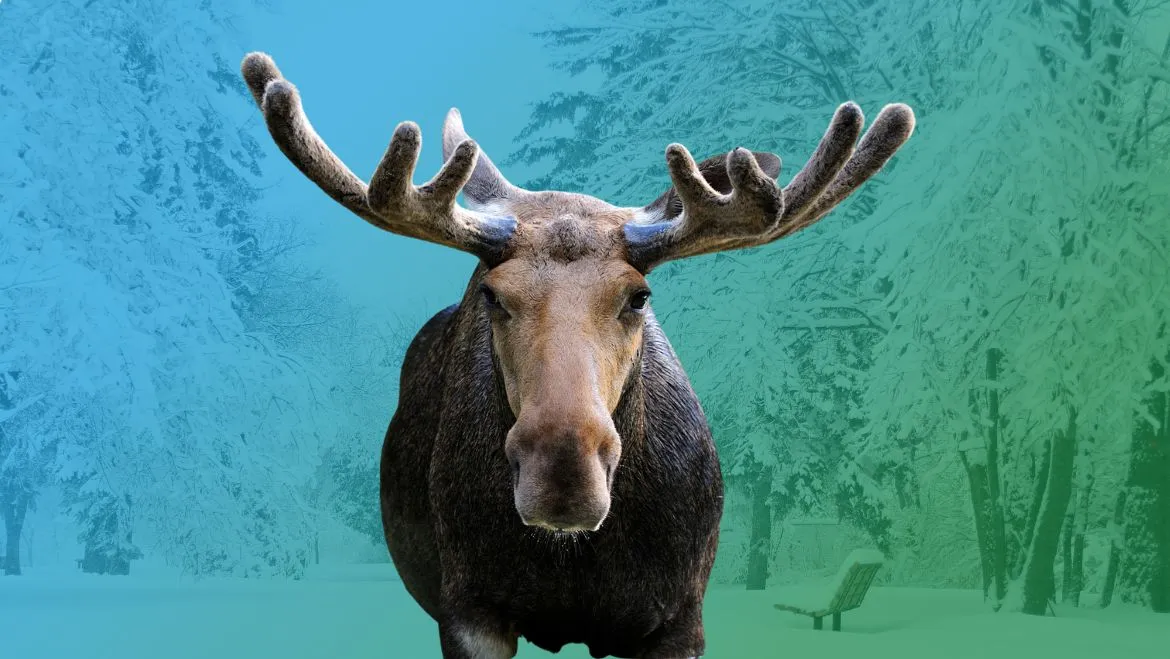
The moose does not arrive in a journey the way most of the deer family do. There is no flicker at the treeline, no nervous readiness to bolt. It is simply standing in the water when you turn around — vast, dark, unhurried, up to its knees in a bog that would swallow most animals — and it looks at you without the slightest concern about being seen. People almost always report the same thing afterwards: not fear, but a strange embarrassment at how much space it takes up, and how little it cares.
This page is about the moose spiritual meaning — what it means when this animal keeps appearing in your dreams, your journeys, or on a road at dusk when you had not thought about moose in years. It is not about antler measurements. In my practice, the moose tends to arrive for people who have spent their lives making themselves smaller — quieter, more agreeable, easier to be around — and who are quietly exhausted by the effort of it. The moose does not do that. It is the largest thing in the forest and it moves through the world as though that is simply a fact rather than a problem.
The Bridge: What the Real Animal Teaches About the Moose Spirit Animal
Everything the moose has to say is written into how it actually lives, and the real animal is stranger and more instructive than the noble-strength cliché attached to it.
- It is the one deer that does not herd. Almost every other member of the deer family lives in groups; the moose is genuinely solitary for most of the year, and it is not lonely in its solitude — it is simply built for it. Moose medicine is self-possession, not sociability. If it has come to you while you are surrounded by people and still feel unseen, that is not a coincidence.
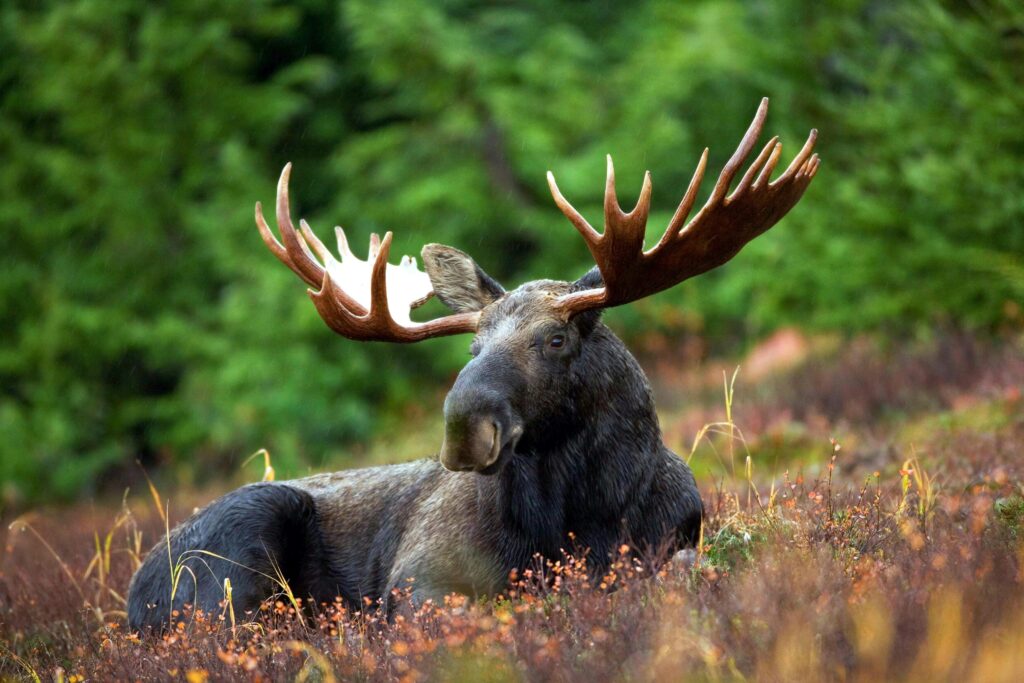
- It builds an enormous crown every year and then drops it. A bull grows the largest antlers of any living animal — broad, heavy, unmistakable — and then sheds the whole thing each winter and walks the cold months bare-headed before growing a larger set. The most conspicuous thing it owns is discarded on schedule, without grief. Any authority you are clinging to past its season, the moose has already let fall.
- It thrives exactly where other animals get stuck. Long legs for deep snow and soft bog, and a body that swims well enough to dive and feed on the bottom of a lake. The moose goes willingly into the wet, boggy, half-drowned ground that most creatures skirt around. Its terrain is the terrain everyone else avoids — which is a precise description of the emotional ground this animal asks you to enter.
- It sees poorly and senses everything else acutely. A moose’s eyesight is weak, but its hearing and its sense of smell are extraordinary. It does not navigate by what is obvious to the eye. It reads the world through the faculties most of us have learned to overrule — which is the bridge to its reputation for deep, unhurried instinct.
Put these together and the comic, ungainly bull disappears. What is left is an animal that is enormous, alone, at home in the ground everything else avoids, and completely unbothered by how it looks doing it.
Moose Symbolism Across Traditions
Wherever moose and humans have shared the cold forests of the north, the animal has been treated with a respect that has little to do with its size and much to do with its bearing.
Algonquian peoples of the northern woodlands
The English word moose itself comes from an Algonquian language — commonly traced to a word meaning something like “he strips off,” for the way the animal browses bark and twigs. I name the language family rather than writing “Native American,” because the moose meant specific things to specific nations of the northern woodlands and the boreal forest, and flattening them erases the very people who knew this animal best. What recurs across the region is the moose as a provider and as a being of self-sufficiency — an animal whose dignity is inseparable from its solitude.
Nordic and Siberian forest traditions
Across Scandinavia and Siberia the great antlered browser — the elk, as it is called in Europe — is one of the oldest figures in the art of the north. Rock carvings thousands of years old show it again and again, and in several Siberian traditions the cosmic elk is placed in the sky itself, hunted eternally across the night. The animal that walks the boreal forest on earth also walks the heavens. Its dignity was never a matter of dominance. It was a matter of belonging so completely to the cold country that it needed to prove nothing.
What runs through all of it is earned, unhurried authority. The moose carrying the widest antlers has survived the most winters, and its standing cannot be performed or claimed — only accumulated, season by season.
The Shadow: When Self-Possession Becomes a Wall
The moose is easy to romanticise as pure quiet strength, which is exactly why its shadow goes unnoticed for years.
- Solitude that has hardened into isolation. The moose is genuinely solitary, and people who carry this medicine often mistake withdrawal for strength. The distinction is simple: the moose is alone because that is its nature, and it can still be reached. Many people are alone because being reached costs them something they have decided not to pay. If you cannot remember the last time you let someone in, the moose is not confirming your independence — it is questioning it.
- Presence that has become intimidation. The moose takes up space without apology, and that is medicine. Its shadow is the person whose size — of personality, of certainty, of will — has quietly made everyone around them smaller, and who has stopped noticing. Taking up your space is not the same as taking up everyone else’s.
- Refusing to shed. The bull drops its crown every winter. The shadow is the person who has built an identity on a form of authority they outgrew years ago — the role, the title, the reputation — and cannot let it fall. Holding last year’s antlers does not preserve them. It only prevents the next set.
- The rut with no off-season. A bull in rut is genuinely dangerous, and it is dangerous for a few weeks a year. People carrying moose medicine badly stay permanently braced for confrontation, reading challenge into everything, unable to stand down. Constant readiness to charge is not strength. It is exhaustion wearing strength’s antlers.
A moose that appears charging or blocking the path in a recurring dream is rarely a hostile figure. In my experience it is the dreamer’s own suppressed force, arriving at the only volume it has left after being ignored for a long time. A moose stuck or drowning in a bog points somewhere more painful — to a strength that went into ground it should have known how to cross, and got mired instead. And a moose that appears with its antlers already shed, standing bare-headed in the snow is one of the most honest images this animal gives: something is being released, and it is not yet clear what will replace it.
How to Journey to the Moose
Shamanic work is not a substitute for medical or psychological care. If you are new to this, begin with the beginner’s guide to shamanic journeying before working with the practice below.
- Set a moose-shaped intention. Not “make me stronger.” Rather: “Show me where I have made myself smaller than I am — and where my size has cost the people around me.” This animal answers that question with unusual directness.
- Journey to wet, northern ground. A bog, a lake edge, a flooded forest in cold light. Do not soften it into a meadow. The moose will not come to easy terrain, and the difficulty of the ground is part of the message.
- Do not approach it. Let it stand. The moose does not need to be summoned or chased. Stay where you are and let it regard you. How long it takes to acknowledge you is itself information.
- Look at the antlers. Full and heavy, in velvet, or already shed? A full crown speaks to a season of visible authority. Velvet — tender, still growing — speaks to something new that must be protected before it hardens. Shed and bare is the hardest and most honest: something is being let go of.
- Follow it into the water. If it wades into the bog or the lake, go with it. The moose is at home in exactly the ground you have been avoiding, and it is showing you that you can enter it without drowning.
- Afterwards, shed one thing. In waking life, name one authority, role, or reputation you have been carrying past its season, and set it down for a week. It grows back if you need it — that is the whole promise of this animal.
If it is the pace and the endurance rather than the solitude that draws you, the elk spirit animal carries a closely related medicine of sustained, herd-borne movement — the two animals are a clean study in the same strength solved alone and solved together. For a structured way to test which guide is actually with you, work through the A–Z spirit animal guide or sit with the Path of the Paws oracle deck.
Moose Spirit Animal: Questions People Actually Ask
What does it mean when a moose appears to you?
It usually means you are being asked to take up the space you actually occupy — to stop shrinking, apologising, or waiting for permission to be as large as you are. The moose does not arrive to make you louder. It arrives to point out that your size is a fact rather than a flaw, and that you have been treating it as something to manage.
Is the moose a good or bad omen?
Neither, and it is not a soft one. The moose is an omen of self-possession and of season — of authority that has to be earned over time and released on time. Whether that reads as good news depends entirely on whether you are willing to both claim your standing and let the outgrown version of it fall.
What does a moose in a dream mean?
Read the antlers and the ground. A moose standing calmly in water points to strength that is at home in difficult emotional terrain. A moose charging is usually your own force arriving at full volume after being ignored. A moose stuck in a bog points to power that went into the wrong ground; a bare-headed moose in snow points to something being released before its replacement is visible.
What is the difference between the moose and the elk spirit animal?
The elk keeps to the herd and its medicine is sustained pace and shared vigilance across long distances. The moose stands alone, and its medicine is self-possession, solitary dignity, and comfort in the ground others avoid. If you are unsure which came to you, ask whether it was accompanied. Elk medicine travels with others. Moose medicine stands by itself.
The moose does not arrive to make you formidable. It arrives to tell you that you have been standing in cold, difficult water this whole time, taking up exactly as much room as you were built for — and that there was never anything to apologise for.
The Path of the Paws
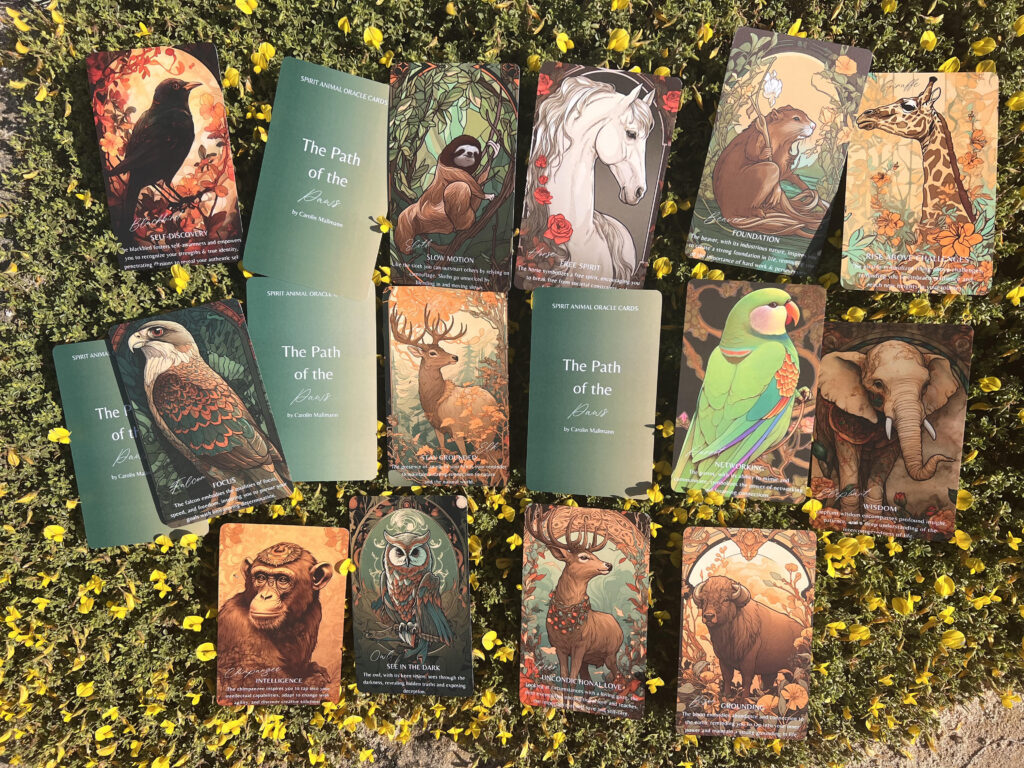
42 hand-illustrated oracle cards, one for each animal guide — drawn from the same practice these articles come from. A way to sit with an animal instead of only reading about it.
Order your deck →