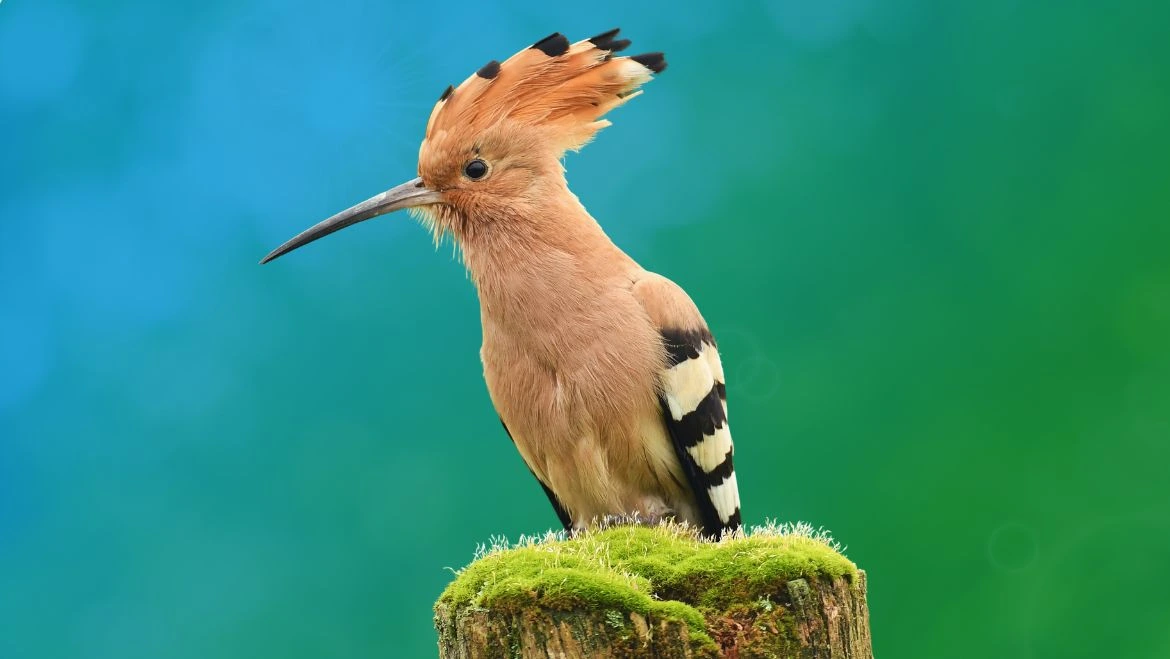
The hoopoe does not make an entrance. It is simply there, on the ground, a few steps ahead of you — hopping, stopping, driving that long curved bill into the soil, entirely uninterested in whether you are watching. It does not startle. It does not perform. When people meet it on a journey they almost always describe the same thing: they were expecting an oracle and they got a bird that would not look up from its work.
This page is not about plumage and migration routes. It is about the hoopoe spirit animal — what it means when this bird keeps arriving, in dreams, in journeys, on a path you were walking too fast down. If you are here for the ornithology, the hoopoe will bore you. If you are here because it will not leave you alone, stay.
In my practice, the hoopoe tends to arrive for people who are looking outward for an answer they already have. It is not a bird that brings news. It brings the thing you buried.
The Bridge: What the Real Bird Teaches About Hoopoe Spiritual Meaning
Take away the biology and you have decoration. So start with the bird.
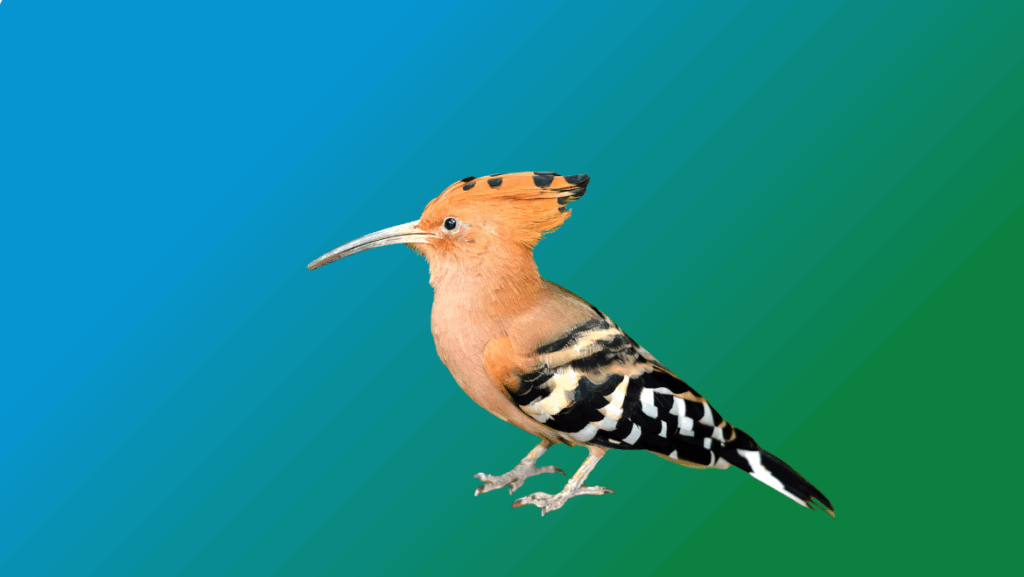
- It feeds on what it cannot see. The hoopoe’s long decurved bill is a probe. Its prey — mole crickets, beetle larvae, pupae — lives underground, out of sight. The bird taps, listens, feels the soil, and then strikes into the earth with precision. It does not scan the horizon for food. It goes down. That is the entire message in one behaviour: what will sustain you is beneath the surface, and it will not present itself.
- The crown is not permanent. The hoopoe’s crest is erectile. It goes up on landing, in alarm, in display — and then it folds flat again. This is a bird that carries a crown and wears it only when the moment calls for it. Any teaching you have heard about “owning your gifts” that means displaying them constantly is not hoopoe medicine.
- Its flight is deliberately unsteady. The hoopoe flies in an irregular, flapping, butterfly-like motion that makes it very hard for a falcon to predict. It does not travel in straight lines. Its unpredictability is not confusion — it is defence.
- Its nest stinks. This is the fact almost every spiritual article omits. The nesting female’s preen gland produces a secretion that smells of rotting meat, and the chicks can spray faeces at anything that reaches in. The bird of sacred wisdom raises its young in a hole that reeks. Hold that. We will come back to it, because it is the most important thing on this page.
Hoopoe Symbolism Across Traditions
Few birds have been read so consistently by cultures that never met. The hoopoe is a messenger and a guide almost everywhere it flies — and, revealingly, an unclean bird in some of the same places.
Sufi: the guide who has already made the journey
The hoopoe’s greatest role is in The Conference of the Birds, the twelfth-century Persian poem by Farid ud-Din Attar. All the birds of the world gather to seek the Simorgh, their true king. It is the hoopoe who leads them — and the hoopoe’s job, for most of the poem, is not to inspire. It is to answer excuses. Each bird explains why it cannot go, and the hoopoe dismantles the excuse. The journey costs almost all of them their lives. The hoopoe is the guide who tells you the truth about the cost before you set out, and this is precisely how it behaves as a spirit ally: unsentimental, patient, and unimpressed by your reasons.
Egypt: the bird on the tomb wall
The hoopoe appears repeatedly in ancient Egyptian tomb and temple art, where it belongs to the register of birds that move between the visible world and what lies beyond it. An animal that lives by extracting the hidden from the earth was never going to be read by Egypt as ordinary. Its crest and its downward-turned bill place it exactly where Egyptian thought was most attentive: at the boundary between what is buried and what is known.
Hebrew and Qur’anic: the messenger of Solomon
In the Qur’an (Surah an-Naml), the hoopoe — the hudhud — is Solomon’s messenger, and the story is worth reading closely. The bird goes missing from the king’s assembly, and when it returns it brings news the king did not have: it has seen the kingdom of Sheba. The hoopoe is the one who leaves, sees, and comes back with information nobody else possessed. In the Hebrew Bible the same bird, the duchifat, is listed among the unclean birds — and is today Israel’s national bird. Sacred messenger and unclean creature, in the same tradition, without contradiction. That double reading is not a mistake. It is the truest thing anyone has said about this animal.
European folk tradition: the dirty bird
Across parts of rural Europe the hoopoe was long treated as a bird of ill omen and filth — the stink of the nest was well known, and in some regions its call was read as a warning of death or rain. The hoopoe has therefore been simultaneously a prophet and a pariah for most of recorded history. When it comes to you, expect both.
The Shadow: Wisdom That Nests in Filth
Now go back to the nest. The bird that Sufism made the guide to God raises its young in a stinking hole, and defends them with excrement. This is not an unfortunate detail to be embarrassed about — it is the hoopoe’s shadow, stated plainly by the animal itself.
- The seeker who will not look at their own ground. The most common hoopoe distortion I encounter is the person who probes everything — every book, every teacher, every tradition, every other person’s psychology — and has never once dug into the soil directly under their own feet. Insight becomes a way of staying away from home. If the hoopoe has arrived while you are deep in study, the question is not “what shall I read next.” It is: what is buried where I live?
- Truth as a weapon. The hoopoe of Attar tells every bird exactly what is wrong with it. In a human being, this hardens into the person who has confused honesty with permission to wound — who probes other people’s hidden places and calls the result clarity. The hoopoe digs for food, not for leverage.
- The permanent crest. A crown displayed at all times is not authority; it is anxiety. People carrying hoopoe medicine badly cannot let the crest down — always the wise one, always the one who sees, never the one who is simply eating and quiet.
- The stink you will not smell. And the hardest one. The wisdom is real and the nest still reeks. Spiritual insight does not cleanse the ordinary mess of a life — the resentment, the avoidance, the thing you have not said to the person you live with. If the hoopoe appears while you are being very spiritual and very unwell, it is not congratulating you.
A hoopoe that appears threatening in a recurring dream — striking at you, digging into your body, refusing to leave — is very rarely hostile. In my experience it is aimed at something specific you have decided not to know, and it will keep coming back until it is dug up. A hoopoe that appears dead or silent tends to arrive when a person has stopped trusting their own perception and outsourced it to someone with more authority.
How to Journey to the Hoopoe
Shamanic work is not a substitute for medical or psychological care. If you are new to this, begin with the beginner’s guide to shamanic journeying before working with the practice below.
- Bring a specific question, not a spiritual one. Not “what is my purpose.” Something narrow and slightly uncomfortable: “What do I already know about this situation and keep declining to know?” The hoopoe does not respond to broad enquiry. It responds to a location to dig.
- Journey down, into open ground. Not forest, not sky. Grassland, orchard, bare soil, an old field. The hoopoe is a bird of the crown and the sky that spends its working life on the earth, and you meet it where it works.
- State the question once, then be quiet and watch the ground. Do not follow the bird. Watch where it chooses to dig. In hoopoe journeys, the location is the message far more often than anything the bird communicates.
- Look at what it pulls up. Take the first image, however strange or trivial — a root, an object, a bone, something that makes no sense. Do not interpret it in the journey. The hoopoe brings things up whole; interpreting too early is how people put them back.
- Watch the crest. Raised means: this matters, mark it. Flat means: keep going, you are not there yet.
- Write before you think. Return, and record the raw images before you make them mean anything. Then close the book and leave it for a day.
- Do one small physical thing with what came up. Hoopoe insight rots if it stays in the notebook. Say the sentence. Send the message. Open the drawer. One action, within forty-eight hours.
If the hoopoe is not yet a familiar guide, the wider A–Z spirit animal guide and the Path of the Paws oracle deck are both good ways to let the animal come to you rather than the other way round.
Affirmations for Hoopoe Medicine
- “What I need is already here, beneath the surface, and I am willing to dig for it.”
- “I raise my crown when it matters and lower it when it does not.”
- “I can carry wisdom and still have a life that needs cleaning. Both are true.”
Hoopoe Spirit Animal: Questions People Actually Ask
What does it mean when a hoopoe crosses your path?
It is a prompt to dig, not a prediction. The hoopoe marks a moment when the information you need is already in your possession and is being avoided rather than sought. The useful response is not to look for a sign somewhere else, but to ask what you would have to admit if you stopped moving for an hour.
Is the hoopoe a good or bad omen?
It has been read as both, in the same regions, for thousands of years — sacred guide in Sufi and Qur’anic tradition, unclean bird in Levitical law, harbinger of death or rain in European folklore. That contradiction is the honest answer. The hoopoe brings what is buried to the surface. Whether that is good news depends entirely on what you buried.
What does a hoopoe in a dream mean?
Read three things: the ground, the bill, and the crest. A hoopoe probing speaks to something concealed that is being worked toward. A hoopoe in flight, especially away from you, tends to accompany a message in transit — something is on its way, or something needs to be sent. A hoopoe with its crest fully raised marks recognition: you have just seen something for what it is, and the dream is confirming it.
What is the spiritual meaning of the hoopoe’s crown?
It is a crown that folds away. The hoopoe raises the crest at moments of significance and flattens it the rest of the time. Read as medicine, it is the discipline of carrying real authority without needing it visible — the opposite of the constant spiritual performance that so much of this field encourages.
Can the hoopoe be my spirit animal if I have never seen one?
Yes. Guides are not distributed by postcode. What matters is persistence — whether the bird keeps returning without your invitation, in dreams, in images, in the odd coincidence of encountering it three times in a week. The hoopoe in particular has a habit of arriving to people who have never heard of it, which is very much in character for a bird whose entire message is you already have this and do not know it.
The hoopoe will not tell you anything new. It will stand in your path, dig up what you buried, and wait while you decide whether to look at it.